Department of Preventive Medicine and Public Health, Tokyo Medical University, 6-1-1 Shinjuku, Shinjuku-ku, Tokyo 160-8402, Japan; Department of Infection Prevention and Control, Tokyo Medical University Hospital, 6-7-1 Nishishinjuku, Shinjuku-ku, Tokyo 160-0023, Japan.
Department of Infection Prevention and Control, Tokyo Medical University Hospital, 6-7-1 Nishishinjuku, Shinjuku-ku, Tokyo 160-0023, Japan.
Int J Infect Dis. 2020 Jul;96:371-375. doi: 10.1016/j.ijid.2020.05.039. Epub 2020 May 17.
To clarify changes in the implementation of personal protective measures among ordinary Japanese citizens from the early phase of the COVID-19 outbreak to the community transmission phase.
This longitudinal, internet-based survey included 2141 people (50.8% men; 20-79 years). The baseline and follow-up surveys were conducted from February 25-27, 2020, and April 1-6, 2020, respectively. Participants were asked how often they implemented the five personal protective measures recommended by the World Health Organization (hand hygiene, social distancing, avoiding touching the eyes, nose and mouth, respiratory etiquette, and self-isolation) in the baseline and follow-up surveys.
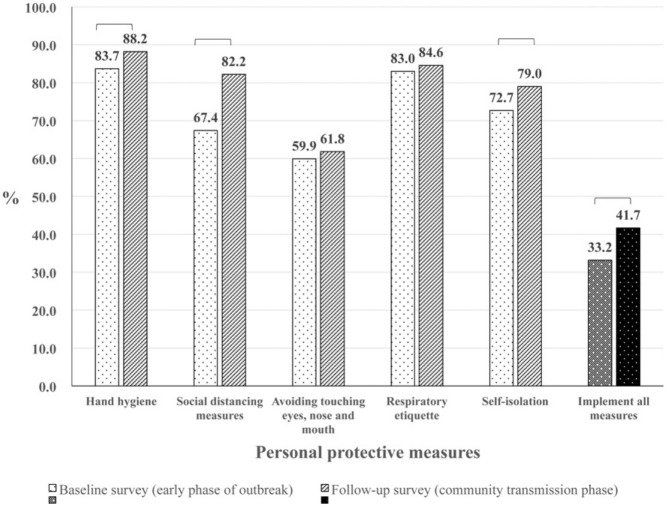
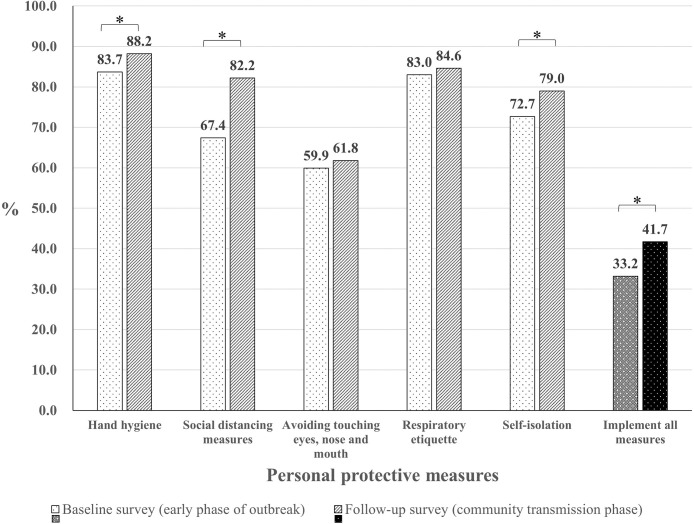
Three of the five personal protective measures' availability significantly improved during the community transmission phase compared to the early phase. Social distancing measures showed significant improvement, from 67.4% to 82.2%. However, the prevalence of avoiding touching the eyes, nose, and mouth, which had the lowest prevalence in the early phase, showed no significant improvement (approximately 60%). Multivariate logistic regression analysis revealed that men and persons of low-income households made fewer improvements than women and persons of high-income households.
The availability of personal protective measures by ordinary citizens is improving; however, there is potential for improvement, especially concerning avoiding touching eyes, nose, and mouth.
阐明普通日本公民在 COVID-19 疫情早期至社区传播阶段个人防护措施实施情况的变化。
这是一项纵向、基于互联网的调查,共纳入 2141 人(50.8%为男性;20-79 岁)。基线和随访调查分别于 2020 年 2 月 25-27 日和 2020 年 4 月 1-6 日进行。参与者被要求在基线和随访调查中回答他们实施世界卫生组织(手部卫生、保持社交距离、避免触摸眼睛、鼻子和嘴巴、呼吸道礼仪和自我隔离)推荐的五项个人防护措施的频率。
与疫情早期相比,在社区传播阶段,五项个人防护措施中有三项的实施情况显著改善。保持社交距离措施的改善最为显著,从 67.4%提高到 82.2%。然而,在早期阶段普及率最低的避免触摸眼睛、鼻子和嘴巴的措施,并没有显著改善(约 60%)。多变量逻辑回归分析显示,男性和低收入家庭的人比女性和高收入家庭的人改善较少。
普通公民采取个人防护措施的普及率正在提高;然而,仍有改进的空间,特别是在避免触摸眼睛、鼻子和嘴巴方面。