Kwok Yen Lee Angela, Gralton Jan, McLaws Mary-Louise
School of Public Health and Community Medicine, UNSW Medicine, UNSW Australia, Sydney, NSW, Australia.
School of Public Health and Community Medicine, UNSW Medicine, UNSW Australia, Sydney, NSW, Australia.
Am J Infect Control. 2015 Feb;43(2):112-4. doi: 10.1016/j.ajic.2014.10.015.
There is limited literature on the frequency of face-touching behavior as a potential vector for the self-inoculation and transmission of Staphylococcus aureus and other common respiratory infections.
A behavioral observation study was undertaken involving medical students at the University of New South Wales. Their face-touching behavior was observed via videotape recording. Using standardized scoring sheets, the frequency of hand-to-face contacts with mucosal or nonmucosal areas was tallied and analyzed.
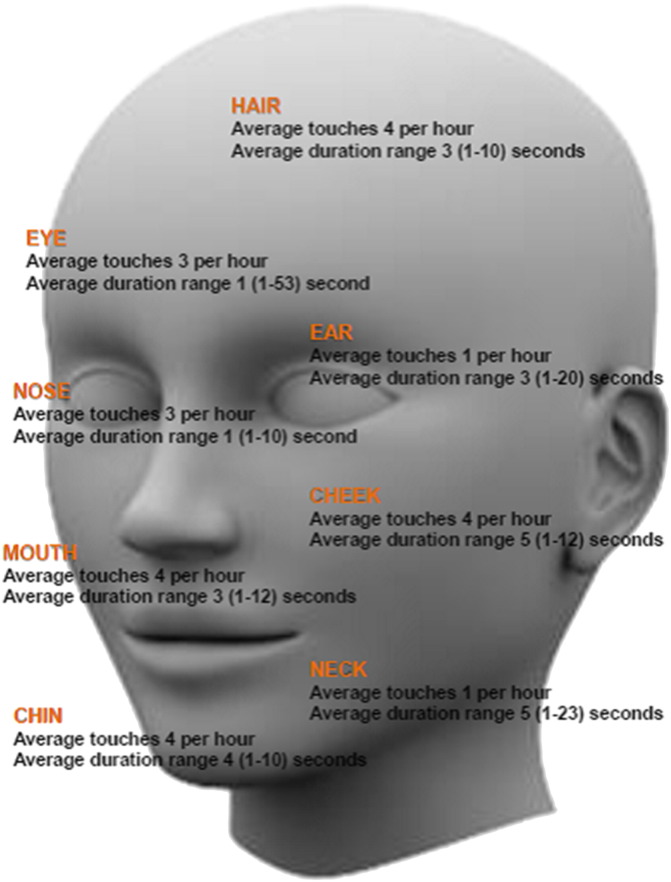
On average, each of the 26 observed students touched their face 23 times per hour. Of all face touches, 44% (1,024/2,346) involved contact with a mucous membrane, whereas 56% (1,322/2,346) of contacts involved nonmucosal areas. Of mucous membrane touches observed, 36% (372) involved the mouth, 31% (318) involved the nose, 27% (273) involved the eyes, and 6% (61) were a combination of these regions.
Increasing medical students' awareness of their habituated face-touching behavior and improving their understanding of self-inoculation as a route of transmission may help to improve hand hygiene compliance. Hand hygiene programs aiming to improve compliance with before and after patient contact should include a message that mouth and nose touching is a common practice. Hand hygiene is therefore an essential and inexpensive preventive method to break the colonization and transmission cycle associated with self-inoculation.
关于面部触摸行为作为金黄色葡萄球菌及其他常见呼吸道感染自我接种和传播潜在载体的频率,相关文献有限。
对新南威尔士大学的医学生进行了一项行为观察研究。通过录像记录观察他们的面部触摸行为。使用标准化评分表,统计并分析手与面部黏膜或非黏膜区域接触的频率。
平均而言,观察的26名学生每人每小时触摸面部23次。在所有面部触摸中,44%(1024/2346)涉及与黏膜接触,而56%(1322/2346)的接触涉及非黏膜区域。在观察到的黏膜触摸中,36%(372次)涉及口腔,31%(318次)涉及鼻子,27%(273次)涉及眼睛,6%(61次)是这些区域的组合。
提高医学生对习惯性面部触摸行为的认识,并增进他们对自我接种作为传播途径的理解,可能有助于提高手部卫生依从性。旨在提高患者接触前后依从性的手部卫生计划应包含一条信息,即触摸口鼻是常见行为。因此,手部卫生是打破与自我接种相关的定植和传播循环的一种基本且低成本的预防方法。