Wang Yi, Xiao Huiwen, Zhang Xiaotian, Wang Li
Faculty of Education, University of Macau, Macau, China.
School of Psychology, Fujian Normal University, Fuzhou, China.
Front Psychol. 2020 Apr 30;11:647. doi: 10.3389/fpsyg.2020.00647. eCollection 2020.
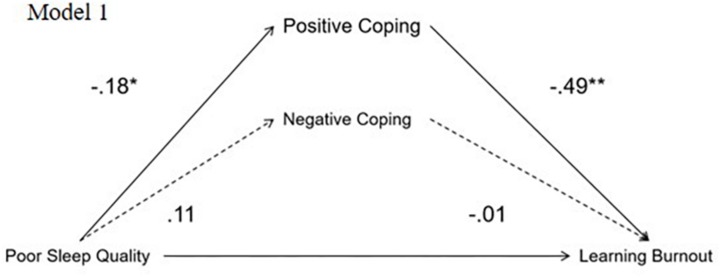
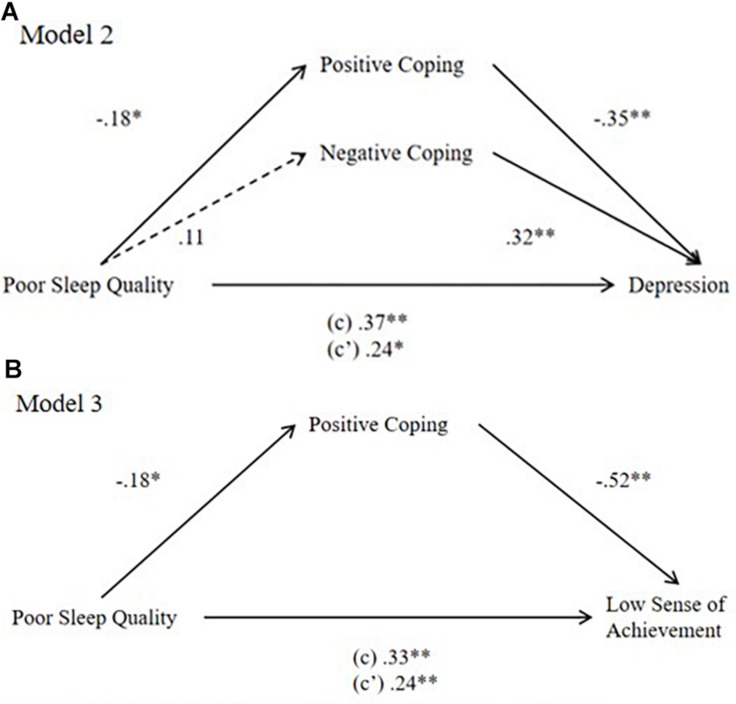
Learning burnout negatively influences students' learning and well-being. Sleep quality is directly related to students' health and learning outcomes. Research indicates that sleep quality and coping style may be associated with learning burnout. However, the interrelationship among learning burnout, sleep quality, and coping style has not yet been fully studied. This study aimed to explore the relationship between sleep quality and learning burnout and examine whether coping mediates this relationship in Chinese university students. A total of 228 undergraduate students were recruited to participate in this research. The Simplified Coping Style Questionnaire (SCSQ), Learning Burnout Questionnaire (LBQ), and Pittsburgh Sleep Quality Index-Chinese (PSQI-C) were employed to collect data. The results showed the following: (1) poor sleep quality had a positive association with learning burnout, and (2) active coping style mediated the effects of poor sleep quality on learning burnout and the dimensions of learning burnout (depression and low sense of achievement). The findings of the current study contribute to knowledge of learning burnout and provide theoretical evidence for further educational interventions.
学习倦怠对学生的学习和幸福感有负面影响。睡眠质量与学生的健康和学习成绩直接相关。研究表明,睡眠质量和应对方式可能与学习倦怠有关。然而,学习倦怠、睡眠质量和应对方式之间的相互关系尚未得到充分研究。本研究旨在探讨睡眠质量与学习倦怠之间的关系,并检验应对方式是否在中国大学生中中介了这种关系。共有228名本科生被招募参加本研究。采用简易应对方式问卷(SCSQ)、学习倦怠问卷(LBQ)和匹兹堡睡眠质量指数中文版(PSQI-C)收集数据。结果如下:(1)睡眠质量差与学习倦怠呈正相关,(2)积极应对方式中介了睡眠质量差对学习倦怠及其维度(抑郁和成就感低)的影响。本研究的结果有助于了解学习倦怠,并为进一步的教育干预提供理论依据。