Nóbrega Paulo Ribeiro, Morais Norma Martins de Menezes, Braga-Neto Pedro, Barros Liziana Sofia da Silva, Honório Fernanda Paiva Pereira, Dellavance Alessandra, Hoftberger Romana, Dutra Lívia Almeida
Division of Neurology, Department of Clinical Medicine, Universidade Federal do Ceará, Fortaleza, Brazil.
Department of Pediatrics, Unichristus Medical School, Fortaleza, Brazil.
Front Pediatr. 2020 Apr 30;8:176. doi: 10.3389/fped.2020.00176. eCollection 2020.
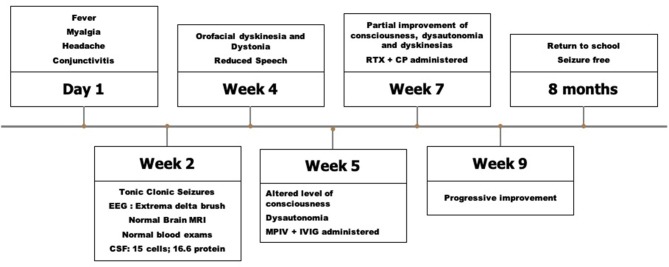
Anti-NMDAR encephalitis is the most frequent cause of autoimmune encephalitis. Chikungunya (CHIK) is an arbovirus responsible for outbreaks of fever, cutaneous rash and arthritis in underdeveloped countries, and a trigger for autoimmunity. We report a five-year-old male patient with fever, myalgia, headache and conjunctivitis for 5 days. After 1 week he developed tonic-clonic seizures and evolved with dystonia and oromandibular dyskinesia followed by onset of focal motor seizures, decreased level of consciousness, dysautonomia and central apnea. Brain MRI was normal, CSF analysis revealed 15 cells, protein 16.6 mg/dL and glucose 68 mg/dL. Anti-NMDAR antibodies were detected in serum and CSF after 3 weeks of symptom onset. CHIK serology was positive for both IgM and IgG, suggesting a recent infection. Dengue and Zika serologies were negative. CSF PCR for herpes viruses and arboviruses (CHIK, Dengue and Zika) were negative. We report the occurrence of anti-NMDAR encephalitis after acute CHIK infection. The biphasic course, positivity for both CHIK IgM and IgG and negative CHIK CSF PCR results, as well as a dramatic response to immunotherapy suggest an immune-mediated pathogenesis. Because of the global epidemic of CHIK infection and unknown mechanisms involving CHIK and autoimmunity, patients with acute CHIK infections and neurological manifestations should be considered for antineuronal antibody testing.
抗N-甲基-D-天冬氨酸受体(NMDAR)脑炎是自身免疫性脑炎最常见的病因。基孔肯雅病毒(CHIK)是一种虫媒病毒,在不发达国家可引发发热、皮疹和关节炎疫情,也是自身免疫的诱因。我们报告一例5岁男性患者,发热、肌痛、头痛和结膜炎5天。1周后出现强直阵挛发作,随后发展为肌张力障碍和口下颌运动障碍,继之出现局灶性运动性发作、意识水平下降、自主神经功能障碍和中枢性呼吸暂停。脑部磁共振成像(MRI)正常,脑脊液分析显示有15个细胞,蛋白16.6mg/dL,葡萄糖68mg/dL。症状出现3周后,在血清和脑脊液中检测到抗NMDAR抗体。CHIK血清学检测IgM和IgG均为阳性,提示近期感染。登革热和寨卡病毒血清学检测为阴性。脑脊液中疱疹病毒和虫媒病毒(CHIK、登革热和寨卡病毒)的聚合酶链反应(PCR)检测结果均为阴性。我们报告急性CHIK感染后发生抗NMDAR脑炎。双相病程、CHIK IgM和IgG均为阳性以及CHIK脑脊液PCR结果阴性,以及对免疫治疗的显著反应提示免疫介导的发病机制。鉴于CHIK感染的全球流行以及CHIK与自身免疫相关的未知机制,对于急性CHIK感染并有神经表现的患者应考虑进行抗神经元抗体检测。