Institute of Family Medicine, University Hospital Schleswig-Holstein, Luebeck, Germany.
Association of Statutory Health Insurance Physicians of the Federal State of Schleswig-Holstein, Bad Segeberg, Germany.
PLoS One. 2020 May 19;15(5):e0233345. doi: 10.1371/journal.pone.0233345. eCollection 2020.
The treatment of upper respiratory tract infections (URTIs) accounts for the majority of antibiotic prescriptions in primary care, although an antibiotic therapy is rarely indicated. Non-clinical factors, such as time pressure and the perceived patient expectations are considered to be reasons for prescribing antibiotics in cases where they are not indicated. The improper use of antibiotics, however, can promote resistance and cause serious side effects. The aim of the study was to clarify whether the antibiotic prescription rate for infections of the upper respiratory tract can be lowered by means of a short (2 x 2.25h) communication training based on the MAAS-Global-D for primary care physicians.
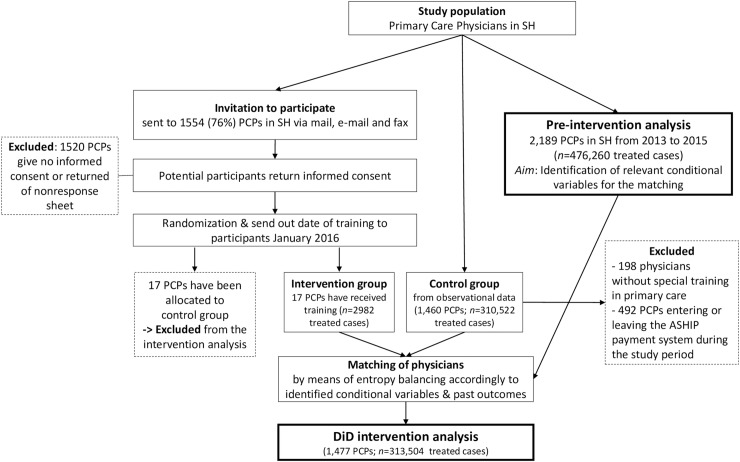
In total, 1554 primary care physicians were invited to participate in the study. The control group was formed from observational data. To estimate intervention effects we applied a combination of difference-in-difference (DiD) and statistical matching based on entropy balancing. We estimated a corresponding multi-level logistic regression model for the antibiotic prescribing decision of German primary care physicians for URTIs.
Univariate estimates detected an 11-percentage-point reduction of prescriptions for the intervention group after the training. For the control group, a reduction of 4.7% was detected. The difference between both groups in the difference between the periods was -6.5% and statistically significant. The estimated effects were nearly identical to the effects estimated for the multi-level logistic regression model with applied matching. Furthermore, for the treatment of young women, the impact of the training on the reduction of antibiotic prescription was significantly stronger.
Our results suggest that communication skills, implemented through a short communication training with the MAAS-Global-D-training, lead to a more prudent prescribing behavior of antibiotics for URTIs. Thereby, the MAAS-Global-D-training could not only avoid unnecessary side effects but could also help reducing the emergence of drug resistant bacteria. As a consequence of our study we suggest that communication training based on the MAAS-Global-D should be applied in the postgraduate training scheme of primary care physicians.
在上呼吸道感染(URTI)的治疗中,尽管抗生素治疗很少有指征,但抗生素的处方仍占初级保健中大多数抗生素处方。非临床因素,如时间压力和患者预期,被认为是在没有指征的情况下开抗生素的原因。然而,抗生素的不当使用会促进耐药性并引起严重的副作用。本研究旨在阐明基于 MAAS-Global-D 的短期(2 x 2.25 小时)沟通培训是否可以降低初级保健医生治疗上呼吸道感染的抗生素处方率。
共邀请了 1554 名初级保健医生参加研究。对照组来自观察性数据。为了估计干预效果,我们应用了基于熵平衡的差异(DiD)和统计匹配的组合。我们针对德国初级保健医生对上呼吸道感染的抗生素处方决策,估计了相应的多水平逻辑回归模型。
单变量估计发现,干预组在培训后抗生素处方减少了 11 个百分点。对照组检测到减少了 4.7%。两个组在两个时期之间的差异为-6.5%,具有统计学意义。估计的效果与应用匹配的多水平逻辑回归模型估计的效果几乎相同。此外,对于年轻女性的治疗,培训对减少抗生素处方的影响明显更强。
我们的结果表明,通过 MAAS-Global-D 培训实施沟通技巧,可以使治疗 URTI 的抗生素处方更谨慎。因此,MAAS-Global-D 培训不仅可以避免不必要的副作用,还可以帮助减少耐药细菌的出现。基于我们的研究,我们建议在初级保健医生的研究生培训计划中应用基于 MAAS-Global-D 的沟通培训。