Social Science Department, Dodowa Health Research Centre, Dodowa, Ghana.
Department of Medicine, FIND, Geneva, Switzerland.
Clin Infect Dis. 2023 Jul 25;77(Suppl 2):S182-S190. doi: 10.1093/cid/ciad327.
The aim was to explore behavioral factors relating to the prescription and communication of prescription-adherence messages for patients with acute febrile illness, from which to develop a training-and-communication (T&C) intervention to be delivered as part of a clinical trial.
The study undertook a content analysis of primary, qualitative data collection using in-depth interviews and focus group discussions, informed by the Capability, Opportunity, Motivation (COM-B) theory of behavior, the Theoretical Domains Framework (TDF), and Behavior Change Wheel (BCW) approach, in health facilities (39 health workers) and communities (66 community members) in the Shai-Osudoku District of Ghana.
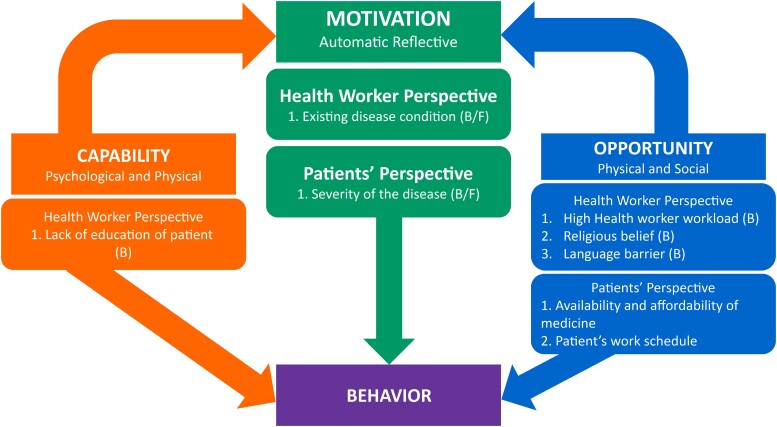
Health workers perceive that prescribers' and dispensers' communication with patients is influenced by the following factors: patient's educational level, existing disease conditions, health worker's workload, patient's religion, language barrier between health worker and patient, outcome of laboratory results, and medicine availability. Community members' adherence to prescription was influenced by the availability of money and affordability of medicine (outside of provision by the national health insurance scheme), the severity of the condition, work schedule, and forgetfulness.
Our study contributes to knowledge on nesting qualitative methods in a clinical trial and reveals factors that affect the antibiotic prescription communication process. Tailored messages for patient-specific needs can shape antibiotic prescription adherence behavior and ultimately contribute to decreasing the incidence of antibiotic resistance.
本研究旨在探讨与急性发热患者处方和传递用药依从性信息相关的行为因素,从而开发一种培训和沟通(T&C)干预措施,作为临床试验的一部分。
本研究采用深入访谈和焦点小组讨论的定性数据收集方法,基于行为的能力、机会和动机(COM-B)理论、理论领域框架(TDF)和行为改变轮(BCW)方法,在加纳 Shai-Osudoku 区的卫生机构(39 名卫生工作者)和社区(66 名社区成员)中进行了内容分析。
卫生工作者认为,开方者和发药者与患者的沟通受到以下因素的影响:患者的教育水平、现有疾病状况、卫生工作者的工作量、患者的宗教信仰、卫生工作者和患者之间的语言障碍、实验室结果的结果以及药物的可获得性。社区成员的用药依从性受到以下因素的影响:是否有足够的钱购买药物(国家健康保险计划之外)、病情的严重程度、工作安排和健忘。
我们的研究为嵌套定性方法在临床试验中的应用提供了知识,并揭示了影响抗生素处方沟通过程的因素。针对患者特定需求的定制信息可以塑造抗生素处方的依从性行为,最终有助于降低抗生素耐药性的发生率。