Alcocer-Ávila Mario E, Ferreira Aymeric, Quinto Michele A, Morgat Clément, Hindié Elif, Champion Christophe
Centre Lasers Intenses et Applications, Université de Bordeaux - CNRS - CEA, Talence, F-33400, France.
CERVO Brain Research Center, Department of Biochemistry, Microbiology and Bioinformatics, Université Laval, Quebec City, G1J 2G3, Quebec, Canada.
EJNMMI Phys. 2020 May 19;7(1):33. doi: 10.1186/s40658-020-00301-2.
Targeted radionuclide therapy (TRT) is gaining importance. For TRT to be also used as adjuvant therapy or for treating minimal residual disease, there is a need to increase the radiation dose to small tumours. The aim of this in silico study was to compare the performances of Tb (a medium-energy β emitter with additional Auger and conversion electron emissions) and Lu for irradiating single tumour cells and micrometastases, with various distributions of the radionuclide.
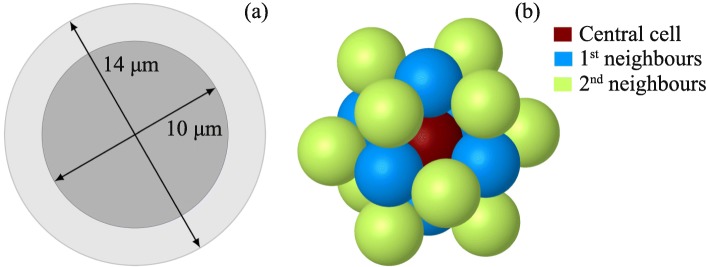
We used the Monte Carlo track-structure (MCTS) code CELLDOSE to compute the radiation doses delivered by Tb and Lu to single cells (14 μm cell diameter with 10 μm nucleus diameter) and to a tumour cluster consisting of a central cell surrounded by two layers of cells (18 neighbours). We focused the analysis on the absorbed dose to the nucleus of the single tumoral cell and to the nuclei of the cells in the cluster. For both radionuclides, the simulations were run assuming that 1 MeV was released per μm (1436 MeV/cell). We considered various distributions of the radionuclides: either at the cell surface, intracytoplasmic or intranuclear.
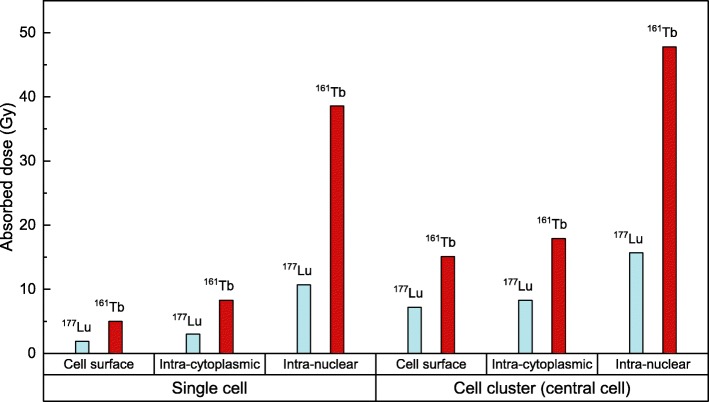
For the single cell, the dose to the nucleus was substantially higher with Tb compared to Lu, regardless of the radionuclide distribution: 5.0 Gy vs. 1.9 Gy in the case of cell surface distribution; 8.3 Gy vs. 3.0 Gy for intracytoplasmic distribution; and 38.6 Gy vs. 10.7 Gy for intranuclear location. With the addition of the neighbouring cells, the radiation doses increased, but remained consistently higher for Tb compared to Lu. For example, the dose to the nucleus of the central cell of the cluster was 15.1 Gy for Tb and 7.2 Gy for Lu in the case of cell surface distribution of the radionuclide, 17.9 Gy for Tb and 8.3 Gy for Lu for intracytoplasmic distribution and 47.8 Gy for Tb and 15.7 Gy for Lu in the case of intranuclear location.
Tb should be a better candidate than Lu for irradiating single tumour cells and micrometastases, regardless of the radionuclide distribution.
靶向放射性核素治疗(TRT)正变得越来越重要。为了将TRT也用作辅助治疗或用于治疗微小残留病,有必要增加对小肿瘤的辐射剂量。这项计算机模拟研究的目的是比较铽(一种具有额外俄歇电子和内转换电子发射的中能β发射体)和镥在不同放射性核素分布情况下对单个肿瘤细胞和微转移灶的照射性能。
我们使用蒙特卡罗径迹结构(MCTS)代码CELLDOSE来计算铽和镥对单个细胞(细胞直径14μm,细胞核直径10μm)以及由一个中心细胞被两层细胞(18个相邻细胞)包围组成的肿瘤簇所传递的辐射剂量。我们将分析重点放在单个肿瘤细胞核以及簇中细胞核的吸收剂量上。对于这两种放射性核素,模拟运行时假设每微米释放1 MeV(1436 MeV/细胞)。我们考虑了放射性核素的各种分布:细胞表面、胞质内或核内。
对于单个细胞,无论放射性核素分布如何,铽对细胞核的剂量相比镥都显著更高:细胞表面分布时为5.0 Gy对1.9 Gy;胞质内分布时为8.3 Gy对3.0 Gy;核内定位时为38.6 Gy对10.7 Gy。加入相邻细胞后,辐射剂量增加,但铽的剂量相比镥仍始终更高。例如,在放射性核素细胞表面分布的情况下,簇中心细胞的细胞核剂量铽为15.1 Gy,镥为7.2 Gy;胞质内分布时,铽为17.9 Gy,镥为8.3 Gy;核内定位时,铽为47.8 Gy,镥为15.7 Gy。
无论放射性核素分布如何,铽在照射单个肿瘤细胞和微转移灶方面应比镥更具优势。