Thompson Tess, Rodebaugh Thomas L, Bessaha Melissa L, Sabbath Erika L
1Brown School of Social Work, Washington University in St. Louis, One Brookings Drive, Campus Box 1196, St. Louis, MO 63130 USA.
2Department of Psychological and Brain Sciences, Washington University in St. Louis, One Brookings Drive, Campus Box 1125, St. Louis, MO 63130 USA.
Clin Soc Work J. 2020;48(1):18-24. doi: 10.1007/s10615-019-00730-2. Epub 2019 Oct 28.
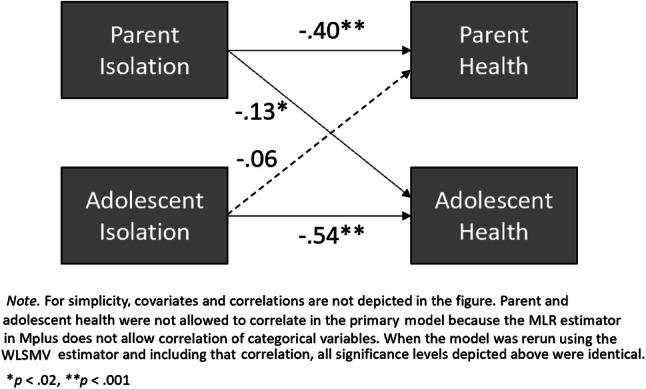
We examined the relationship between social isolation and health among parents and their adolescent children. Data came from the 2014 Family Life, Activity, Sun, Health, and Eating Study (FLASHE), a cross-sectional internet study from the National Cancer Institute. Parents and their adolescent children (ages 12-17) completed surveys about demographics, physical activity, and diet; analyses include all dyads in which at least one member provided information for any of the analyzed variables ( = 1851). Actor Partner Interdependence Models in Mplus with demographic covariates tested whether parent and adolescent perceived social isolation (2 items from the UCLA Loneliness Scale) were associated with each person's self-reported health. Most dyads included a mother (38% mother-daughter, 36% mother-son). Most parents were non-Hispanic White (69%), married/partnered (77%), and reported household income below $100,000 (79%). Both social isolation and self-reported health were significantly correlated between parents and their adolescent children (Pearson correlation = .38 for isolation, .32 for health). There were negative associations between parent isolation and parent health, adolescent isolation and adolescent health, and parent isolation and adolescent health (all s < .05), but no association between adolescent isolation and parent health. The finding that parents' social isolation was linked to lower self-reported health not only for themselves but also for their adolescent children highlights the importance of addressing social isolation in clinical social work practice. Family interventions, or interventions to reduce adults' negative social cognitions or promote social connections, may improve health for both adults and their adolescent children.
我们研究了父母及其青春期子女中社会隔离与健康之间的关系。数据来自2014年家庭生活、活动、阳光、健康和饮食研究(FLASHE),这是一项来自美国国家癌症研究所的横断面网络研究。父母及其青春期子女(12 - 17岁)完成了关于人口统计学、身体活动和饮食的调查;分析包括所有至少有一名成员为任何分析变量提供信息的二元组(n = 1851)。在Mplus中使用人口统计学协变量的 Actor Partner Interdependence 模型测试了父母和青少年感知到的社会隔离(来自加州大学洛杉矶分校孤独量表的2个项目)是否与每个人自我报告的健康状况相关。大多数二元组包括母亲(38%为母女,36%为母子)。大多数父母是非西班牙裔白人(69%),已婚/有伴侣(77%),家庭收入低于10万美元(79%)。父母及其青春期子女之间的社会隔离和自我报告的健康状况均显著相关(隔离的皮尔逊相关系数 = 0.38,健康的相关系数 = 0.32)。父母隔离与父母健康、青少年隔离与青少年健康以及父母隔离与青少年健康之间均存在负相关(所有p值 < 0.05),但青少年隔离与父母健康之间无关联。父母的社会隔离不仅与他们自己较低的自我报告健康状况有关,还与他们青春期子女的健康状况有关,这一发现凸显了在临床社会工作实践中解决社会隔离问题的重要性。家庭干预,或减少成年人负面社会认知或促进社会联系的干预措施,可能会改善成年人及其青春期子女的健康状况。