González-Alcaide Gregorio, Pinargote Héctor, Ramos José M
1Department of History of Science and Documentation, University of Valencia, Valencia, Spain.
Department of Internal Medicine, General University Hospital of Alicante, Alicante, Spain.
Scientometrics. 2020;123(2):707-733. doi: 10.1007/s11192-020-03404-w. Epub 2020 Feb 28.
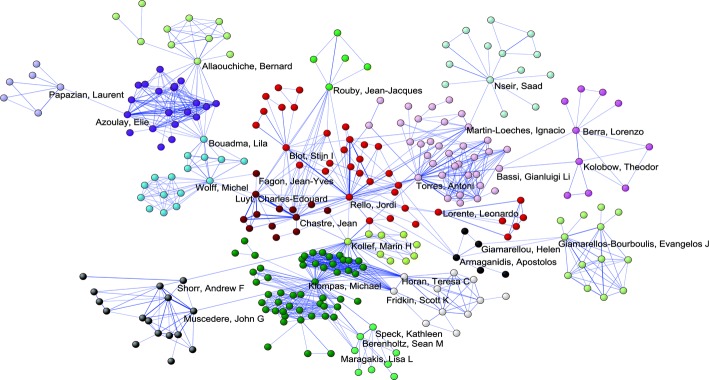
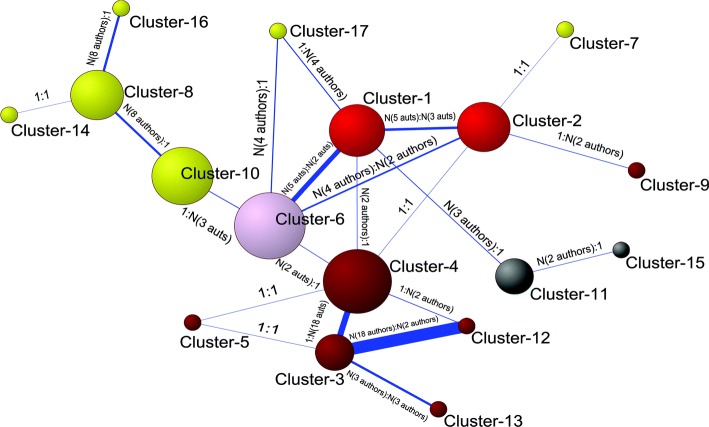
In co-authorship networks, some nodes play the key role of cut-point, facilitating the integration of other authors and favoring connectivity among different research communities. The present study uses bibliometric and network embeddedness indicators to analyze the scientific activity on ventilator-associated pneumonia and the roles of 17 research communities and 30 cut-points therein. In addition to fostering network connectivity and cohesion, cut-points are characterized by other differential features compared to other authors, including a much higher level of productivity and greater participation in leadership positions, higher betweenness values, lower clustering coefficients and higher levels of constraint. The cut-points identified have different characteristics in terms of the connectivity they facilitate between research communities: some cut-points have established weak intercommunity ties in the form of bridges with a single author from a different community; in other cases, they serve as gatekeepers due to their connection with different authors of a community that they link with their own; cut-points may also act as structural folds, that is, actors with an overlapping role between two cohesive communities. The cut-points present very diverse connectivity degrees, with some cut-points whose elimination would provoke severe network fragmentation and others who are responsible for linking far fewer external authors to their network. The cut-points that present both the main mechanisms for obtaining social capital-that is, filling structural holes and participating in cohesive network structures-can be considered key actors/players because their participation is crucial for ensuring both integration into the main research focus of some communities with high research performance and the overall cohesion of a co-authorship network.
在共同作者网络中,一些节点起着关键的切点作用,促进其他作者的整合,并有利于不同研究群体之间的连通性。本研究使用文献计量学和网络嵌入性指标来分析呼吸机相关性肺炎的科学活动以及17个研究群体和其中30个切点的作用。除了促进网络连通性和凝聚力外,切点与其他作者相比还具有其他不同特征,包括更高的生产力水平、更多地担任领导职务、更高的中介中心性值、更低的聚类系数和更高的约束水平。所确定的切点在促进研究群体之间连通性方面具有不同特征:一些切点以与来自不同群体的单一作者建立桥梁的形式建立了薄弱的群体间联系;在其他情况下,它们由于与它们所连接的群体的不同作者建立联系而充当守门人;切点也可能充当结构褶皱,即在两个有凝聚力的群体之间具有重叠角色的参与者。切点呈现出非常多样化的连通程度,一些切点的消除会引发严重的网络碎片化,而另一些切点则负责将少得多的外部作者与其网络连接起来。那些呈现出获取社会资本的主要机制(即填补结构洞和参与有凝聚力的网络结构)的切点可以被视为关键参与者,因为它们的参与对于确保融入一些具有高研究绩效的社区的主要研究重点以及共同作者网络的整体凝聚力至关重要。