Turner David T, Reijnders Mirjam, van der Gaag Mark, Karyotaki Eirini, Valmaggia Lucia R, Moritz Steffen, Lecomte Tania, Turkington Douglas, Penadés Rafael, Elkis Helio, Cather Corinne, Shawyer Frances, O'Connor Kieron, Li Zhan-Jiang, de Paiva Barretto Eliza Martha, Cuijpers Pim
Department of Clinical, Neuro and Developmental Psychology, Amsterdam Public Health Research Institute, Vrije Universiteit, Amsterdam, Netherlands.
Parnassia Psychiatric Institute, The Hague, Netherlands.
Front Psychiatry. 2020 May 5;11:402. doi: 10.3389/fpsyt.2020.00402. eCollection 2020.
Study-level meta-analyses have demonstrated the efficacy of cognitive-behavioural therapy for psychosis (CBTp). Limitations of conventional meta-analysis may be addressed using individual-participant-data (IPD). We aimed to determine a) whether results from IPD were consistent with study-level meta-analyses and b) whether demographic and clinical characteristics moderate treatment outcome.
We systematically searched PubMed, Embase, PsychInfo and CENTRAL. Authors of RCTs comparing CBTp with other psychological interventions were contacted to obtain original databases. Hierarchical mixed effects models were used to examine efficacy for psychotic symptoms. Patient characteristics were investigated as moderators of symptoms at post-treatment. Sensitivity analyses were conducted for risk of bias, treatment format and study characteristics.
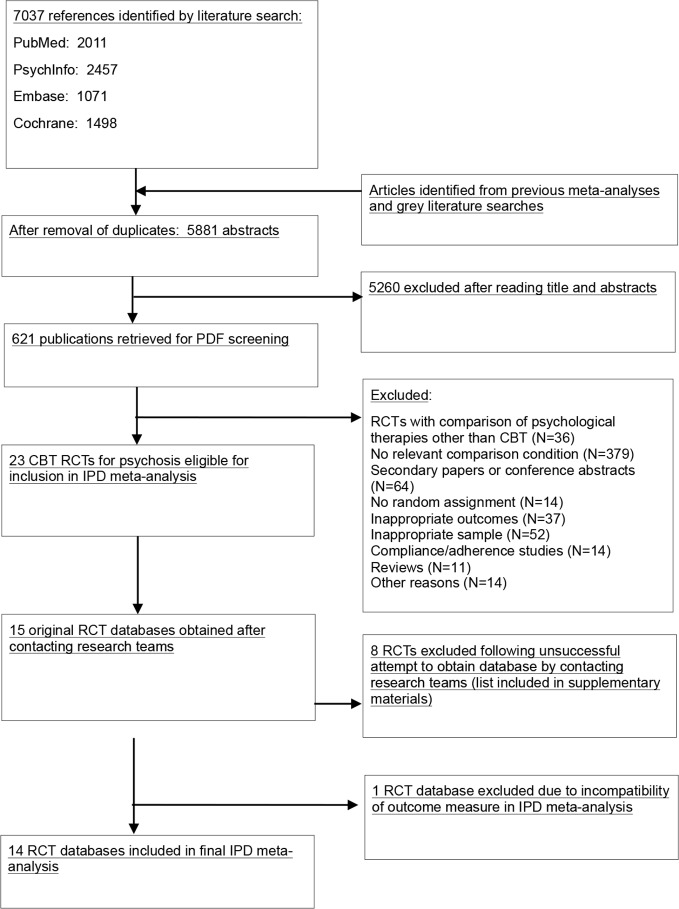
We included 14 of 23 eligible RCTs in IPD meta-analyses including 898 patients. Ten RCTs minimised risk of bias. There was no significant difference in efficacy between RCTs providing IPD and those not (0.05). CBTp was superior vs. other interventions for total psychotic symptoms and PANSS general symptoms. No demographic or clinical characteristics were robustly demonstrated as moderators of positive, negative, general or total psychotic symptoms at post-treatment. Sensitivity analyses demonstrated that number of sessions moderated the impact of treatment assignment (CBTp or other therapies) on total psychotic symptoms ( = 0.02).
IPD suggest that patient characteristics, including severity of psychotic symptoms, do not significantly influence treatment outcome in psychological interventions for psychosis while investing in sufficient dosage of CBTp is important. IPD provide roughly equivalent efficacy estimates to study-level data although significant benefit was not replicated for positive symptoms. We encourage authors to ensure IPD is accessible for future research.
研究层面的荟萃分析已证明认知行为疗法治疗精神病(CBTp)的疗效。传统荟萃分析的局限性可通过个体参与者数据(IPD)来解决。我们旨在确定:a)IPD的结果是否与研究层面的荟萃分析一致;b)人口统计学和临床特征是否会调节治疗结果。
我们系统检索了PubMed、Embase、PsychInfo和CENTRAL。联系了比较CBTp与其他心理干预措施的随机对照试验(RCT)的作者,以获取原始数据库。采用分层混合效应模型来检验对精神病症状的疗效。将患者特征作为治疗后症状的调节因素进行研究。针对偏倚风险、治疗形式和研究特征进行了敏感性分析。
我们在IPD荟萃分析中纳入了23项合格RCT中的14项,包括898名患者。10项RCT将偏倚风险降至最低。提供IPD的RCT与未提供IPD的RCT在疗效上无显著差异(P = 0.05)。在总精神病症状和阳性和阴性症状量表(PANSS)的一般症状方面,CBTp优于其他干预措施。没有人口统计学或临床特征被有力地证明是治疗后阳性、阴性、一般或总精神病症状的调节因素。敏感性分析表明,治疗疗程数调节了治疗分配(CBTp或其他疗法)对总精神病症状的影响(P = 0.02)。
IPD表明,在针对精神病的心理干预中,包括精神病症状严重程度在内的患者特征不会显著影响治疗结果,而投入足够剂量的CBTp很重要。IPD提供的疗效估计与研究层面的数据大致相当,尽管阳性症状未重复出现显著益处。我们鼓励作者确保未来的研究能够获取IPD。