University Medical Centre Groningen, University of Groningen, Groningen, the Netherlands.
Parnassia Psychiatry Institute, Hague, The Netherlands.
BMC Psychiatry. 2021 Oct 11;21(1):496. doi: 10.1186/s12888-021-03473-y.
Seventy per cent of patients with psychotic disorders has paranoid delusions. Paranoid delusions are associated with significant distress, hospital admission and social isolation. Cognitive-behavioural therapy for psychosis (CBTp) is the primary psychological treatment, but the median effect size is only small to medium. Virtual reality (VR) has a great potential to improve the effectiveness of CBTp. In a previous study, we found that VR based CBT (VRcbt) for paranoid delusions is superior to waiting list. As a next step, a direct comparison with CBTp is needed. The present study aims to investigate whether VRcbt is more effective and cost-effective than regular CBTp in treating paranoid delusions and improving daily life social functioning of patients with psychotic disorders.
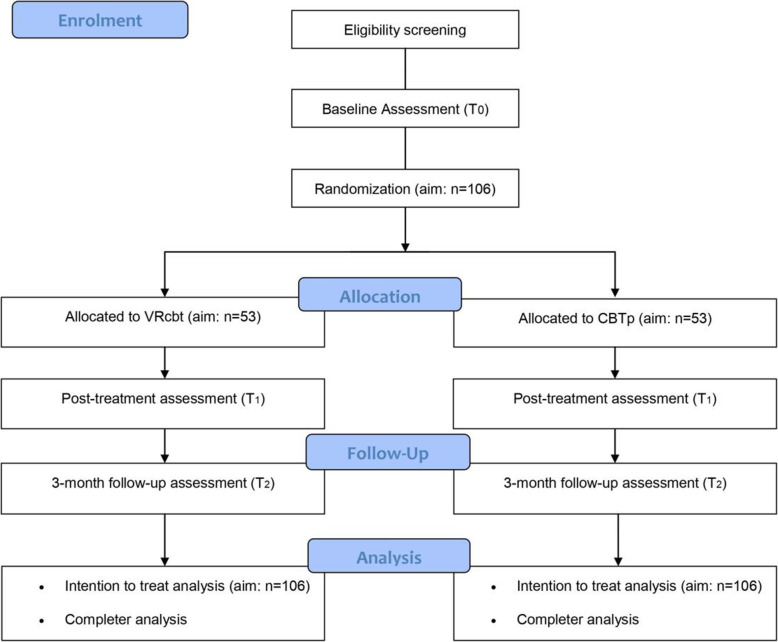
A total of 106 patients with DSM-5 diagnosis of psychotic disorder and at least moderate level of paranoid ideations will be recruited for this multicentre randomized controlled trial (RCT). Patients will be randomized to either VRcbt or standard CBTp for paranoid delusions. VRcbt consists of maximum 16 sessions in virtual social situations that trigger paranoid ideations and distress, delivered in an 8-12 week time frame. Standard CBTp also consists of maximum 16 sessions including exposure and behavioural experiments, delivered in an 8-12 week time frame. The two groups will be compared at baseline, post-treatment and six months follow-up. Primary outcome is the level of paranoid ideations in daily life social situations, measured with ecological momentary assessments (EMA) at semi-random moments ten times a day during seven days, before and after treatment. Every session, participants and therapists will rate the level of paranoid ideation and global clinical impression.
Comparison of VRcbt and CBTp will provide information about the relative (cost-) effectiveness of VRcbt for this population. VRcbt may become a preferred psychological treatment for paranoid delusions and social anxiety in patients with psychotic disorder.
Netherlands Trial Register, NL7758. Registered on 23 May 2019.
70%的精神病患者存在妄想。妄想与显著的痛苦、住院和社会隔离有关。针对精神病的认知行为疗法(CBTp)是主要的心理治疗方法,但中位数效应大小仅为小到中等。虚拟现实(VR)在提高 CBTp 的效果方面具有巨大潜力。在之前的一项研究中,我们发现基于 VR 的妄想症 CBT(VRcbt)优于候补名单。作为下一步,需要与 CBTp 进行直接比较。本研究旨在探讨 VRcbt 是否比常规 CBTp 更有效地治疗妄想症并改善精神病患者的日常生活社交功能。
这项多中心随机对照试验(RCT)将招募 106 名符合 DSM-5 精神病诊断标准且至少存在中度妄想观念的患者。患者将被随机分配到 VRcbt 或标准 CBTp 治疗妄想症。VRcbt 包括在引发妄想和痛苦的虚拟社交情境中进行最多 16 次治疗,在 8-12 周的时间内完成。标准 CBTp 也包括最多 16 次治疗,包括暴露和行为实验,在 8-12 周的时间内完成。两组将在基线、治疗后和六个月随访时进行比较。主要结局是日常生活社交情境中的妄想程度,通过每天半随机时刻进行 10 次、持续 7 天的生态瞬时评估(EMA)进行测量,在治疗前后进行。每次治疗时,参与者和治疗师都会评估妄想程度和整体临床印象。
VRcbt 与 CBTp 的比较将提供有关该人群中 VRcbt 的相对(成本)有效性的信息。VRcbt 可能成为精神病患者妄想症和社交焦虑的首选心理治疗方法。
荷兰试验注册处,NL7758。于 2019 年 5 月 23 日注册。