Popovic Iva, Matias Ambrocio Melvin A, Bierne Nicolas, Riginos Cynthia
School of Biological Sciences University of Queensland St Lucia Qld Australia.
Institute of Biology University of the Philippines Diliman Quezon City Philippines.
Evol Appl. 2019 Sep 18;13(3):515-532. doi: 10.1111/eva.12857. eCollection 2020 Mar.
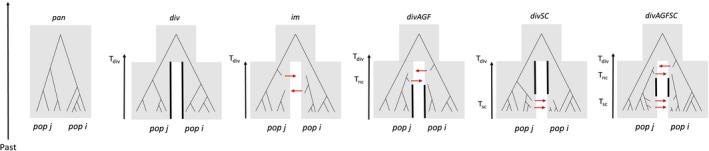
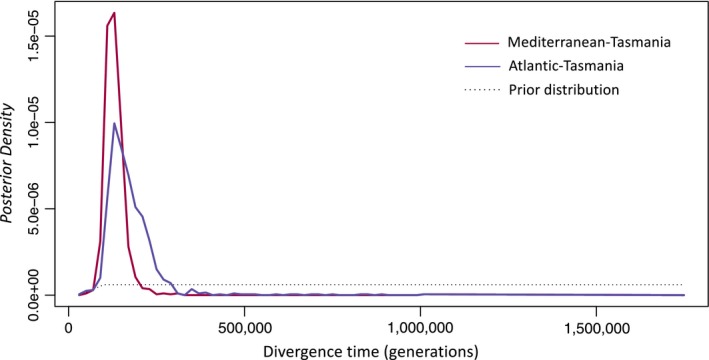
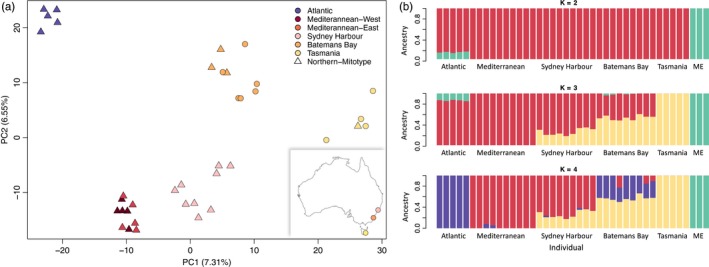
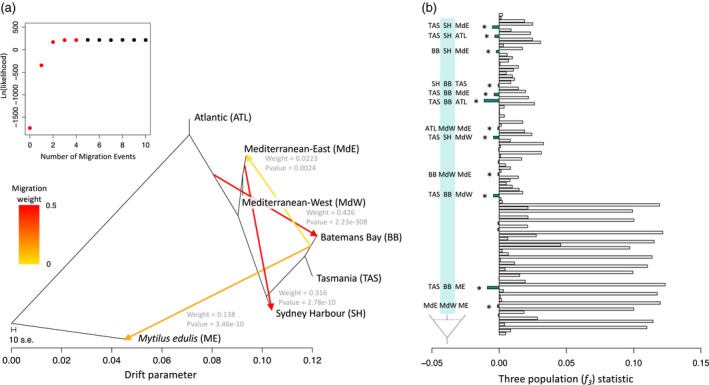
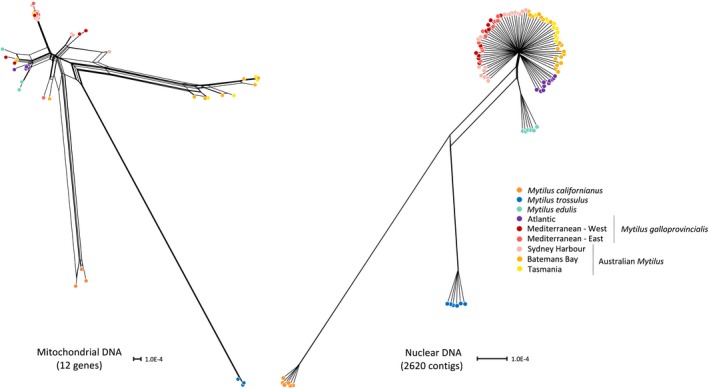
Introduced species can impose profound impacts on the evolution of receiving communities with which they interact. If native and introduced taxa remain reproductively semi-isolated, human-mediated secondary contact may promote genetic exchange across newly created hybrid zones, potentially impacting native genetic diversity and invasive species spread. Here, we investigate the contributions of recent divergence histories and ongoing (post-introduction) gene flow between the invasive marine mussel, and a morphologically indistinguishable and taxonomically contentious native Australian taxon, . Using transcriptome-wide markers, we demonstrate that two contemporary introductions into south-eastern Australia originate from genetically divergent lineages from its native range in the Mediterranean Sea and Atlantic Europe, where both introductions have led to repeated instances of admixture between introduced and endemic populations. Through increased genome-wide resolution of species relationships, combined with demographic modelling, we validate that mussels sampled in Tasmania are representative of the endemic Australian taxon ( ), but share strong genetic affinities to . Demographic inferences indicate late-Pleistocene divergence times and historical gene flow between the Tasmanian endemic lineage and northern , suggesting that native and introduced taxa have experienced a period of historical isolation of at least 100,000 years. Our results demonstrate that many genomic loci and sufficient sampling of closely related lineages in both sympatric (e.g. Australian populations) and allopatric (e.g. northern hemisphere taxa) ranges are necessary to accurately (a) interpret patterns of intraspecific differentiation and to (b) distinguish contemporary invasive introgression from signatures left by recent divergence histories in high dispersal marine species. More broadly, our study fills a significant gap in systematic knowledge of native Australian biodiversity and sheds light on the intrinsic challenges for invasive species research when native and introduced species boundaries are not well defined.
外来物种会对与其相互作用的接受群落的进化产生深远影响。如果本地和外来分类群在生殖上保持半隔离状态,人类介导的二次接触可能会促进新形成的杂交区域内的基因交流,从而可能影响本地遗传多样性和入侵物种的传播。在这里,我们研究了入侵性海洋贻贝与形态上难以区分且分类上存在争议的澳大利亚本地分类群之间近期分化历史和持续(引入后)基因流动的作用。使用全转录组标记,我们证明,澳大利亚东南部的两次当代引入源自其在地中海和欧洲大西洋本土范围内遗传分化的谱系,这两次引入都导致了引入种群和本地种群之间多次混合的情况。通过提高物种关系的全基因组分辨率,并结合人口统计学建模,我们验证了在塔斯马尼亚采集的贻贝代表澳大利亚本地分类群,但与[具体名称缺失]具有很强的遗传亲和力。人口统计学推断表明,塔斯马尼亚本地谱系与北部[具体名称缺失]之间在晚更新世时期发生了分化,并存在历史基因流动,这表明本地和引入分类群经历了至少10万年的历史隔离期。我们的结果表明,为了准确(a)解释种内分化模式以及(b)区分当代入侵基因渗入与高扩散海洋物种近期分化历史留下的特征,需要许多基因组位点以及对同域(如澳大利亚种群)和异域(如北半球[具体名称缺失]分类群)范围内密切相关谱系进行充分采样。更广泛地说,我们的研究填补了澳大利亚本土生物多样性系统知识的一个重大空白,并揭示了在本地和引入物种边界定义不明确时入侵物种研究面临的内在挑战。