Jamali M Arif M, Gopalasingam Chai C, Johnson Rachel M, Tosha Takehiko, Muramoto Kazumasa, Muench Stephen P, Antonyuk Svetlana V, Shiro Yoshitsugu, Hasnain Samar S
Graduate School of Life Science, University of Hyogo, 3-2-1 Kouto, Kamigori, Ako, Hyogo 678-1297, Japan.
Molecular Biophysics Group, Institute of Integrative Biology, Faculty of Health and Life Sciences, University of Liverpool, Liverpool L69 7ZB, United Kingdom.
IUCrJ. 2020 Mar 21;7(Pt 3):404-415. doi: 10.1107/S2052252520003656. eCollection 2020 May 1.
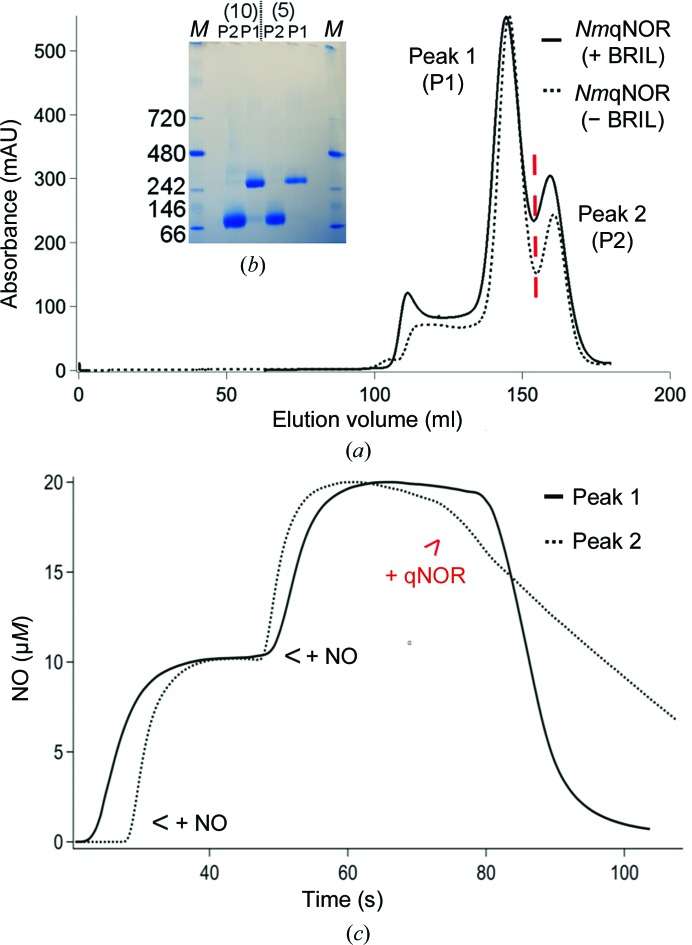
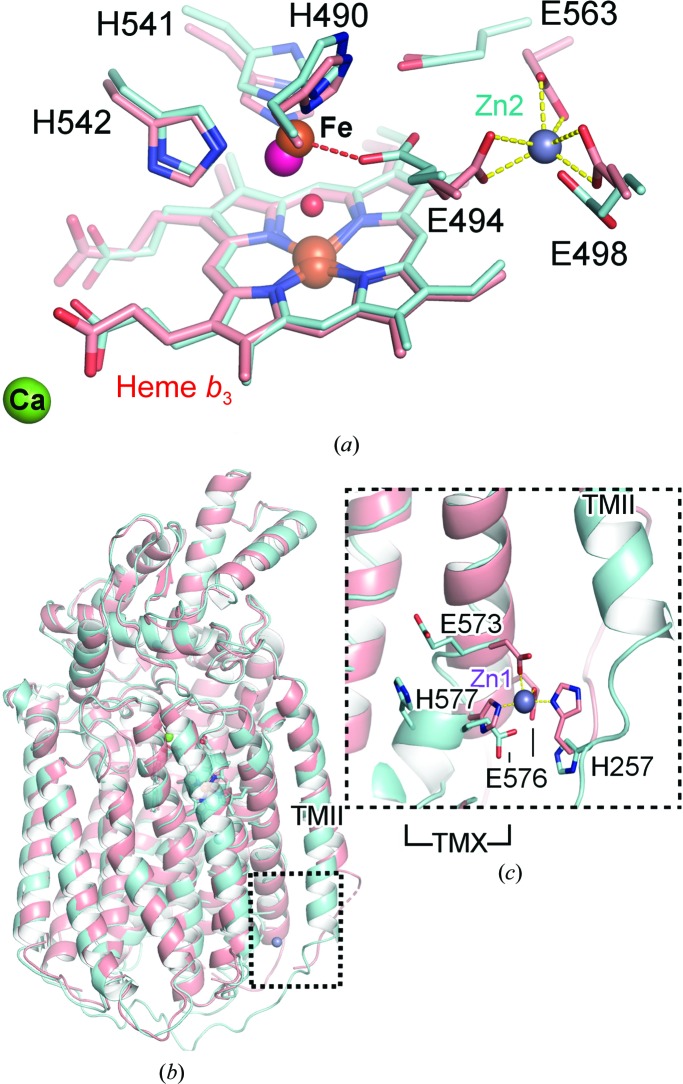
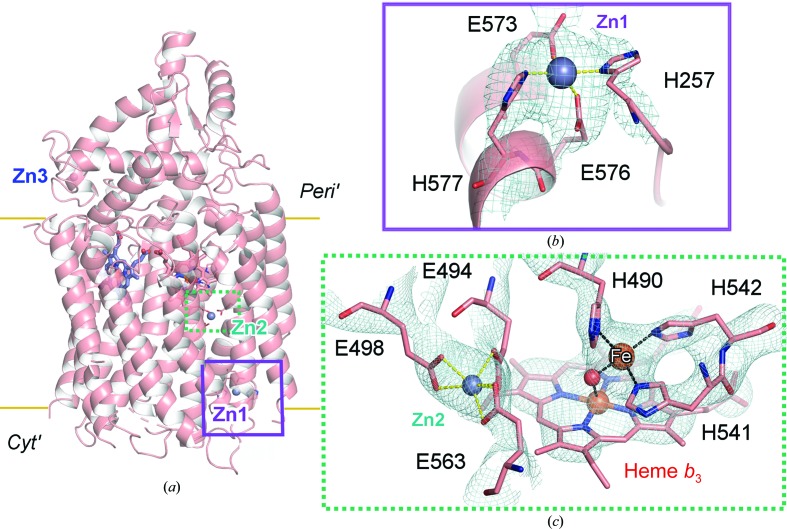
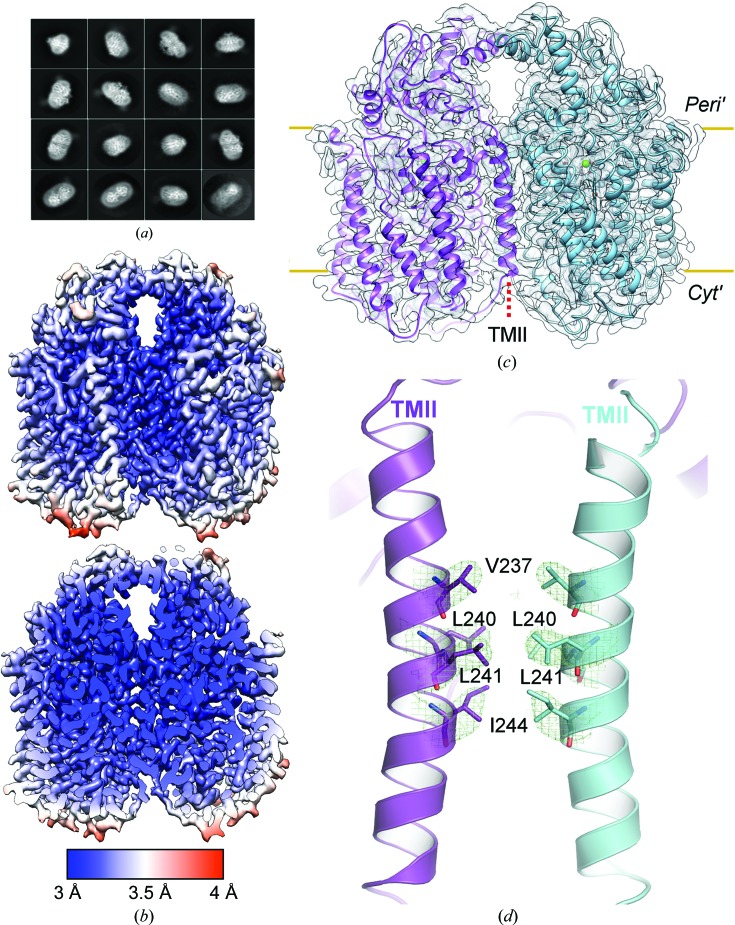
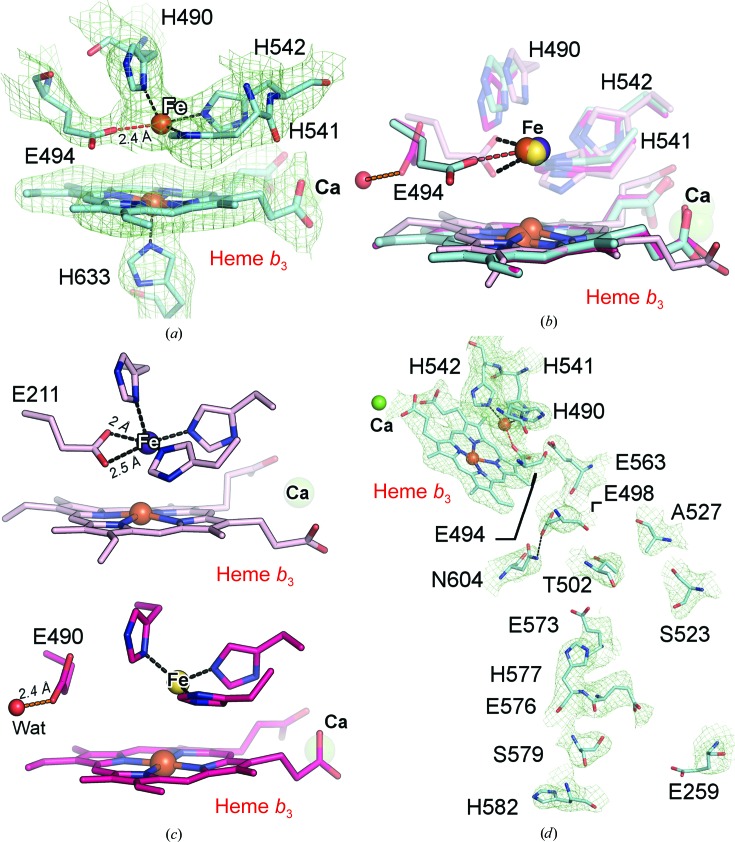
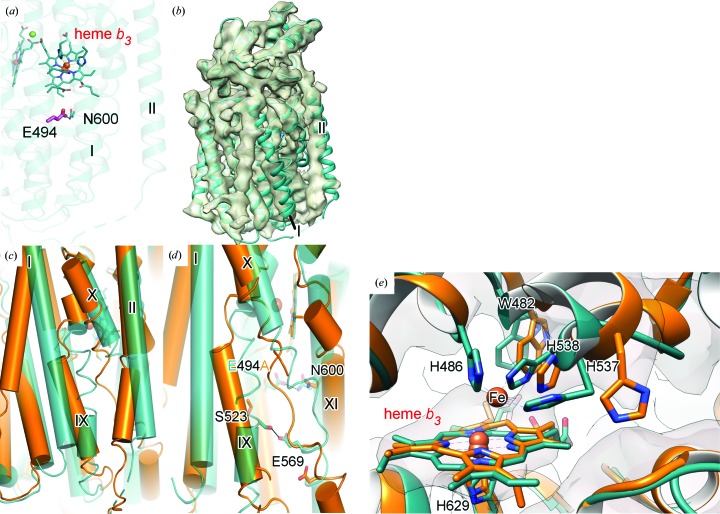
is carried by nearly a billion humans, causing developmental impairment and over 100 000 deaths a year. A quinol-dependent nitric oxide reductase (qNOR) plays a critical role in the survival of the bacterium in the human host. X-ray crystallographic analyses of qNOR, including that from (qNOR) reported here at 3.15 Å resolution, show monomeric assemblies, despite the more active dimeric sample being used for crystallization. Cryo-electron microscopic analysis of the same chromatographic fraction of qNOR, however, revealed a dimeric assembly at 3.06 Å resolution. It is shown that zinc (which is used in crystallization) binding near the dimer-stabilizing TMII region contributes to the disruption of the dimer. A similar destabilization is observed in the monomeric (∼85 kDa) cryo-EM structure of a mutant (Glu494Ala) qNOR from the opportunistic pathogen () , which primarily migrates as a monomer. The monomer-dimer transition of qNORs seen in the cryo-EM and crystallographic structures has wider implications for structural studies of multimeric membrane proteins. X-ray crystallographic and cryo-EM structural analyses have been performed on the same chromatographic fraction of qNOR to high resolution. This represents one of the first examples in which the two approaches have been used to reveal a monomeric assembly and a dimeric assembly in vitrified cryo-EM grids. A number of factors have been identified that may trigger the destabilization of helices that are necessary to preserve the integrity of the dimer. These include zinc binding near the entry of the putative proton-transfer channel and the preservation of the conformational integrity of the active site. The mutation near the active site results in disruption of the active site, causing an additional destabilization of helices (TMIX and TMX) that flank the proton-transfer channel helices, creating an inert monomeric enzyme.
近十亿人携带这种病菌,每年导致发育障碍以及超过10万例死亡。一种喹啉依赖性一氧化氮还原酶(qNOR)在该细菌于人类宿主中的存活中起着关键作用。对qNOR进行的X射线晶体学分析,包括此处报道的分辨率为3.15 Å的[具体来源未提及](qNOR)的分析,显示为单体组装,尽管用于结晶的是活性更高的二聚体样品。然而,对qNOR相同色谱级分的冷冻电子显微镜分析在3.06 Å分辨率下揭示了二聚体组装。结果表明,在二聚体稳定的TMII区域附近结合的锌(用于结晶)导致二聚体的破坏。在来自机会致病菌[具体名称未提及]的突变体(Glu494Ala)qNOR的单体(约85 kDa)冷冻电镜结构中也观察到了类似的不稳定情况,该突变体主要以单体形式迁移。在冷冻电镜和晶体学结构中看到的qNOR的单体 - 二聚体转变对多聚体膜蛋白的结构研究具有更广泛的意义。已对qNOR的相同色谱级分进行了高分辨率的X射线晶体学和冷冻电镜结构分析。这代表了首批使用这两种方法在玻璃化冷冻电镜网格中揭示单体组装和二聚体组装的例子之一。已经确定了一些可能引发维持二聚体完整性所需螺旋不稳定的因素。这些因素包括在假定的质子转移通道入口附近结合的锌以及活性位点构象完整性的维持。活性位点附近的突变导致活性位点的破坏,引起质子转移通道螺旋两侧的螺旋(TMIX和TMX)的额外不稳定,从而产生无活性的单体酶。