Castro Danielle Karoline Silva do Vale, da Silva Sabrina Matos de Oliveira, Pereira Humberto D'Muniz, Macedo Joci Neuby Alves, Leonardo Diego Antonio, Valadares Napoleão Fonseca, Kumagai Patricia Suemy, Brandão-Neto José, Araújo Ana Paula Ulian, Garratt Richard Charles
Instituto de Física de São Carlos, Universidade de São Paulo, Avenida Joao Dagnone 1100, São Carlos-SP 13563-723, Brazil.
Instituto de Química de São Carlos, Universidade de São Paulo, Avenida Trabalhador São-carlense 400, São Carlos-SP 13566-590, Brazil.
IUCrJ. 2020 Mar 28;7(Pt 3):462-479. doi: 10.1107/S2052252520002973. eCollection 2020 May 1.
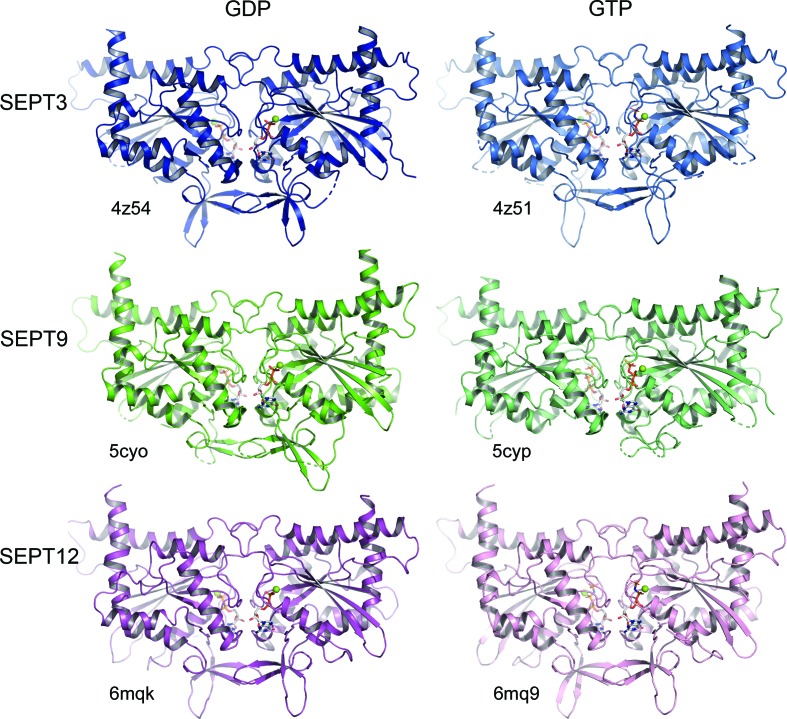
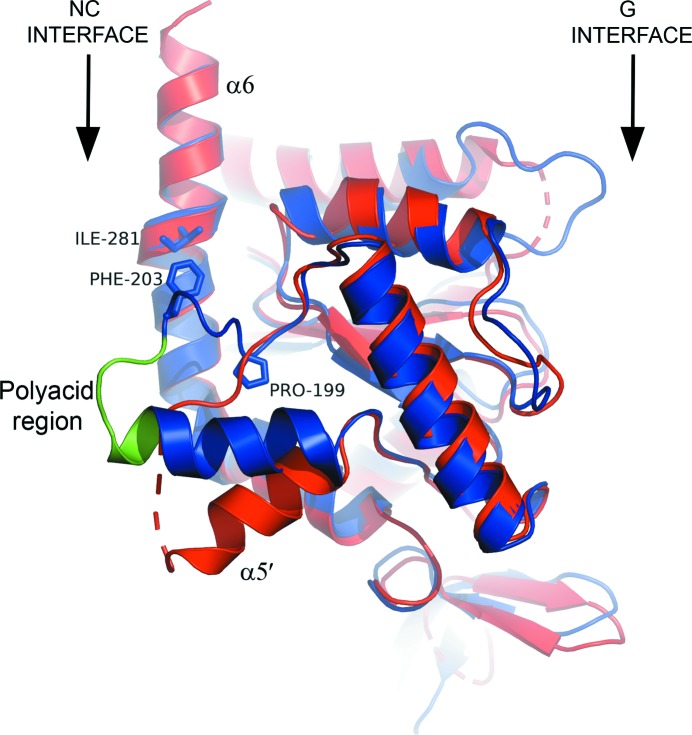
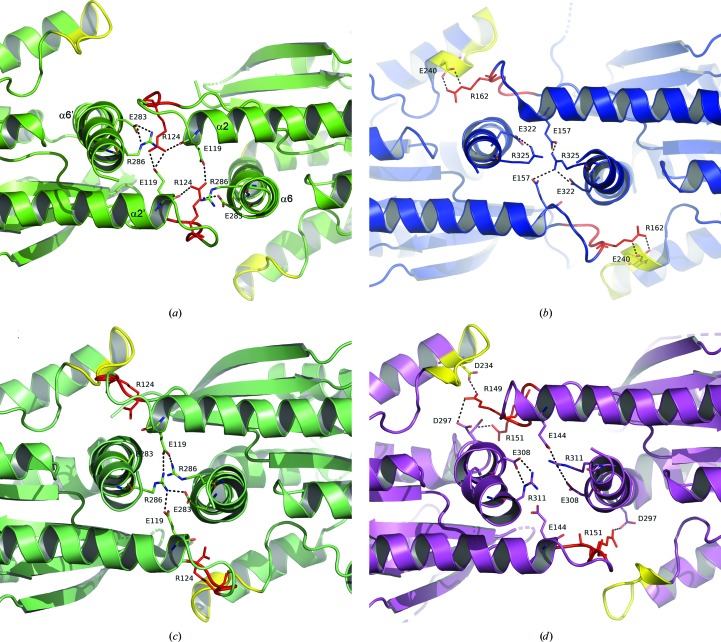
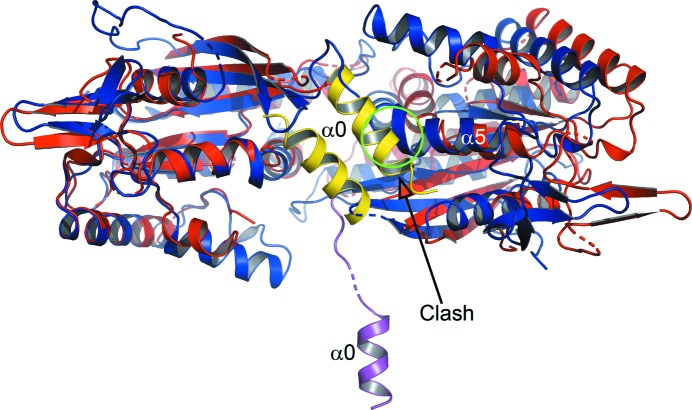
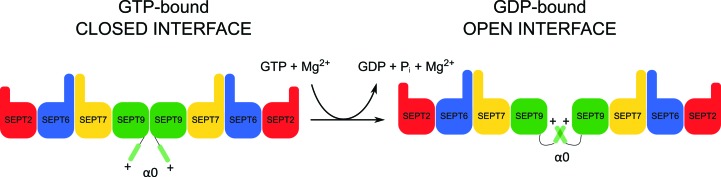
Human septins 3, 9 and 12 are the only members of a specific subgroup of septins that display several unusual features, including the absence of a C-terminal coiled coil. This particular subgroup (the SEPT3 septins) are present in rod-like octameric protofilaments but are lacking in similar hexameric assemblies, which only contain representatives of the three remaining subgroups. Both hexamers and octamers can self-assemble into mixed filaments by end-to-end association, implying that the SEPT3 septins may facilitate polymerization but not necessarily function. These filaments frequently associate into higher order complexes which associate with biological membranes, triggering a wide range of cellular events. In the present work, a complete compendium of crystal structures for the GTP-binding domains of all of the SEPT3 subgroup members when bound to either GDP or to a GTP analogue is provided. The structures reveal a unique degree of plasticity at one of the filamentous interfaces (dubbed NC). Specifically, structures of the GDP and GTPγS complexes of SEPT9 reveal a squeezing mechanism at the NC interface which would expel a polybasic region from its binding site and render it free to interact with negatively charged membranes. On the other hand, a polyacidic region associated with helix α5', the orientation of which is particular to this subgroup, provides a safe haven for the polybasic region when retracted within the interface. Together, these results suggest a mechanism which couples GTP binding and hydrolysis to membrane association and implies a unique role for the SEPT3 subgroup in this process. These observations can be accounted for by constellations of specific amino-acid residues that are found only in this subgroup and by the absence of the C-terminal coiled coil. Such conclusions can only be reached owing to the completeness of the structural studies presented here.
人类septin 3、9和12是septin特定亚组的仅有的成员,该亚组具有几个不同寻常的特征,包括缺乏C端卷曲螺旋。这个特定的亚组(SEPT3 septin)存在于棒状八聚体原丝中,但在类似的六聚体组装体中不存在,后者仅包含其余三个亚组的代表。六聚体和八聚体都可以通过端对端结合自组装成混合丝,这意味着SEPT3 septin可能促进聚合,但不一定发挥功能。这些丝经常组装成与生物膜相关的高阶复合物,引发广泛的细胞事件。在本研究中,提供了所有SEPT3亚组成员的GTP结合结构域与GDP或GTP类似物结合时的完整晶体结构汇编。这些结构揭示了丝状界面之一(称为NC)处独特程度的可塑性。具体而言,SEPT9的GDP和GTPγS复合物的结构揭示了NC界面处的挤压机制,该机制会将一个多碱性区域从其结合位点排出,使其能够自由地与带负电荷的膜相互作用。另一方面,与螺旋α5'相关的一个多酸性区域,其取向是该亚组特有的,当在界面内缩回时为多碱性区域提供了一个安全区域。总之,这些结果提示了一种将GTP结合和水解与膜结合相偶联的机制,并暗示了SEPT3亚组在此过程中的独特作用。这些观察结果可以由仅在该亚组中发现的特定氨基酸残基的组合以及缺乏C端卷曲螺旋来解释。只有由于这里所呈现的结构研究的完整性才能得出这样的结论。