Department of Gastroenterology, Affiliated Hospital of Guangdong Medical University, Zhanjiang, China.
Communicable and Non-communicable Diseases Control Directorate, Federal Ministry of Health, Khartoum, Sudan.
Front Cell Infect Microbiol. 2020 Apr 28;10:184. doi: 10.3389/fcimb.2020.00184. eCollection 2020.
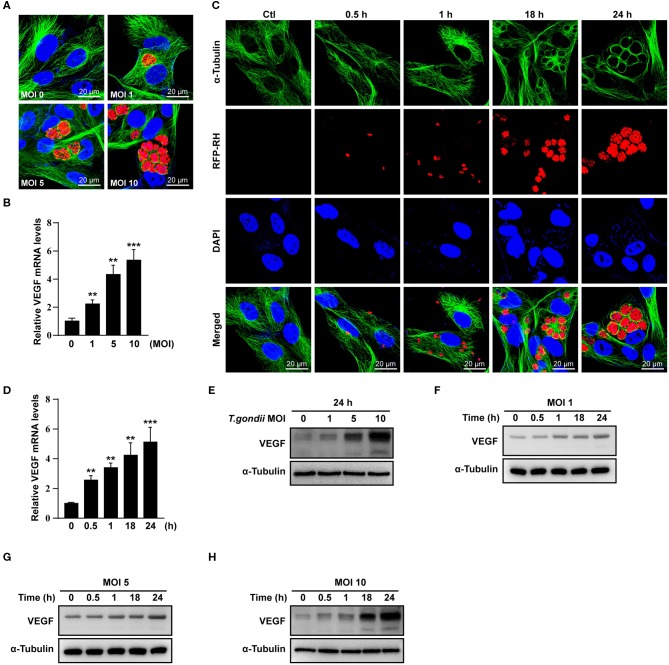
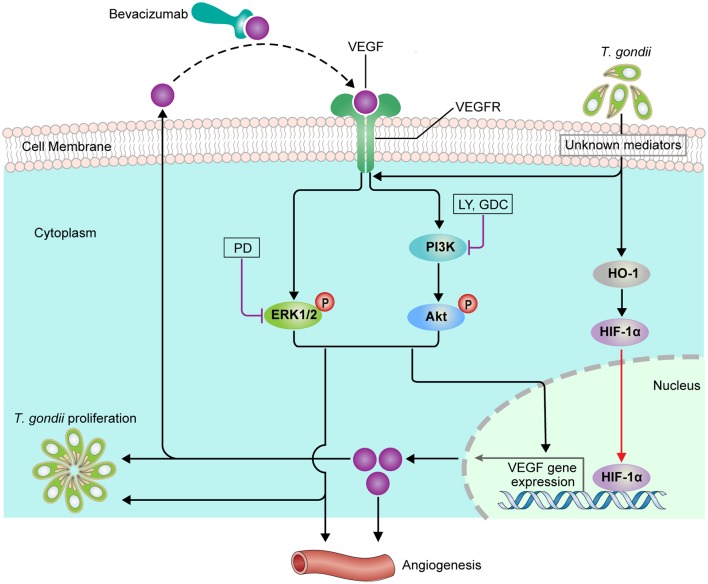
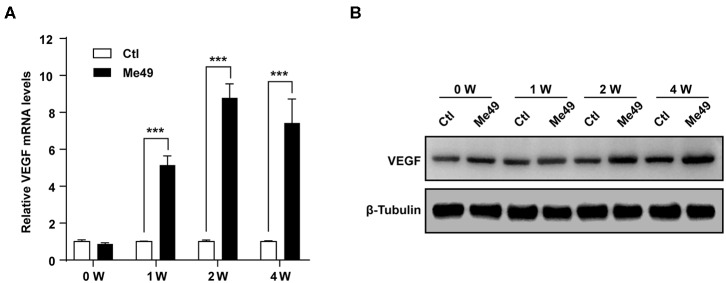
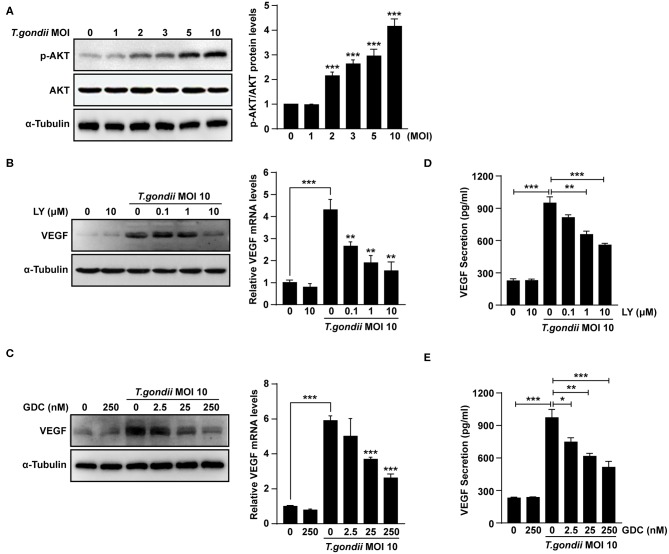
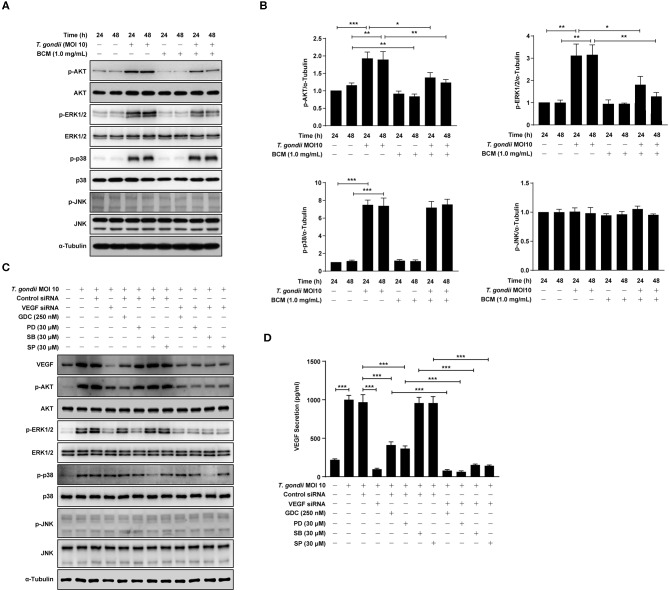
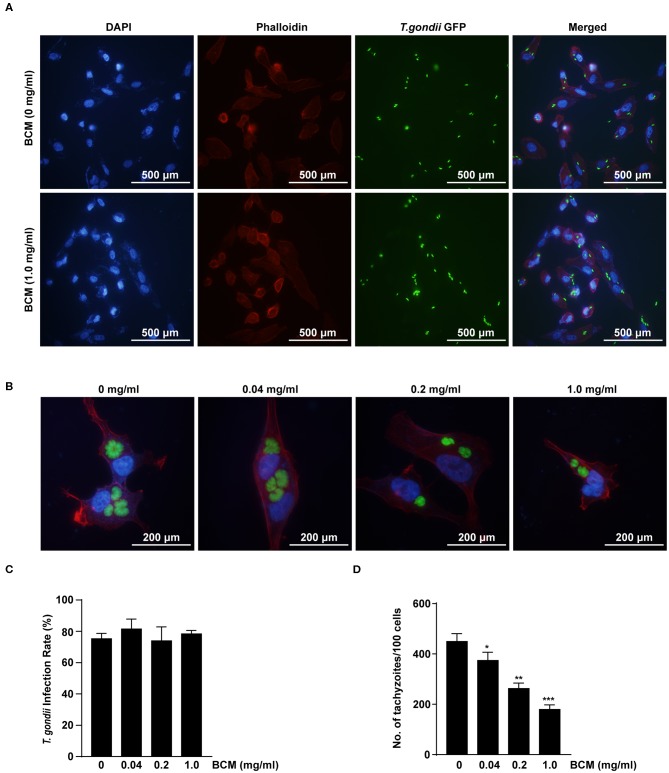
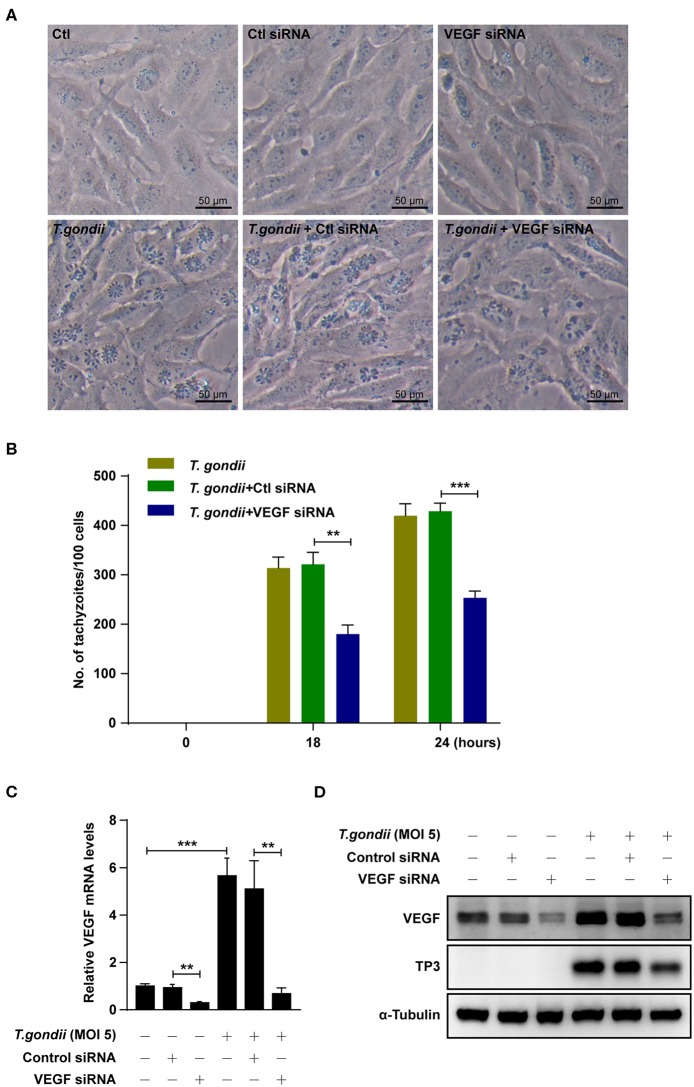
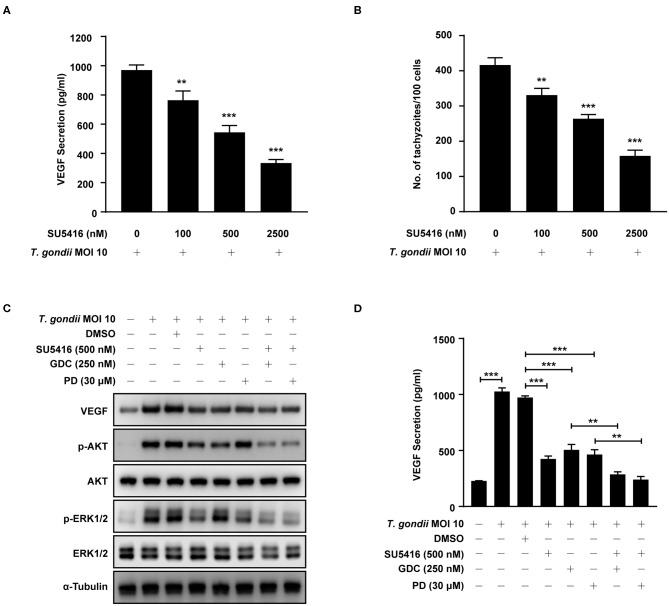
The retina is the primary site of infection in the eye, and choroidal neovascularization in ocular toxoplasmosis is one of the most important causes of visual impairment. Vascular endothelial growth factor (VEGF) is one of the key regulators of blood vessel development, however, little is known about the mechanisms of -induced VEGF production in ocular toxoplasmosis. Here, we investigate the effect of on VEGF production regulation in human retinal pigment epithelium ARPE-19 cells and attempted to unveil the underlying mechanism of this event by focusing on the interaction between parasite and the selected host intracellular signaling pathways. infection increased the expression of VEGF mRNA and protein in ARPE-19 cells in parasite burden- and infection time-dependent manner. The proportional increase of VEGF upstream regulators, HIF-1α and HO-1, was also observed. induced the activation of host p-AKT, p-ERK1/2, and p-p38 MAPK in ARPE-19 cells in a parasite-burden dependent manner. However, VEGF expression decreased after the pre-treatment with PI3K inhibitors (LY294002 and GDC-0941), ERK1/2 inhibitor (PD098059), and p38 MAPK inhibitor (SB203580), but not JNK inhibitor (SP600125), in a dose-dependent manner. The anti-VEGF agent bevacizumab or VEGF siRNA transfection prominently inhibited the activation of p-AKT and p-ERK1/2, but not p-p38 MAPK and JNK1/2 in -infected ARPE-19 cells. Bevacizumab treatment or VEGF siRNA transfection significantly inhibited the proliferation of tachyzoites in the host cell, dose-dependently, but not invasion of parasites. VEGF-receptor 2 (VEGF-R2) antagonist, SU5416, attenuated VEGF production and tachyzoite proliferation in -infected ARPE-19 cells in a dose-dependent manner. Collectively, prominently induces VEGF production in ARPE-19 cells, and VEGF and AKT/ERK1/2 signaling pathways mutually regulate each other in -infected ARPE-19 cells, but not p38 MAPK and JNK1/2 signaling pathways. VEGF and VEGF-R2 control the parasite proliferation in -infected ARPE-19 cells. From this study, we revealed the putative mechanisms for VEGF induction as well as the existence of positive feedback between VEGF and PI3K/MAPK signaling pathways in -infected retinal pigment epithelium.
视网膜是眼部感染的主要部位,眼弓形体病中的脉络膜新生血管是视力损害的最重要原因之一。血管内皮生长因子(VEGF)是血管发育的关键调节剂之一,然而,关于弓形虫感染引起的 VEGF 产生的机制知之甚少。在这里,我们研究了弓形虫对人视网膜色素上皮 ARPE-19 细胞中 VEGF 产生调节的影响,并通过关注寄生虫与选定的宿主细胞内信号通路之间的相互作用,试图揭示这一事件的潜在机制。弓形虫感染以寄生虫负担和感染时间依赖的方式增加 ARPE-19 细胞中 VEGF mRNA 和蛋白的表达。还观察到 VEGF 上游调节剂 HIF-1α 和 HO-1 的比例增加。弓形虫感染以寄生虫负担依赖的方式诱导 ARPE-19 细胞中宿主 p-AKT、p-ERK1/2 和 p-p38 MAPK 的激活。然而,在用 PI3K 抑制剂(LY294002 和 GDC-0941)、ERK1/2 抑制剂(PD098059)和 p38 MAPK 抑制剂(SB203580)预处理后,VEGF 表达在剂量依赖性方式下降,但 JNK 抑制剂(SP600125)不下降。抗 VEGF 药物 bevacizumab 或 VEGF siRNA 转染明显抑制了感染 ARPE-19 细胞中 p-AKT 和 p-ERK1/2 的激活,但不抑制 p-p38 MAPK 和 JNK1/2 的激活。bevacizumab 处理或 VEGF siRNA 转染显著抑制宿主细胞中弓形虫速殖子的增殖,呈剂量依赖性,但不抑制寄生虫的侵袭。VEGF 受体 2(VEGF-R2)拮抗剂 SU5416 以剂量依赖性方式减弱感染 ARPE-19 细胞中 VEGF 的产生和速殖子的增殖。总之,弓形虫明显诱导 ARPE-19 细胞中 VEGF 的产生,并且 VEGF 和 AKT/ERK1/2 信号通路在感染 ARPE-19 细胞中相互调节,但不调节 p38 MAPK 和 JNK1/2 信号通路。VEGF 和 VEGF-R2 控制感染 ARPE-19 细胞中的寄生虫增殖。从这项研究中,我们揭示了 VEGF 诱导的假设机制,以及 VEGF 和 PI3K/MAPK 信号通路之间存在正反馈关系。