European Institute of Chemistry and Biology (IECB), ARNA laboratory, INSERM U1212 - CNRS UMR 5320, University of Bordeaux, France.
Department of Medicine, Laboratory of Biochemistry, 33100 Udine, Italy.
Nucleic Acids Res. 2020 Sep 18;48(16):9336-9345. doi: 10.1093/nar/gkaa387.
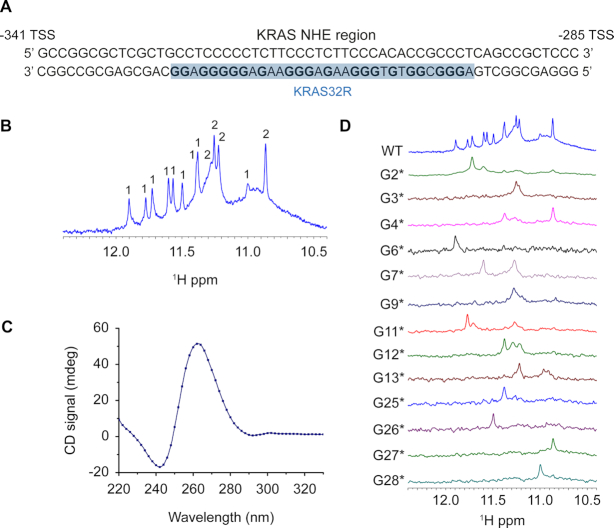
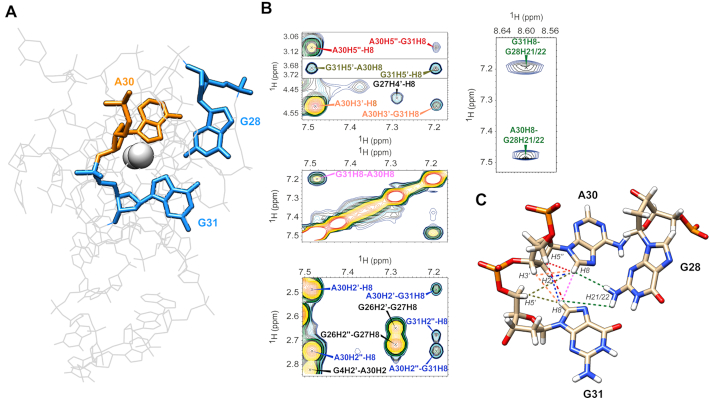
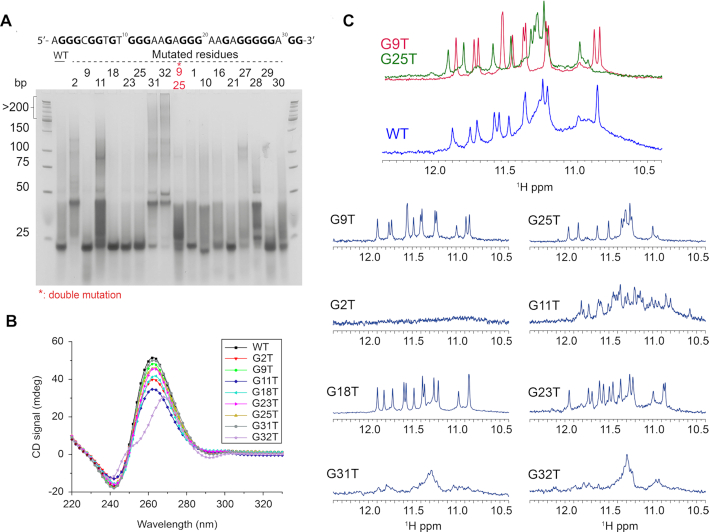
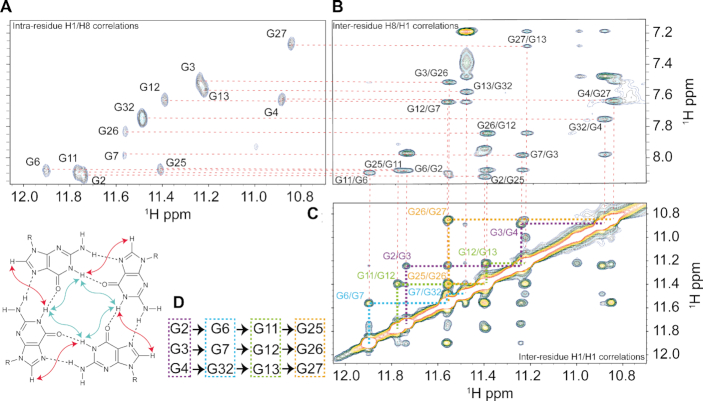
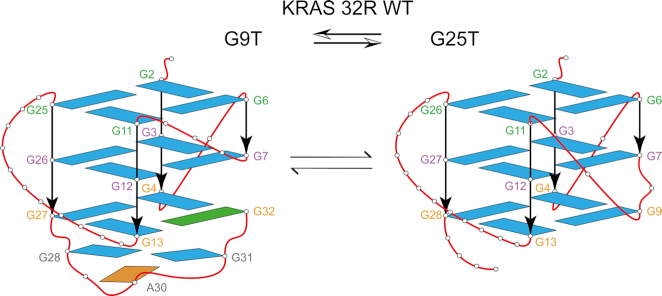
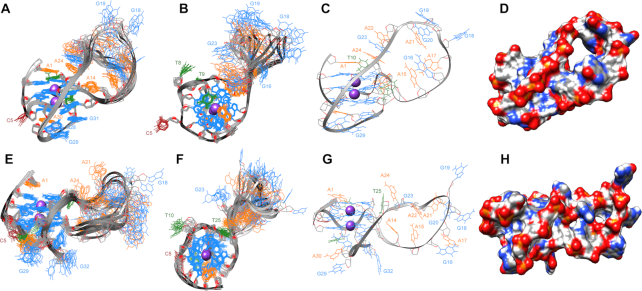
KRAS is one of the most mutated oncogenes and still considered an undruggable target. An alternative strategy would consist in targeting its gene rather than the protein, specifically the formation of G-quadruplexes (G4) in its promoter. G4 are secondary structures implicated in biological processes, which can be formed among G-rich DNA (or RNA) sequences. Here we have studied the major conformations of the commonly known KRAS 32R, or simply 32R, a 32 residue sequence within the KRAS Nuclease Hypersensitive Element (NHE) region. We have determined the structure of the two major stable conformers that 32R can adopt and which display slow equilibrium (>ms) with each other. By using different biophysical methods, we found that the nucleotides G9, G25, G28 and G32 are particularly implicated in the exchange between these two conformations. We also showed that a triad at the 3' end further stabilizes one of the G4 conformations, while the second conformer remains more flexible and less stable.
KRAS 是突变频率最高的致癌基因之一,目前仍然被认为是一个不可成药的靶点。一种替代策略是针对其基因而不是蛋白质,特别是针对其启动子中 G-四链体 (G4) 的形成。G4 是涉及生物过程的二级结构,可以在富含 G 的 DNA(或 RNA)序列之间形成。在这里,我们研究了常见的 KRAS 32R(或简称 32R)的主要构象,32R 是 KRAS 核酸酶高敏感元件 (NHE) 区域内的 32 个残基序列。我们已经确定了 32R 可以采用的两种主要稳定构象的结构,它们彼此之间显示出缓慢的平衡(>ms)。通过使用不同的生物物理方法,我们发现核苷酸 G9、G25、G28 和 G32 特别参与了这两种构象之间的交换。我们还表明,3'端的三联体进一步稳定了 G4 构象之一,而第二种构象仍然更加灵活和不稳定。