Department of Statistics, College of Natural and Computational Science, University of Gondar, Gondar, Ethiopia.
BMC Pediatr. 2020 May 20;20(1):239. doi: 10.1186/s12887-020-02141-6.
Diarrhoea is one of the major contributors to death among under-five children in Ethiopia. Studies conducted in different countries showed that rural children are more severely affected by diarrhoea than urban children. Thus, this study was aimed to identify the socio-demographic, environmental and behavioural associated risk factors of the occurrence of diarrhoea among under-five children in rural Ethiopia.
Data for the study was drawn from the 2016 Ethiopian Demographic and Health Survey. A total of 8041 under-five children were included in the study. Binary logistic regression was used to assess the association of occurrence of diarrhoea with socio-demographic, environmental and behavioural factors among under-five children.
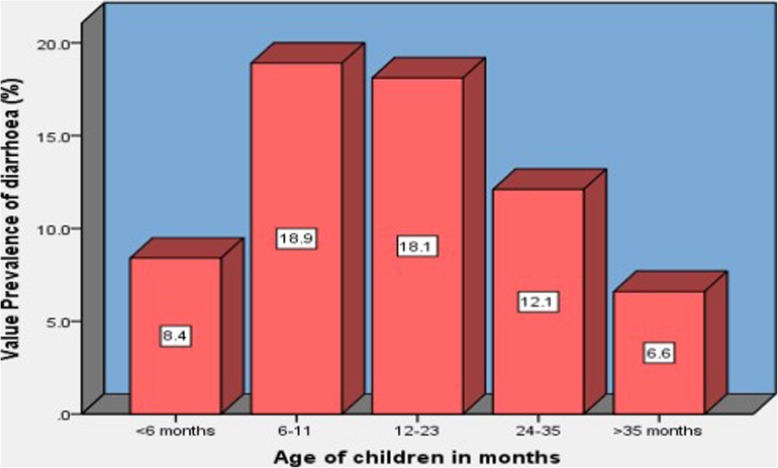
Children aged 6-11 months (AOR:3.5; 95% CI: 2.58-4.87), 12-23 months (AOR: 3.1; 95% CI: 2.33-4.04) and 24-35 months (AOR: 1.7; 95% CI: 1.26-2.34) as compared to > 35 months were significantly associated with an increasing prevalence of diarrhoea. Children in Afar region (AOR: 1.92; 95% CI: 1.01-3.64) and Gambela region (AOR: 2.12; 95% CI: 1.18, 3.81) were significantly associated with an increasing prevalence of diarrhoea, but a decreasing prevalence in Somali region (AOR: .42; 95% CI: (.217-.80) as compared to Tigray region. Increasing prevalence of diarrhoea was also significantly associated with male children (AOR: 1.3; 95% CI: 1.05-1.58); households who shared toilet facilities with other households (AOR: 1.4; 95% CI: 1.09-1.77); fourth birth order (AOR: 1.81; 95% CI: 1.17-2.79), and fifth and above birth order (AOR: 1.85; 95% CI: 1.22, 2.81) as compared to first order; and mother's current age 35-49 years in a household with ≥3 under-five children (AOR: 4.7; 95% CI: 1.64-13.45) as compared to those maternal ages of 15-24 years in a household with ≤2 under-five children.
The age of a child, sex of a child, region, birth order, toilet facilities shared with other households and the interaction effect of the number of under-five children with mother's current age are identified as associated risk factors for diarrhoea occurrence among under-five children in rural Ethiopia. The findings show the need for planning and implementing appropriate prevention strategies considering these risk factors for rural under-five children.
腹泻是导致埃塞俄比亚五岁以下儿童死亡的主要原因之一。在不同国家进行的研究表明,农村儿童比城市儿童更容易受到腹泻的严重影响。因此,本研究旨在确定农村地区五岁以下儿童腹泻发生的社会人口、环境和行为相关危险因素。
本研究的数据来自 2016 年埃塞俄比亚人口与健康调查。共有 8041 名五岁以下儿童纳入研究。采用二元逻辑回归评估五岁以下儿童腹泻发生与社会人口、环境和行为因素之间的关联。
与 >35 个月的儿童相比,6-11 个月(AOR:3.5;95%CI:2.58-4.87)、12-23 个月(AOR:3.1;95%CI:2.33-4.04)和 24-35 个月(AOR:1.7;95%CI:1.26-2.34)的儿童腹泻流行率显著增加。与提格雷地区相比,在阿法尔地区(AOR:1.92;95%CI:1.01-3.64)和甘贝拉地区(AOR:2.12;95%CI:1.18, 3.81)的儿童腹泻流行率显著增加,但在索马里地区(AOR:0.42;95%CI:0.217-0.80)的腹泻流行率显著降低。男孩(AOR:1.3;95%CI:1.05-1.58)、与其他家庭共用厕所设施的家庭(AOR:1.4;95%CI:1.09-1.77)、第四胎(AOR:1.81;95%CI:1.17-2.79)和第五胎及以上(AOR:1.85;95%CI:1.22, 2.81)的儿童腹泻流行率也显著增加,与第一胎相比。与 15-24 岁的儿童相比,有 35-49 岁母亲的家庭(AOR:4.7;95%CI:1.64-13.45)的五岁以下儿童数量与当前母亲年龄的交互作用是腹泻发生的相关危险因素。
儿童年龄、儿童性别、地区、出生顺序、与其他家庭共用厕所设施以及五岁以下儿童数量与母亲当前年龄的交互作用被确定为农村地区五岁以下儿童腹泻发生的相关危险因素。这些发现表明,需要针对农村地区五岁以下儿童制定和实施适当的预防策略,考虑到这些风险因素。