Division of Environmental and Preventive Medicine, Department of Social Medicine, Faculty of Medicine, Tottori University, Nishi-machi 86, Yonago-shi, Tottori, 683-8503, Japan.
Department of Public Health, School of Medicine, Nihon University, Itabashi-ku, Tokyo, Japan.
BMC Public Health. 2020 May 20;20(1):741. doi: 10.1186/s12889-020-08916-x.
From among the global public health concerns, smoking remains one of the most crucial challenges. Especially for adolescents, the increase in the use of electronic cigarettes is controversial, as its use may lead to established smoking. In Japan, where a unique tobacco regulation system exists, the heat-not-burn tobacco market has been growing. However, the prevalence and association of combustible cigarettes and new tobacco-related products have not yet been closely investigated among Japanese adolescents. This study aimed to clarify the prevalence of smoking among adolescents, including new types of tobacco-related products, and to compare the characteristics of their users.
The 2017 Lifestyle Survey of Adolescents is a nationally-representative survey collected in Japan. From the national school directory, 98 junior high schools and 86 high schools were randomly sampled throughout Japan. The students completed an anonymous questionnaire at school. We calculated the prevalence of use for each type of tobacco product. Then, the use of a combination of products and the characteristics of different types of products were examined.
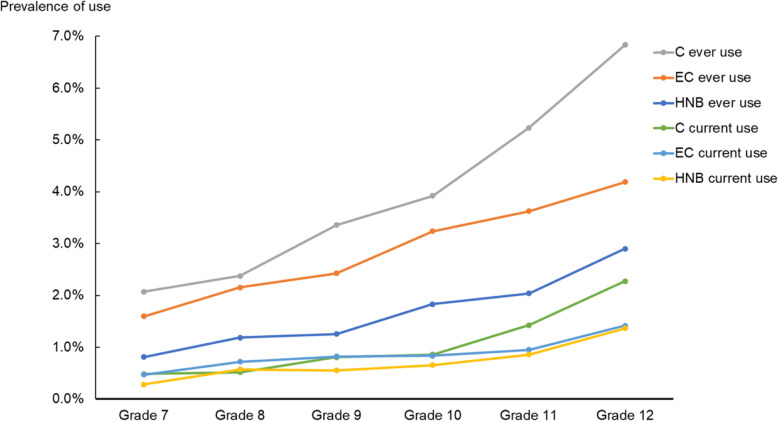
In total, 64,152 students from 48 junior high schools and 55 high schools were included the analysis (school response rate = 56%, M = 15.7 years, 53.9% boys). The age-adjusted rate of ever (current) use of electronic cigarettes was 2.1% (0.7%) in junior high school and 3.5% (1.0%) in high school; that of combustible cigarettes was 2.6% (0.6%) in junior high school and 5.1% (1.5%) in high school. The rate of heat-not-burn tobacco use was lower relative to other products: 1.1% (0.5%) in junior high school and 2.2% (0.9%) in high school. An examination of the combined use of the three products identified a high number of dual users. Comparisons between different types of users indicated different backgrounds for combustible cigarette users and new product users.
The prevalence of new tobacco-alternative products is growing in popularity among Japanese adolescents. Dual use is common, and many adolescents use new products only. Moreover, e-cigarettes might attract a broader range of groups to smoking. Continuous monitoring and research are needed to investigate their influence as a possible gateway to tobacco smoking.
在全球公共卫生关注中,吸烟仍然是最关键的挑战之一。特别是对于青少年来说,电子烟的使用增加存在争议,因为它的使用可能导致已建立的吸烟。在日本,存在独特的烟草监管系统,加热不燃烧烟草市场一直在增长。然而,在日本青少年中,还没有密切调查可燃香烟和新型烟草相关产品的流行率及其关联。本研究旨在阐明青少年吸烟的流行率,包括新型烟草相关产品,并比较其使用者的特征。
2017 年青少年生活方式调查是在日本全国范围内进行的代表性调查。从全国学校名录中,在日本各地随机抽取了 98 所初中和 86 所高中。学生们在学校完成了一份匿名问卷。我们计算了每种烟草产品的使用频率。然后,检查了产品组合的使用情况和不同类型产品的特点。
共有来自 48 所初中和 55 所高中的 64152 名学生参与了分析(学校应答率为 56%,M=15.7 岁,53.9%为男生)。调整年龄后,初中和高中学生电子香烟的终生(当前)使用率分别为 2.1%(0.7%)和 3.5%(1.0%);可燃香烟的使用率分别为 2.6%(0.6%)和 5.1%(1.5%)。加热不燃烧烟草的使用率相对较低:初中和高中分别为 1.1%(0.5%)和 2.2%(0.9%)。对三种产品联合使用的检查发现,双重使用者数量很多。不同类型使用者之间的比较表明,可燃香烟使用者和新型产品使用者具有不同的背景。
新型烟草替代品在日本青少年中的流行率正在上升。双重使用很常见,许多青少年仅使用新型产品。此外,电子烟可能会吸引更广泛的人群吸烟。需要持续监测和研究,以调查它们作为吸烟可能的入口的影响。