Department of Health Care Organization and Policy, University of Alabama at Birmingham School of Public Health, Birmingham.
Department of Health Management and Policy, University of Michigan School of Public Health, Ann Arbor.
JAMA Netw Open. 2021 Aug 2;4(8):e2118788. doi: 10.1001/jamanetworkopen.2021.18788.
With increasing e-cigarette use among US adolescents and decreasing use of other tobacco products, it is unclear how total use of nicotine products, and its long-term health risks, have changed. The Centers for Disease Control and Prevention's standard measure-any tobacco product use in the past 30 days-considers neither frequency of use nor product risk implications.
To investigate how nicotine product use, including frequency of use, and its associated risks have changed among middle school and high school students since 1999.
DESIGN, SETTING, AND PARTICIPANTS: This cross-sectional study used data from the 1999-2020 National Youth Tobacco Survey, an in-school survey of a nationally representative sample of students in grades 6 through 12; each survey recruited between 15 000 and 36 000 participants.
Nicotine product use in the past 30 days.
Use of nicotine products assessed by nicotine product days (NPDs), the number of days that the average student consumed these products in the past 30 days. Risk-adjusted NPDs account for differential long-term health risks of various products.
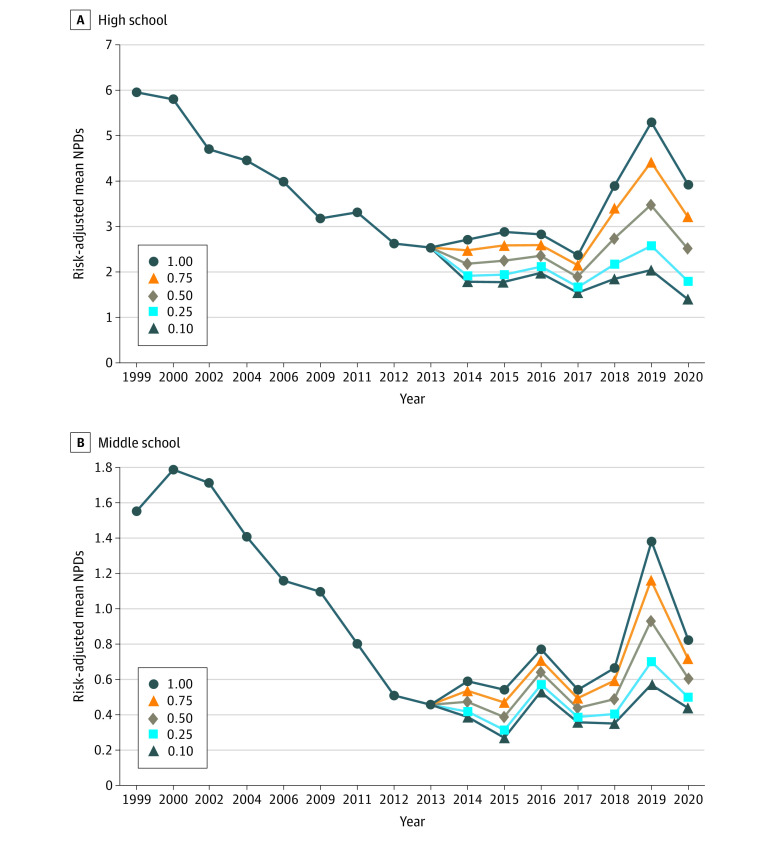
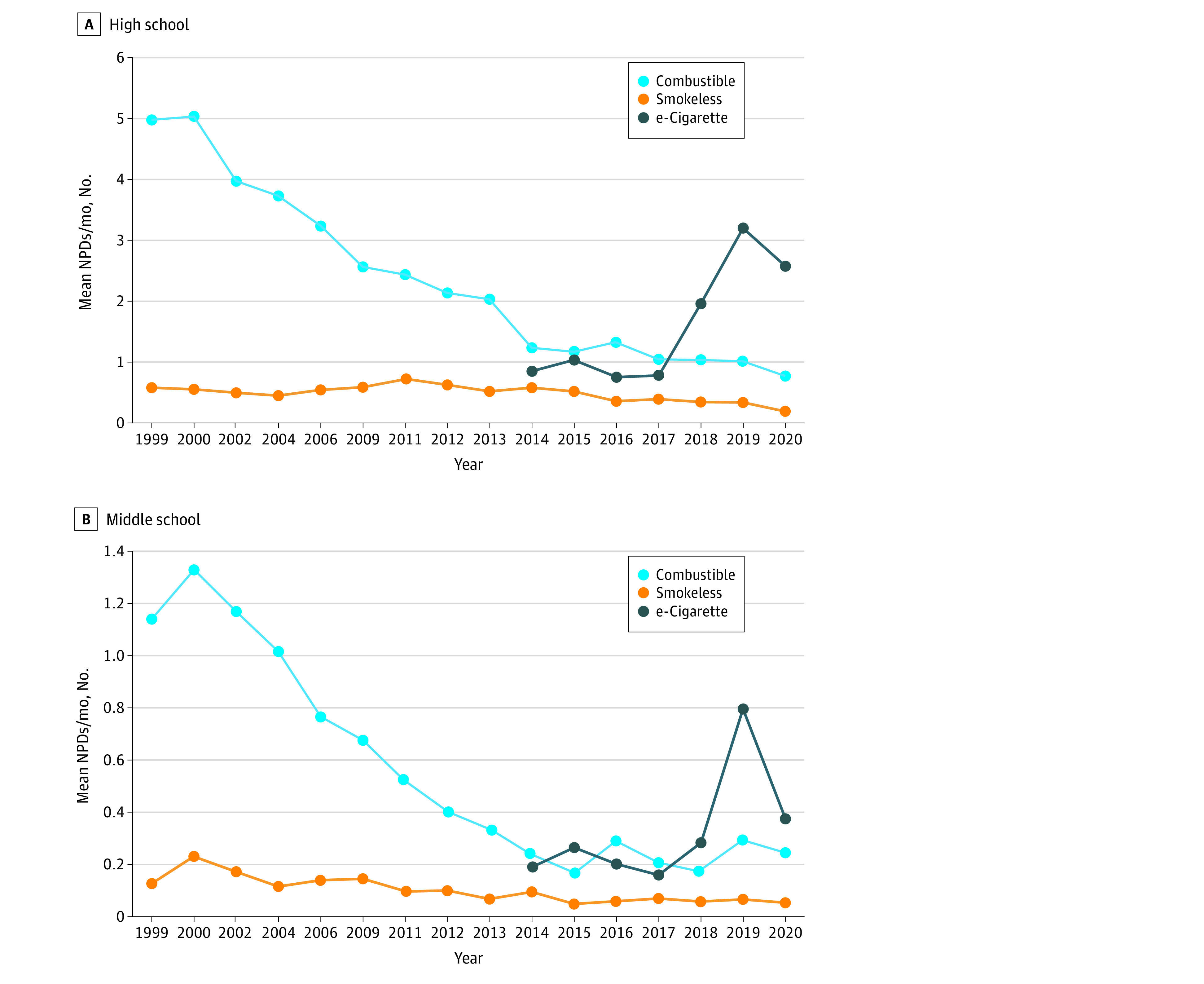
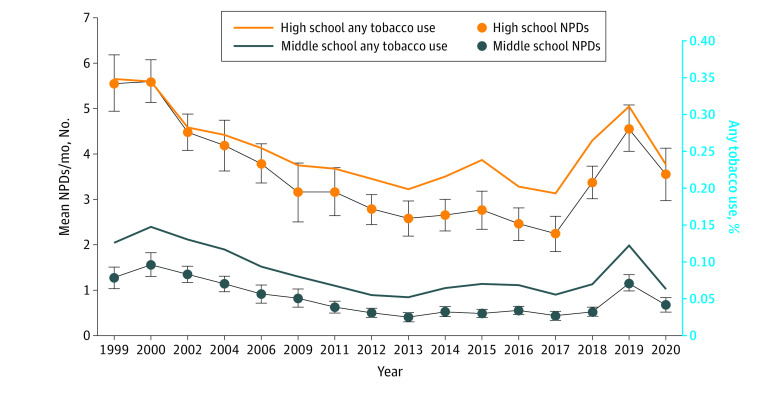
This study included 16 years of cross-sectional survey data. Each survey recruited between 15 000 and 36 000 participants in grades 6 through 12 (male students: mean, 50.4% [minimum, 48.5%; maximum, 58.4%]; mean age, 14.5 years [minimum, 14.0 years; maximum, 14.7 years]). Nationally representative cross-sectional data for high school students showed that NPDs decreased steadily from 5.6 days per month in 1999 (95% CI, 5.0-6.2 days per month) to 2.2 days per month in 2017 (95% CI, 1.9-2.6 days per month), increased to 4.6 days per month in 2019 (95% CI, 4.1-5.1 days per month), and then decreased to 3.6 days per month in 2020 (95% CI, 3.0-4.1 days per month). For a risk weight of 0.1 for e-cigarettes, compared with combustible products, risk-adjusted NPDs decreased from 2.5 days per month in 2013 (95% CI, 2.2-2.9 days per month) (prior to the popularity of e-cigarettes) to 2.0 days per month in 2019 (95% CI, 1.6-2.5 days per month) and 1.4 days per month in 2020 (95% CI, 1.0-1.8 days per month). However, with a risk weight of 1.0 for e-cigarettes (identical to that of combustible products), risk-adjusted NPDs increased to 5.3 days per month in 2019 (95% CI, 4.4-6.2 days per month) and 3.9 days per month in 2020 (95% CI, 3.1-4.7 days per month). Similar trends were found for middle school students.
This study suggests that NPDs represent an improvement, albeit an imperfect one, compared with any 30-day tobacco product use by incorporating the frequency of use of various products. By distinguishing products, NPDs permit consideration of the health consequences associated with different mixes of products over time. Health risks of adolescent nicotine product use could have decreased during vaping's popularity if assessment of the long-term risks associated with vaping compared with those of smoking is low. There is a need to closely monitor youth nicotine and tobacco product use patterns.
随着美国青少年使用电子烟的人数不断增加,而使用其他烟草产品的人数不断减少,尼古丁产品的总使用量及其长期健康风险如何变化尚不清楚。疾病控制和预防中心的标准衡量标准——过去 30 天内使用任何烟草产品——既不考虑使用频率,也不考虑产品风险含义。
调查自 1999 年以来,中学生和高中生使用尼古丁产品(包括使用频率)及其相关风险的变化情况。
设计、地点和参与者:这项横断面研究使用了 1999 年至 2020 年全国青少年烟草调查的数据,这是一项在全国范围内对 6 至 12 年级学生进行的校内调查;每项调查招募了 1.5 万名至 3.6 万名参与者。
过去 30 天内使用尼古丁产品。
使用尼古丁产品的天数(NPD)评估,即学生过去 30 天内平均每天使用这些产品的天数。风险调整后的 NPD 考虑了各种产品的长期健康风险差异。
本研究包括 16 年的横断面调查数据。每项调查招募了 1.5 万名至 3.6 万名 6 至 12 年级的学生(男生:平均 50.4%[最小 48.5%;最大 58.4%];平均年龄 14.5 岁[最小 14.0 岁;最大 14.7 岁])。全国代表性的高中生横断面数据显示,NPD 从 1999 年的每月 5.6 天(95%CI,5.0-6.2 天/月)稳步下降到 2017 年的每月 2.2 天(95%CI,1.9-2.6 天/月),增加到 2019 年的每月 4.6 天(95%CI,4.1-5.1 天/月),然后在 2020 年下降到每月 3.6 天(95%CI,3.0-4.1 天/月)。如果电子烟的风险权重为 0.1,与可燃产品相比,风险调整后的 NPD 从 2013 年的每月 2.5 天(95%CI,2.2-2.9 天/月)(在电子烟普及之前)下降到 2019 年的每月 2.0 天(95%CI,1.6-2.5 天/月)和 2020 年的每月 1.4 天(95%CI,1.0-1.8 天/月)。然而,如果电子烟的风险权重为 1.0(与可燃产品相同),风险调整后的 NPD 在 2019 年增加到每月 5.3 天(95%CI,4.4-6.2 天/月),在 2020 年增加到每月 3.9 天(95%CI,3.1-4.7 天/月)。在中学生中也发现了类似的趋势。
本研究表明,与任何 30 天的烟草产品使用相比,NPD 代表了一种改进,尽管这种改进并不完美,因为它纳入了各种产品的使用频率。通过区分产品,NPD 可以考虑随着时间的推移不同产品组合所带来的健康后果。如果与吸烟相比,对与吸电子烟相关的长期风险的评估较低,那么青少年使用尼古丁产品的健康风险在电子烟流行期间可能已经降低。需要密切监测青少年尼古丁和烟草产品的使用模式。