Department of Neurosciences, University of California San Diego, 200 W. Arbor Drive, San Diego, CA 619-543-7760, United States.
Department of Neurosciences, University of California San Diego, 200 W. Arbor Drive, San Diego, CA 619-543-7760, United States.
J Stroke Cerebrovasc Dis. 2020 Aug;29(8):104927. doi: 10.1016/j.jstrokecerebrovasdis.2020.104927. Epub 2020 May 8.
The COVID-19 pandemic has required the adaptation of hyperacute stroke care (including stroke code pathways) and hospital stroke management. There remains a need to provide rapid and comprehensive assessment to acute stroke patients while reducing the risk of COVID-19 exposure, protecting healthcare providers, and preserving personal protective equipment (PPE) supplies. While the COVID infection is typically not a primary cerebrovascular condition, the downstream effects of this pandemic force adjustments to stroke care pathways to maintain optimal stroke patient outcomes.
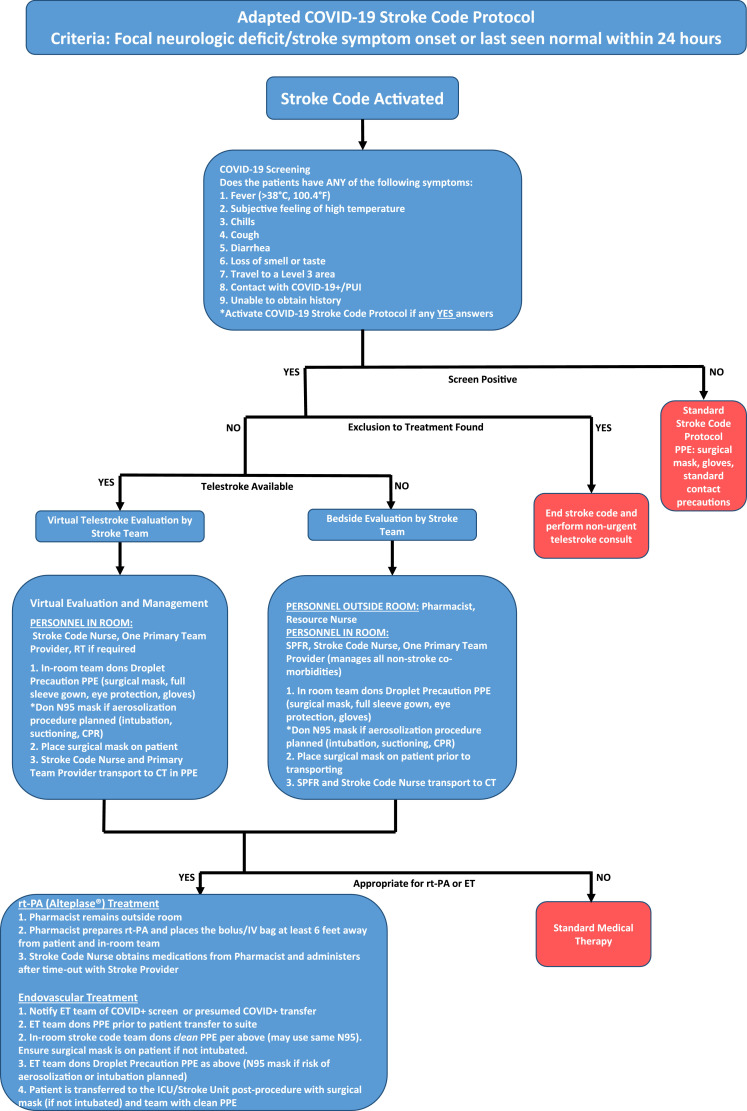
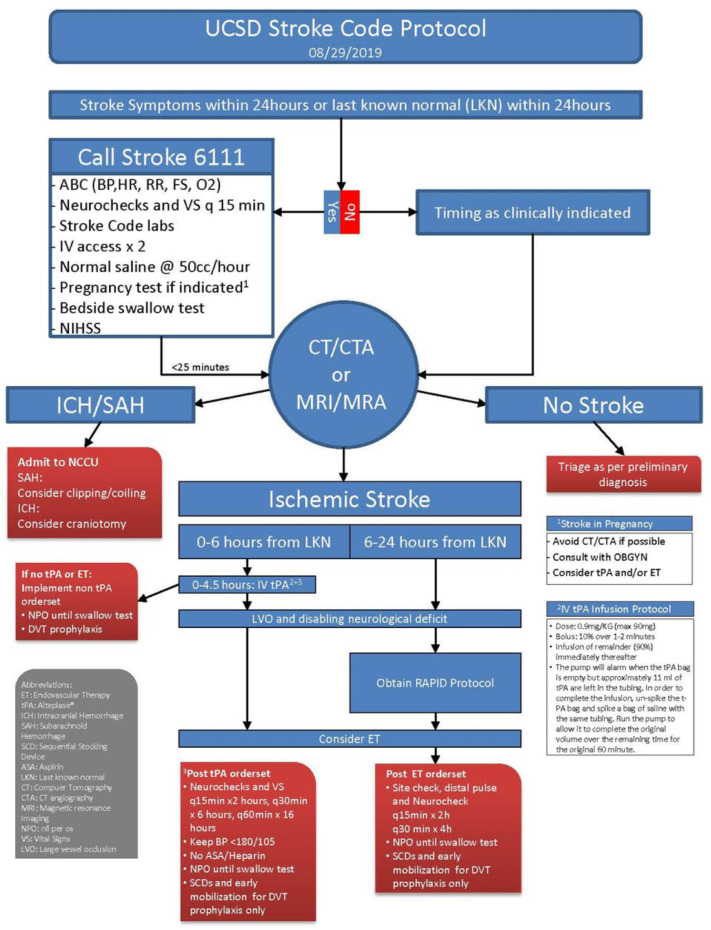
The University of California San Diego (UCSD) Health System encompasses two academic, Comprehensive Stroke Centers (CSCs). The UCSD Stroke Center reviewed the national COVID-19 crisis and implications on stroke care. All current resources for stroke care were identified and adapted to include COVID-19 screening. The adjusted model focused on comprehensive and rapid acute stroke treatment, reduction of exposure to the healthcare team, and preservation of PPE.
The adjusted pathways implement telestroke assessments as a specific option for all inpatient and outpatient encounters and accounts for when telemedicine systems are not available or functional. COVID screening is done on all stroke patients. We outline a model of hyperacute stroke evaluation in an adapted stroke code protocol and novel methods of stroke patient management.
The overall goal of the model is to preserve patient access and outcomes while decreasing potential COVID-19 exposure to patients and healthcare providers. This model also serves to reduce the use of vital PPE. It is critical that stroke providers share best practices via academic and vetted social media platforms for rapid dissemination of tools and care models during the COVID-19 crisis.
COVID-19 大流行要求对超急性中风护理(包括中风代码通道)和医院中风管理进行调整。在降低 COVID-19 暴露风险、保护医护人员和保护个人防护设备(PPE)供应的同时,仍然需要为急性中风患者提供快速和全面的评估。虽然 COVID 感染通常不是主要的脑血管疾病,但这一大流行的后续影响迫使我们调整中风护理路径,以维持中风患者的最佳预后。
加利福尼亚大学圣地亚哥分校(UCSD)医疗系统包括两个学术性综合中风中心(CSC)。UCSD 中风中心审查了国家 COVID-19 危机及其对中风护理的影响。确定了所有中风护理的现有资源,并进行了调整,以纳入 COVID-19 筛查。调整后的模型侧重于全面快速的急性中风治疗、减少医护人员的暴露以及保护 PPE。
调整后的路径将远程中风评估作为所有住院和门诊患者的特定选择,并考虑到远程医疗系统不可用或无法正常运行的情况。对所有中风患者进行 COVID 筛查。我们概述了在适应性中风代码方案中进行超急性中风评估的模型,以及中风患者管理的新方法。
该模型的总体目标是在降低患者和医护人员潜在 COVID-19 暴露风险的同时,保持患者的可及性和预后。该模型还有助于减少宝贵 PPE 的使用。中风提供者通过学术和经过审查的社交媒体平台分享最佳实践,以在 COVID-19 危机期间快速传播工具和护理模式,这一点至关重要。