Department of Epidemiology and Biostatistics, School of Public Health, Peking University Health Science Center, Beijing, 100191, China.
Department of Neurology, Xuanwu Hospital, Capital Medical University, NO.45 Changchun Street, Xicheng District, Beijing, 100053, China.
J Thromb Thrombolysis. 2021 Nov;52(4):1047-1055. doi: 10.1007/s11239-021-02385-8. Epub 2021 Apr 26.
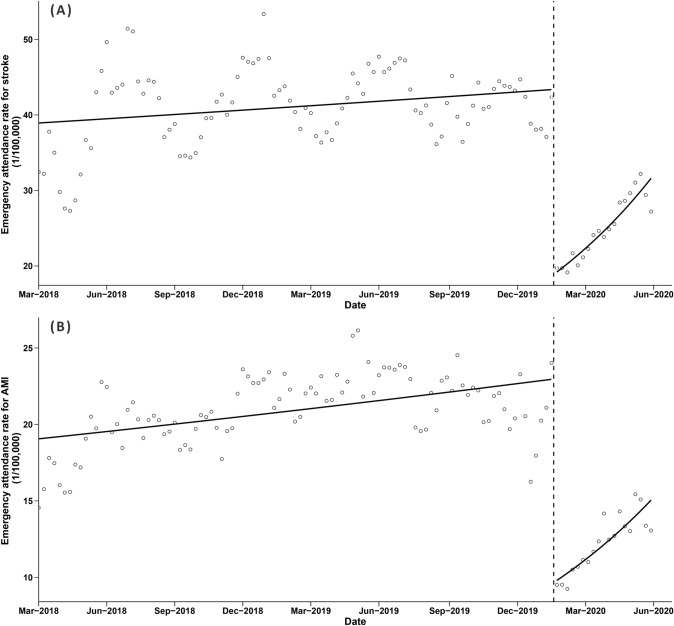
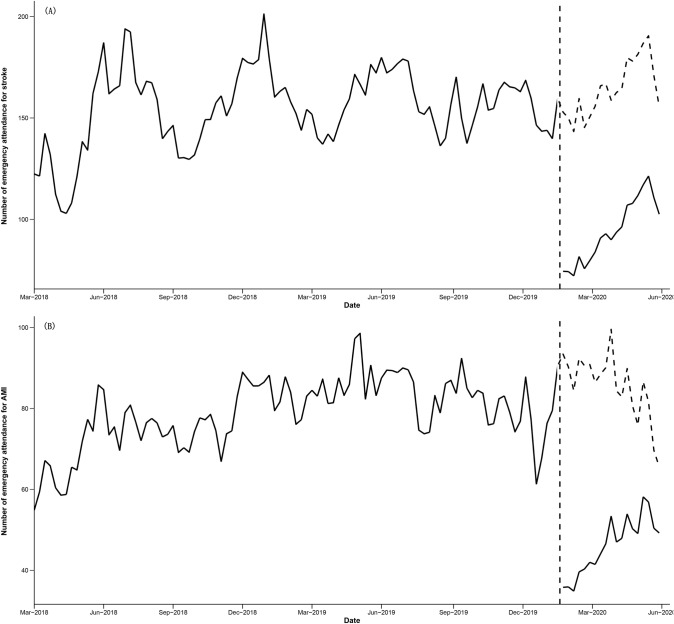
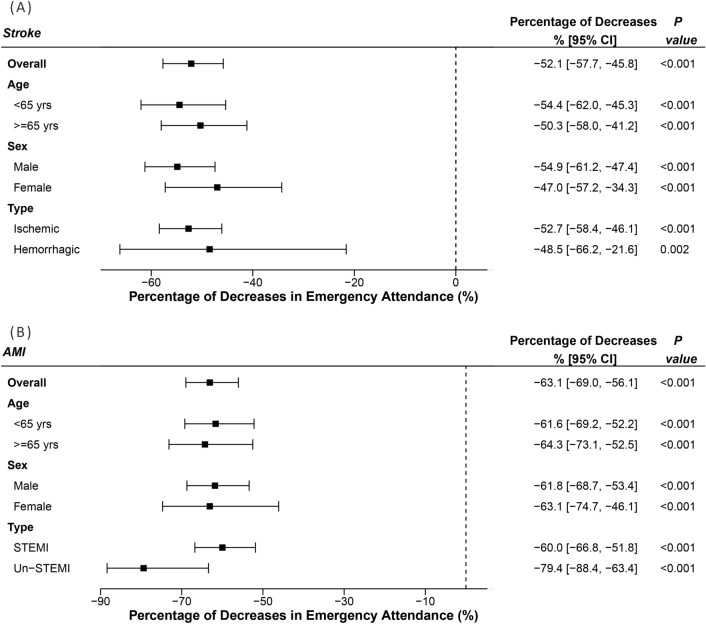
To estimate the impact on emergency attendance for stroke and acute myocardial infarction (AMI) during the pandemic of COVID-19 in Beijing, China. Based on 17,123 and 8693 emergency attendance for stroke and AMI, an interrupted time-series (ITS) study was conducted. Since 01/24/2020, the top two levels of regulations on major public health have been implemented in Beijing. This study covered from 03/01/2018 to 06/03/2020, including 19 weeks of lockdown period and 99 weeks before. A segmented Poisson regression model was used to estimate the immediate change and the monthly change in the secular trend of the emergency attendance rates. The emergency attendance rates of stroke and AMI cut in half at the beginning of the lockdown period, with 52.1% (95% CI 45.8% to 57.7%) and 63.1% (95% CI 56.1% to 63.1%) immediate decreases for stroke and AMI, respectively. Then during the lockdown period, 7.0% (95% CI 2.5%, 11.6%) and 16.1% (95% CI 9.5, 23.1) increases per month in the secular trends of emergency attendance rates were shown for stroke and AMI, respectively. Though the accelerated increasing rates, there were estimated 1335 and 747 patients with stroke and AMI without seeking emergency medical aid during the lockdown, respectively. The emergency attendance for stroke and AMI cut in half at the beginning of the pandemic then had gradual restoration thereafter. The results hint the need for more engagement and communications with all stakeholders to reduce the negative impact on CVD emergency medical services during the crisis.
为了评估 2019 年冠状病毒病(COVID-19)大流行期间北京地区脑卒中与急性心肌梗死(AMI)急诊就诊的影响。基于 17123 例和 8693 例脑卒中与 AMI 的急诊就诊数据,采用中断时间序列(ITS)研究。自 2020 年 1 月 24 日起,北京实施了针对重大突发公共卫生事件的最高级别防控措施。本研究涵盖了 2018 年 3 月 1 日至 2020 年 6 月 3 日,共 19 周的封锁期和 99 周的封锁前。采用分段泊松回归模型来估计封锁期开始时急诊就诊率的即时变化和季节性趋势的每月变化。封锁期开始时,脑卒中与 AMI 的急诊就诊率下降一半,脑卒中与 AMI 的即时降幅分别为 52.1%(95%CI:45.8%57.7%)和 63.1%(95%CI:56.1%63.1%)。然后,在封锁期间,脑卒中与 AMI 的季节性趋势每月分别增加 7.0%(95%CI:2.5%11.6%)和 16.1%(95%CI:9.5%23.1%)。尽管增长率加快,但估计仍有 1335 例和 747 例脑卒中与 AMI 患者在封锁期间未寻求紧急医疗救助。大流行开始时,脑卒中与 AMI 的急诊就诊率下降一半,此后逐渐恢复。研究结果提示,在危机期间,需要与所有利益相关者进行更多的沟通与合作,以减少对心血管疾病急诊医疗服务的负面影响。