College of Physical Education and Sports, Beijing Normal University, Beijing, China.
Institute of Developmental Psychology, Beijing Normal University, Beijing, China.
BMC Public Health. 2021 Mar 19;21(1):542. doi: 10.1186/s12889-021-10584-4.
Influence of migration on externalized behavioral problems (e.g., aggressive) among adolescents has been well assessed, yet lifestyle behaviors of migrant, left-behind and local adolescents have been largely overlooked by researchers and policy-makers. Therefore, this study aimed to identify clustering of multiple lifestyle behaviors and their associations with migrant status among Chinese adolescents.
A cross-sectional survey was conducted in 2015 in Beijing, and Wuhu city (Anhui province). Adolescents self-reported age, gender, family economic status, migrant situation, and lifestyle behaviors (i.e., physical activity, screen time, sleep, smoke, soft-drink, alcohol, fruit and vegetable consumption) via a battery of validated questionnaires. Latent class analysis was conducted to identify behavioral clusters using Mplus 7.1. ANOVA, and multivariable logistic regression were used to examine associations between migrant situations and behavioral clusters using SPSS 22.
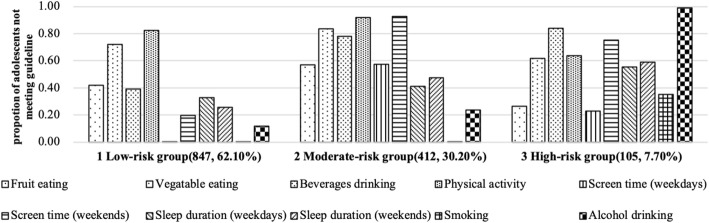
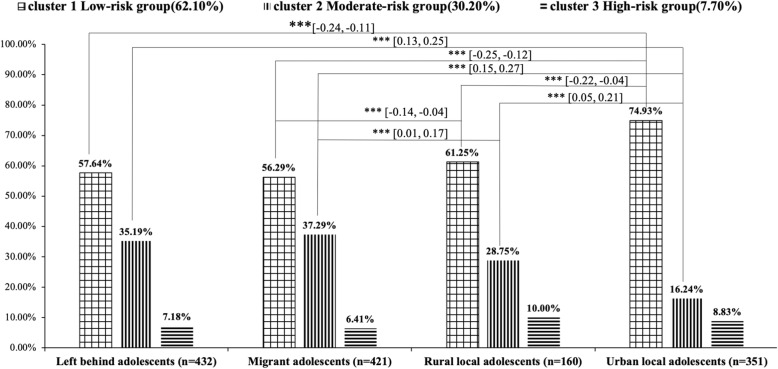
Three distinct behavioral clusters were exhibited among 1364 students (mean age: 13.41 ± 0.84 years): "low risk" (N = 847), "moderate risk" (N = 412) and "high risk" (N = 105). The "high-risk" cluster had the highest prevalence of adolescents not meeting healthy behavioral recommendations. There were no significant differences in the prevalence of high-risk lifestyle among migrant, left-behind, rural local and urban local adolescents. But migrant adolescents had the lowest prevalence of low-risk lifestyle, followed by left-behind, rural and urban local adolescents. Moreover, compared with urban local, migrant (OR = 2.72, 95%CI: 1.88,3.94), left-behind (OR = 2.28, 95%CI: 1.46, 3.55), and rural local (OR = 1.76, 95%CI:1.03,3.01) adolescents had a higher risk of moderate-risk lifestyle.
Clustering of assessed lifestyle behaviors differed by the migrant status. Particularly, migrant and left-behind adolescents were more likely to have moderate-risk lifestyle compared with their counterparts. Interventions that promote moderate to vigorous physical activity and consumption of fruits and vegetables simultaneously are needed among them.
移民对青少年外化行为问题(如攻击性)的影响已得到充分评估,但移民、留守和本地青少年的生活方式行为在很大程度上被研究人员和政策制定者忽视。因此,本研究旨在确定中国青少年多种生活方式行为的聚类及其与移民身份的关系。
2015 年在北京和安徽省芜湖市进行了一项横断面调查。青少年通过一系列经过验证的问卷自我报告年龄、性别、家庭经济状况、移民情况和生活方式行为(即体力活动、屏幕时间、睡眠、吸烟、软饮料、酒精、水果和蔬菜摄入)。使用 Mplus 7.1 进行潜在类别分析,使用 SPSS 22 进行方差分析和多变量逻辑回归,以检验移民情况与行为聚类之间的关联。
在 1364 名学生中(平均年龄:13.41±0.84 岁)表现出三种不同的行为聚类:“低风险”(N=847)、“中风险”(N=412)和“高风险”(N=105)。“高风险”类别的青少年最不符合健康行为建议。移民、留守、农村本地和城市本地青少年中,高风险生活方式的流行率没有显著差异。但移民青少年的低风险生活方式流行率最低,其次是留守、农村和城市本地青少年。此外,与城市本地青少年相比,移民(OR=2.72,95%CI:1.88,3.94)、留守(OR=2.28,95%CI:1.46,3.55)和农村本地(OR=1.76,95%CI:1.03,3.01)青少年有更高的中等风险生活方式风险。
评估的生活方式行为聚类因移民身份而异。特别是,与同龄人相比,移民和留守青少年更有可能拥有中等风险的生活方式。需要针对他们同时开展促进中等到剧烈体力活动和水果及蔬菜摄入的干预措施。