Van Hoecke Lien, Verbeke Rein, De Vlieger Dorien, Dewitte Heleen, Roose Kenny, Van Nevel Sharon, Krysko Olga, Bachert Claus, Schepens Bert, Lentacker Ine, Saelens Xavier
VIB-UGent Center for Medical Biotechnology, VIB, 9000 Ghent, Belgium; Department of Biomedical Molecular Biology, Ghent University, 9000 Ghent, Belgium.
Laboratory of General Biochemistry & Physical Pharmacy, Ghent University, 9000 Ghent, Belgium; Cancer Research Institute Ghent, 9000 Ghent, Belgium.
Mol Ther Nucleic Acids. 2020 Jun 5;20:777-787. doi: 10.1016/j.omtn.2020.04.015. Epub 2020 May 1.
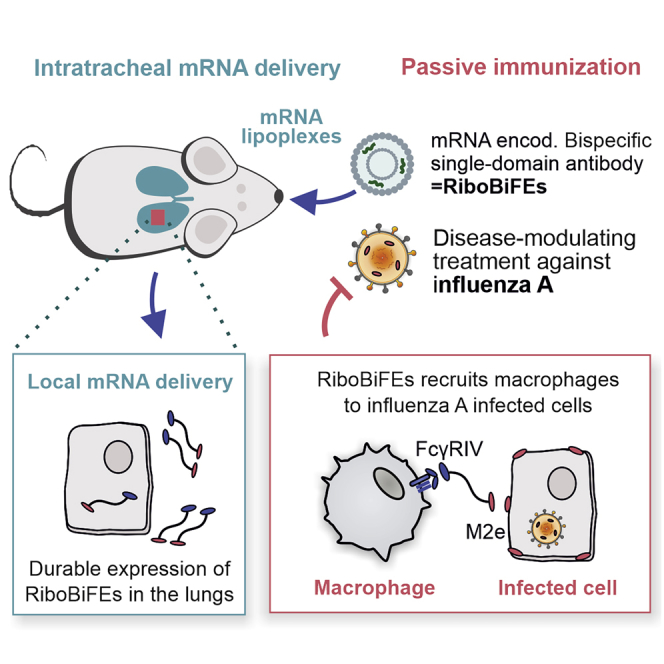
To date, mRNA-based biologics have mainly been developed for prophylactic and therapeutic vaccination to combat infectious diseases or cancer. In the past years, optimization of the characteristics of in vitro transcribed mRNA has led to significant reduction of the inflammatory responses. Thanks to this, mRNA therapeutics have entered the field of passive immunization. Here, we established an mRNA treatment that is based on mRNA that codes for a bispecific single-domain antibody construct that can selectively recruit innate immune cells to cells infected with influenza A virus. The constructs consist of a single-domain antibody that binds to the ectodomain of the conserved influenza A matrix protein 2, while the other single-domain antibody binds to the activating mouse Fcγ receptor IV. Formulating the mRNA into DOTAP (1,2-dioleoyl-3-trimethylammonium-propane)/cholesterol nanoparticles and delivering these intratracheally to mice allowed the production of the bispecific single-domain antibody in the lungs, and administration of these mRNA-particles prior to influenza A virus infection was associated with a significant reduction in viral titers and a reduced morbidity in mice. Overall, our data provide evidence that the local delivery of mRNA encoding a bispecific single-domain antibody format in the lungs could be a promising pulmonary antiviral prophylactic treatment.
迄今为止,基于mRNA的生物制剂主要用于预防性和治疗性疫苗接种,以对抗传染病或癌症。在过去几年中,体外转录mRNA特性的优化已导致炎症反应显著减少。因此,mRNA疗法已进入被动免疫领域。在此,我们建立了一种基于mRNA的治疗方法,该mRNA编码一种双特异性单域抗体构建体,可选择性地将先天免疫细胞募集到感染甲型流感病毒的细胞中。构建体由一个与保守的甲型流感病毒基质蛋白2胞外域结合的单域抗体组成,而另一个单域抗体与活化的小鼠Fcγ受体IV结合。将mRNA制剂化为DOTAP(1,2-二油酰基-3-三甲基铵丙烷)/胆固醇纳米颗粒,并经气管内给药至小鼠,可使肺部产生双特异性单域抗体,在甲型流感病毒感染前给予这些mRNA颗粒与小鼠病毒滴度显著降低和发病率降低相关。总体而言,我们的数据表明,在肺部局部递送编码双特异性单域抗体形式的mRNA可能是一种有前景的肺部抗病毒预防性治疗方法。