Department of Internal Medicine 3, Rheumatology and Immunology, Friedrich Alexander University Erlangen-Nurnberg and Universitätsklinikum Erlangen, Erlangen, Germany.
Nikolaus Fiebiger Center of Molecular Medicine, University of Erlangen- Nuremberg, Erlangen, Germany.
Sci Rep. 2020 May 21;10(1):8428. doi: 10.1038/s41598-020-65305-5.
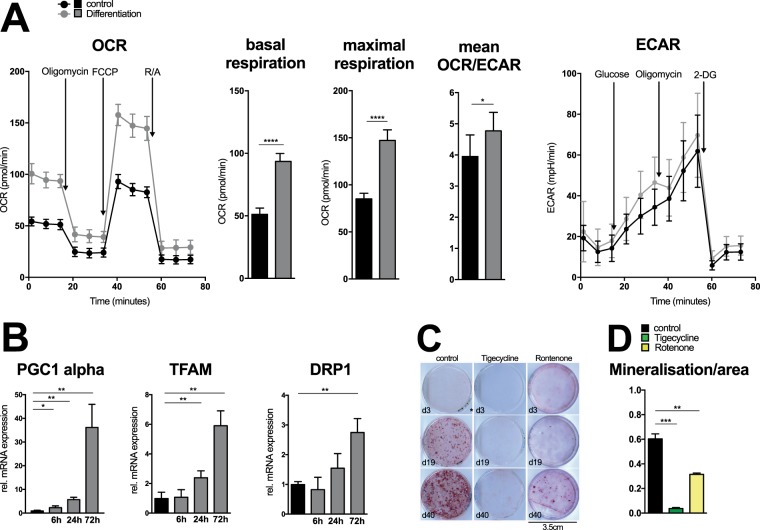
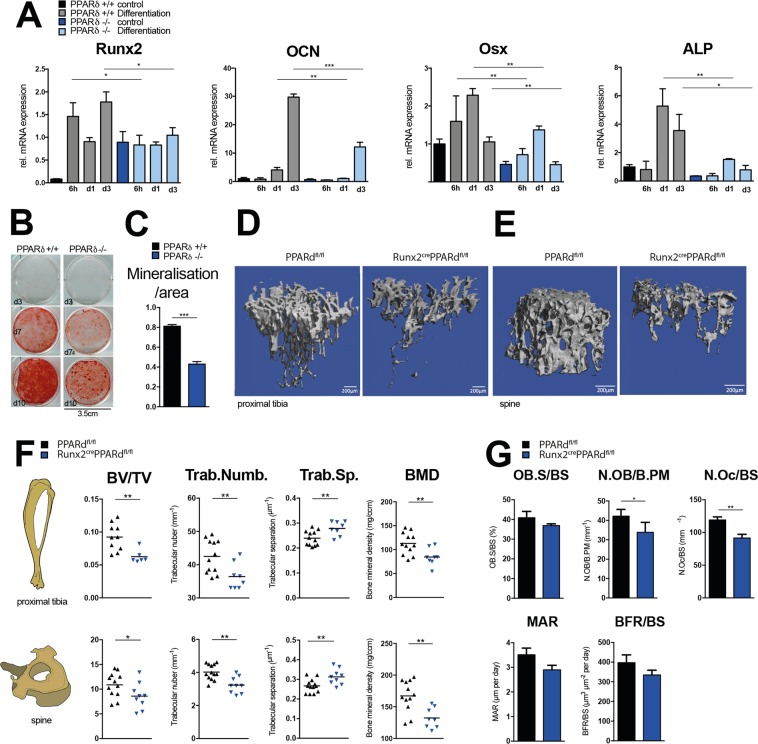
Bone turnover, which is determined by osteoclast-mediated bone resorption and osteoblast-mediated bone formation, represents a highly energy consuming process. The metabolic requirements of osteoblast differentiation and mineralization, both essential for regular bone formation, however, remain incompletely understood. Here we identify the nuclear receptor peroxisome proliferator-activated receptor (PPAR) δ as key regulator of osteoblast metabolism. Induction of PPARδ was essential for the metabolic adaption and increased rate in mitochondrial respiration necessary for the differentiation and mineralization of osteoblasts. Osteoblast-specific deletion of PPARδ in mice, in turn, resulted in an altered energy homeostasis of osteoblasts, impaired mineralization and reduced bone mass. These data show that PPARδ acts as key regulator of osteoblast metabolism and highlight the relevance of cellular metabolic rewiring during osteoblast-mediated bone formation and bone-turnover.
骨转换由破骨细胞介导的骨吸收和成骨细胞介导的骨形成决定,代表了一个高度耗能的过程。然而,对于成骨细胞分化和矿化所必需的代谢需求,仍不完全了解。在这里,我们确定核受体过氧化物酶体增殖物激活受体 (PPAR) δ 为成骨细胞代谢的关键调节剂。PPARδ 的诱导对于代谢适应和增加线粒体呼吸速率是必需的,这对于成骨细胞的分化和矿化是必要的。反过来,在小鼠中成骨细胞特异性缺失 PPARδ 会导致成骨细胞的能量稳态发生改变、矿化受损和骨量减少。这些数据表明,PPARδ 作为成骨细胞代谢的关键调节剂发挥作用,并强调了在成骨细胞介导的骨形成和骨转换过程中细胞代谢重编程的相关性。