Rocha Ricardo, López-Baucells Adrià, Farneda Fábio Z, Ferreira Diogo F, Silva Inês, Acácio Marta, Palmeirim Jorge M, Meyer Christoph F J
Centre for Ecology, Evolution and Environmental Changes, Faculty of Sciences, University of Lisbon, Lisbon, 1749-016, Portugal.
Biological Dynamics of Forest Fragments Project, National Institute for Amazonian Research and Smithsonian Tropical Research Institute, Manaus, 69011-970, Brazil.
Curr Zool. 2020 Apr;66(2):145-153. doi: 10.1093/cz/zoz042. Epub 2019 Sep 5.
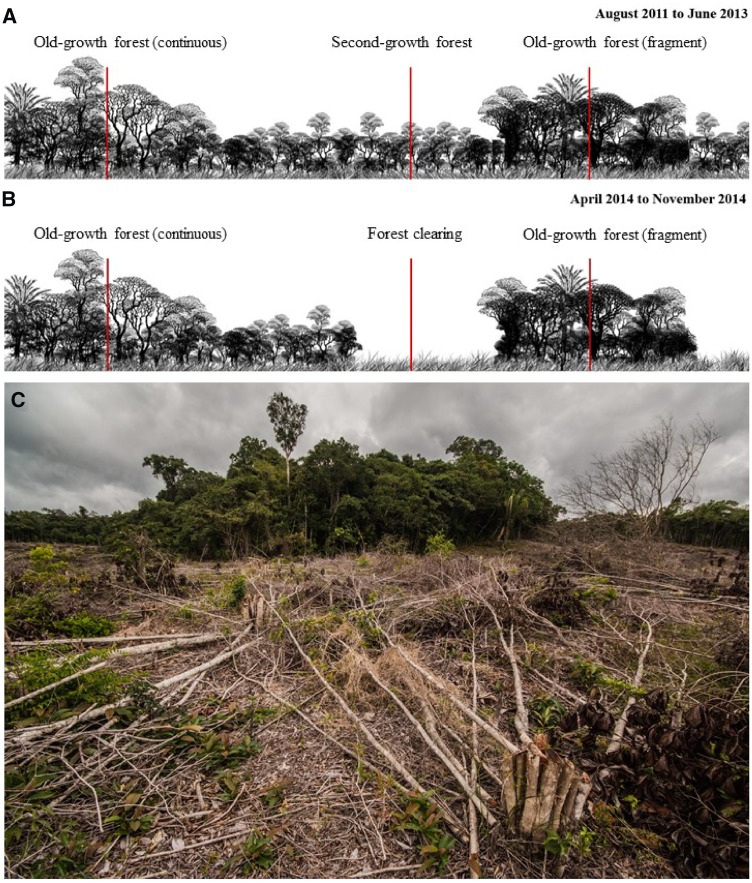
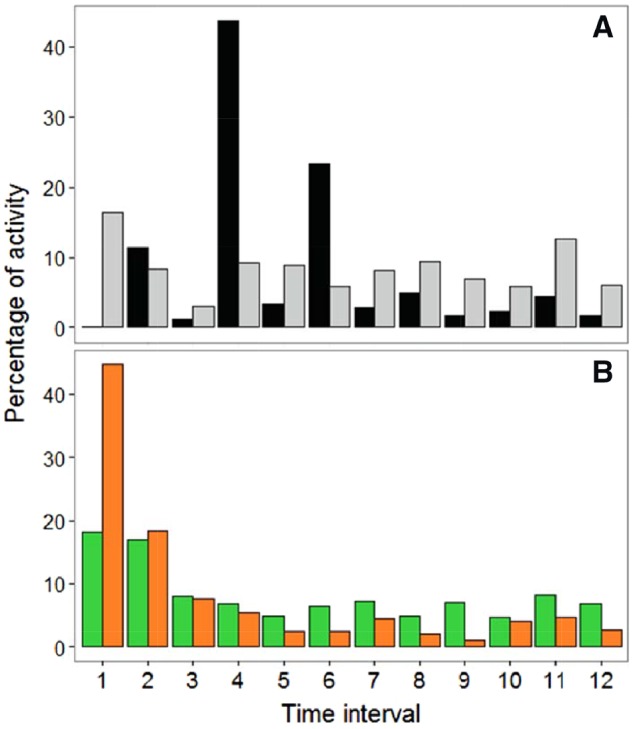
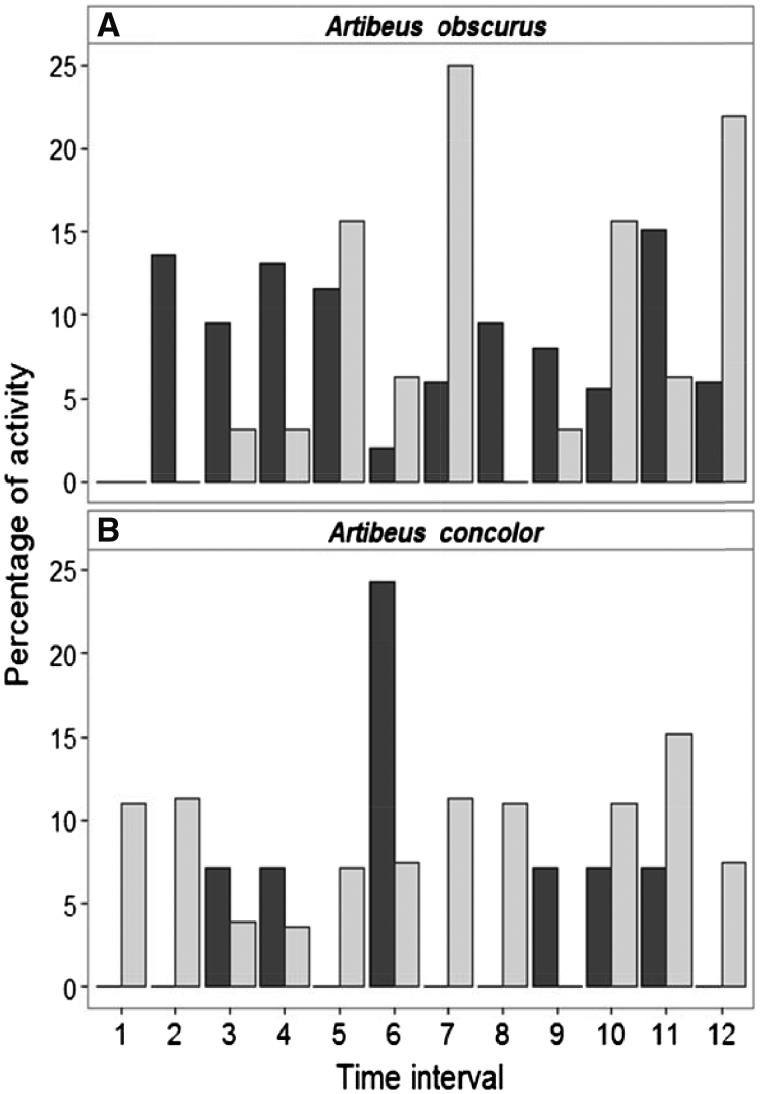
Secondary forests and human-made forest gaps are conspicuous features of tropical landscapes. Yet, behavioral responses to these aspects of anthropogenically modified forests remain poorly investigated. Here, we analyze the effects of small human-made clearings and secondary forests on tropical bats by examining the guild- and species-level activity patterns of phyllostomids sampled in the Central Amazon, Brazil. Specifically, we contrast the temporal activity patterns and degree of temporal overlap of 6 frugivorous and 4 gleaning animalivorous species in old-growth forest and second-growth forest and of 4 frugivores in old-growth forest and forest clearings. The activity patterns of frugivores and gleaning animalivores did not change between old-growth forest and second-growth, nor did the activity patterns of frugivores between old-growth forest and clearings. However, at the species level, we detected significant differences for (old-growth forest vs. second-growth) and (old-growth forest vs. clearings). The degree of temporal overlap was greater than random in all sampled habitats. However, for frugivorous species, the degree of temporal overlap was similar between old-growth forest and second-growth; whereas for gleaning animalivores, it was lower in second-growth than in old-growth forest. On the contrary, forest clearings were characterized by increased temporal overlap between frugivores. Changes in activity patterns and temporal overlap may result from differential foraging opportunities and dissimilar predation risks. Yet, our analyses suggest that activity patterns of bats in second-growth and small forest clearings, 2 of the most prominent habitats in humanized tropical landscapes, varies little from the activity patterns in old-growth forest.
次生林和人为造成的林中空地是热带景观的显著特征。然而,对于这些人为改造森林的方面,其行为反应仍未得到充分研究。在此,我们通过研究在巴西亚马逊中部采样的叶口蝠科在群落和物种水平的活动模式,来分析小型人为林中空地和次生林对热带蝙蝠的影响。具体而言,我们对比了6种食果蝠和4种食虫蝠在原始森林和次生林中的时间活动模式以及时间重叠程度,以及4种食果蝠在原始森林和林中空地的情况。食果蝠和食虫蝠的活动模式在原始森林和次生林之间没有变化,食果蝠在原始森林和林中空地之间的活动模式也没有变化。然而,在物种水平上,我们检测到(原始森林与次生林相比)和(原始森林与林中空地相比)存在显著差异。在所有采样栖息地中,时间重叠程度都大于随机水平。然而,对于食果蝠物种,原始森林和次生林之间的时间重叠程度相似;而对于食虫蝠,次生林中的时间重叠程度低于原始森林。相反,林中空地的特征是食果蝠之间的时间重叠增加。活动模式和时间重叠的变化可能是由于不同的觅食机会和不同的捕食风险导致的。然而,我们的分析表明,次生林和小型林中空地(人类化热带景观中最突出的两种栖息地)中蝙蝠的活动模式与原始森林中的活动模式差异不大。