Forest Ecology and Forest Management Group, Wageningen University, P.O. Box 47, 6700 AA Wageningen, Netherlands.
Department of Biology, University of Regina, 3737 Wascana Parkway, Regina, SK S4S 0A2, Canada.
Sci Adv. 2019 Mar 6;5(3):eaau3114. doi: 10.1126/sciadv.aau3114. eCollection 2019 Mar.
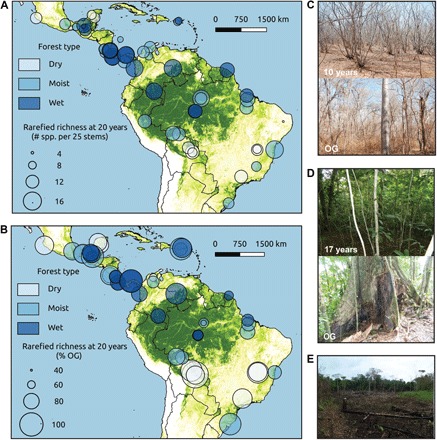
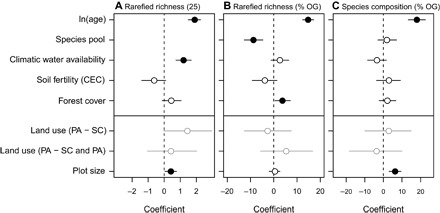
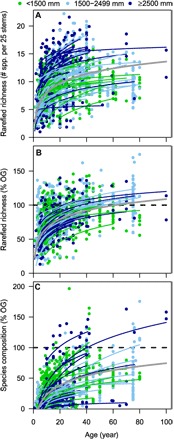
Old-growth tropical forests harbor an immense diversity of tree species but are rapidly being cleared, while secondary forests that regrow on abandoned agricultural lands increase in extent. We assess how tree species richness and composition recover during secondary succession across gradients in environmental conditions and anthropogenic disturbance in an unprecedented multisite analysis for the Neotropics. Secondary forests recover remarkably fast in species richness but slowly in species composition. Secondary forests take a median time of five decades to recover the species richness of old-growth forest (80% recovery after 20 years) based on rarefaction analysis. Full recovery of species composition takes centuries (only 34% recovery after 20 years). A dual strategy that maintains both old-growth forests and species-rich secondary forests is therefore crucial for biodiversity conservation in human-modified tropical landscapes.
古老的热带森林拥有极其丰富的树种多样性,但正在迅速被砍伐,而在废弃的农田上重新生长的次生林则在不断扩大。我们评估了在前所未有的新热带地区多地点分析中,环境条件和人为干扰梯度下,次生演替过程中树种丰富度和组成的恢复情况。次生林在物种丰富度上恢复得非常快,但在物种组成上恢复得非常慢。基于稀疏分析,次生林需要大约五十年的时间才能恢复到原始森林的物种丰富度(20 年后恢复 80%)。物种组成的完全恢复需要几个世纪的时间(20 年后仅恢复 34%)。因此,维持原始森林和物种丰富的次生林的双重策略对于人类改造的热带景观中的生物多样性保护至关重要。