Hu Guowen, Xia Yuguo, Zhang Juntao, Chen Yu, Yuan Ji, Niu Xin, Zhao Bizeng, Li Qing, Wang Yang, Deng Zhifeng
Department of Neurosurgery Shanghai Jiaotong University Affiliated Sixth People's Hospital Shanghai 200233 China.
Institute of Microsurgery on Extremities Shanghai Jiaotong University Affiliated Sixth People's Hospital Shanghai 200233 China.
Adv Sci (Weinh). 2020 Mar 20;7(10):1903330. doi: 10.1002/advs.201903330. eCollection 2020 May.
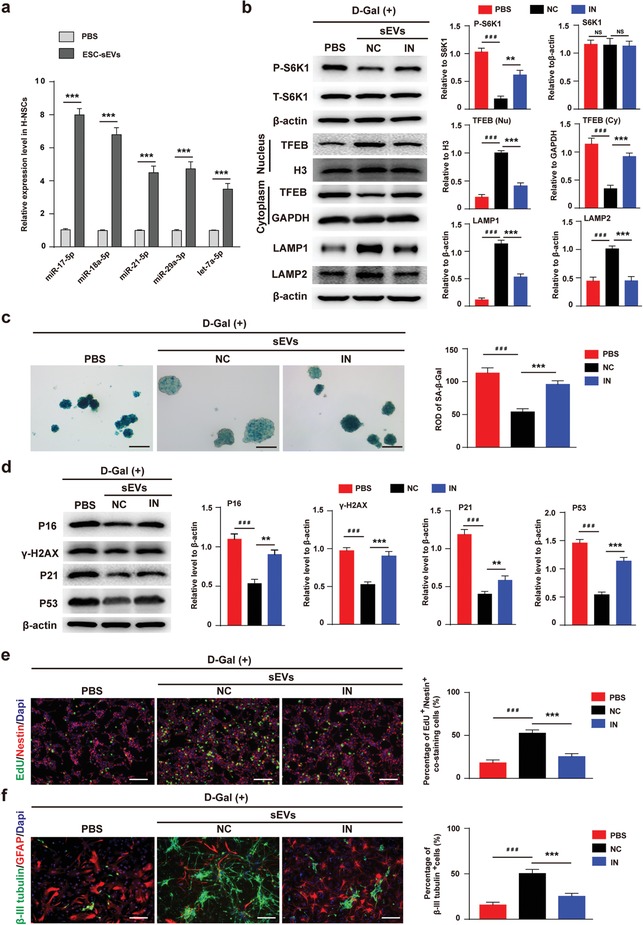
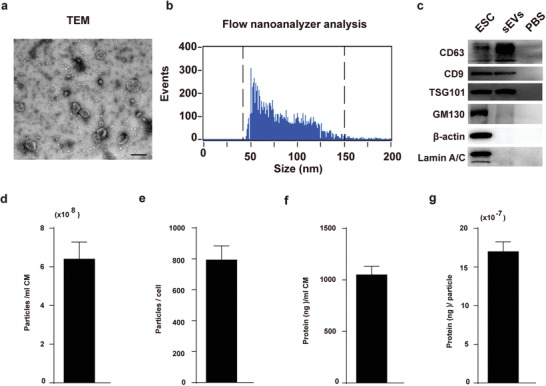
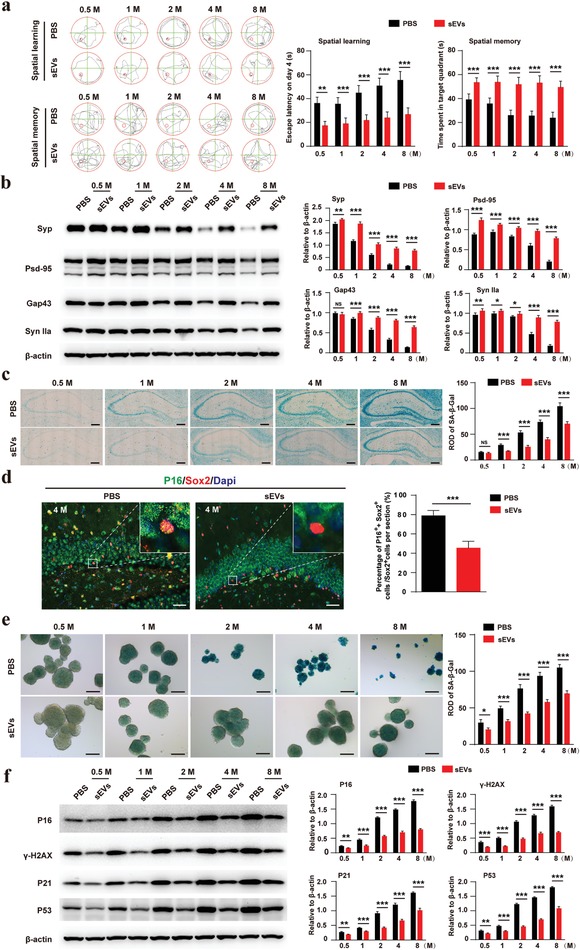
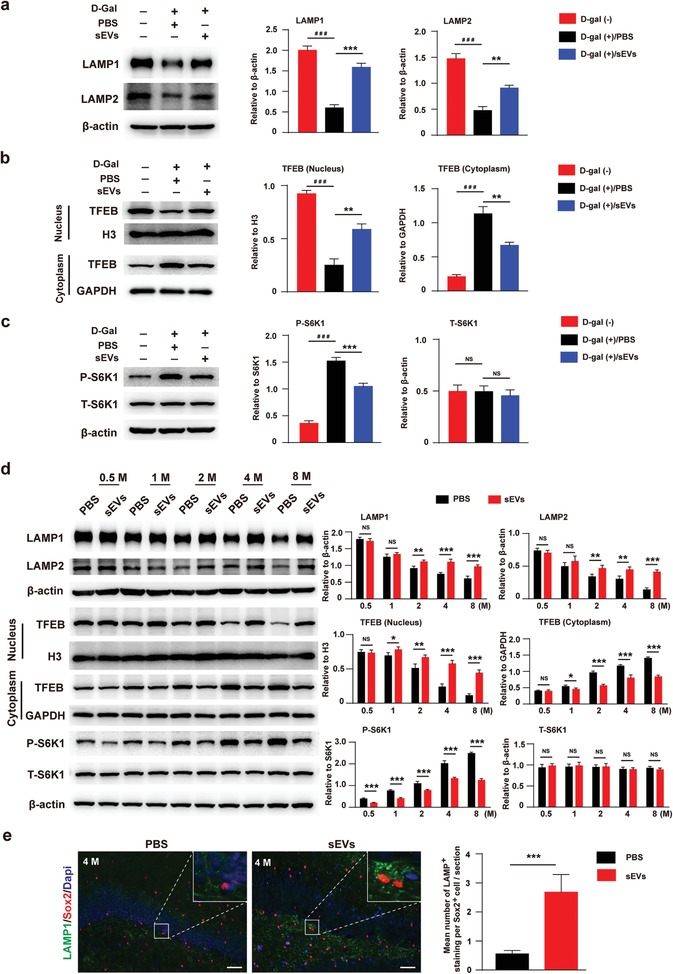
Vascular dementia (VD) is one of the most common types of dementia, however, the intrinsic mechanism is unclear and there is still lack of effective medications. In this study, the VD rats exhibit a progressive cognitive impairment, as well as a time-related increasing in hippocampal neural stem cells (H-NSCs) senescence, lost and neurogenesis decline. Then, embryonic stem cell-derived small extracellular vesicles (ESC-sEVs) are intravenously injected into VD rats. ESC-sEVs treatment significantly alleviates H-NSCs senescence, recovers compromised proliferation and neuron differentiation capacity, and reverses cognitive impairment. By microarray analysis and RT-qPCR it is identified that several miRNAs including miR-17-5p, miR-18a-5p, miR-21-5p, miR-29a-3p, and let-7a-5p, that can inhibit mTORC1 activation, exist in ESC-sEVs. ESC-sEVs rejuvenate H-NSCs senescence partly by transferring these miRNAs to inhibit mTORC1 activation, promote transcription factor EB (TFEB) nuclear translocation and lysosome resumption. Taken together, these data indicate that H-NSCs senescence cause cell depletion, neurogenesis reduction, and cognitive impairment in VD. ESC-sEVs treatment ameliorates H-NSCs senescence by inhibiting mTORC1 activation, and promoting TFEB nuclear translocation and lysosome resumption, thereby reversing senescence-related neurogenesis dysfunction and cognitive impairment in VD. The application of ESC-sEVs may be a novel cell-free therapeutic tool for patients with VD, as well as other aging-related diseases.
血管性痴呆(VD)是最常见的痴呆类型之一,然而其内在机制尚不清楚,且仍然缺乏有效的药物。在本研究中,VD大鼠表现出进行性认知障碍,以及海马神经干细胞(H-NSCs)衰老、丢失和神经发生减少的时间相关性增加。然后,将胚胎干细胞衍生的小细胞外囊泡(ESC-sEVs)静脉注射到VD大鼠体内。ESC-sEVs治疗可显著减轻H-NSCs衰老,恢复受损的增殖和神经元分化能力,并逆转认知障碍。通过微阵列分析和RT-qPCR鉴定出ESC-sEVs中存在几种可抑制mTORC1激活的miRNA,包括miR-17-5p、miR-18a-5p、miR-21-5p、miR-29a-3p和let-7a-5p。ESC-sEVs通过传递这些miRNA抑制mTORC1激活、促进转录因子EB(TFEB)核转位和溶酶体恢复,从而部分恢复H-NSCs衰老。综上所述,这些数据表明H-NSCs衰老导致VD中的细胞耗竭、神经发生减少和认知障碍。ESC-sEVs治疗通过抑制mTORC1激活、促进TFEB核转位和溶酶体恢复来改善H-NSCs衰老,从而逆转VD中与衰老相关的神经发生功能障碍和认知障碍。ESC-sEVs的应用可能是VD患者以及其他衰老相关疾病的一种新型无细胞治疗工具。