Division of Gastroenterology, Hepatology and Nutrition, Cincinnati Children's Hospital Medical Center.
Department of Pediatrics, University of Cincinnati College of Medicine.
J Pediatr Gastroenterol Nutr. 2020 Jun;70(6):e129-e135. doi: 10.1097/MPG.0000000000002666.
The accuracy of different bioelectrical impedance analysis (BIA) devices for assessing body composition in children with obesity is unclear. We determined the relative accuracy of 2 BIA devices compared to dual x-ray absorptiometry (DXA) in obese and severely obese children.
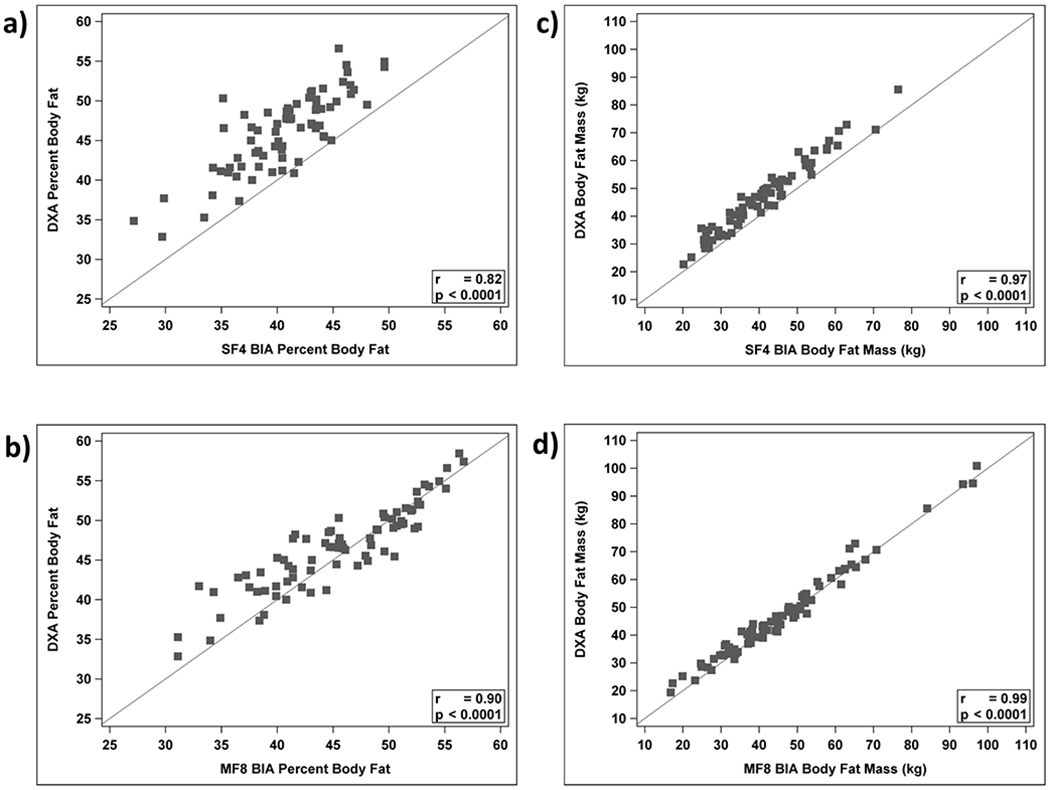
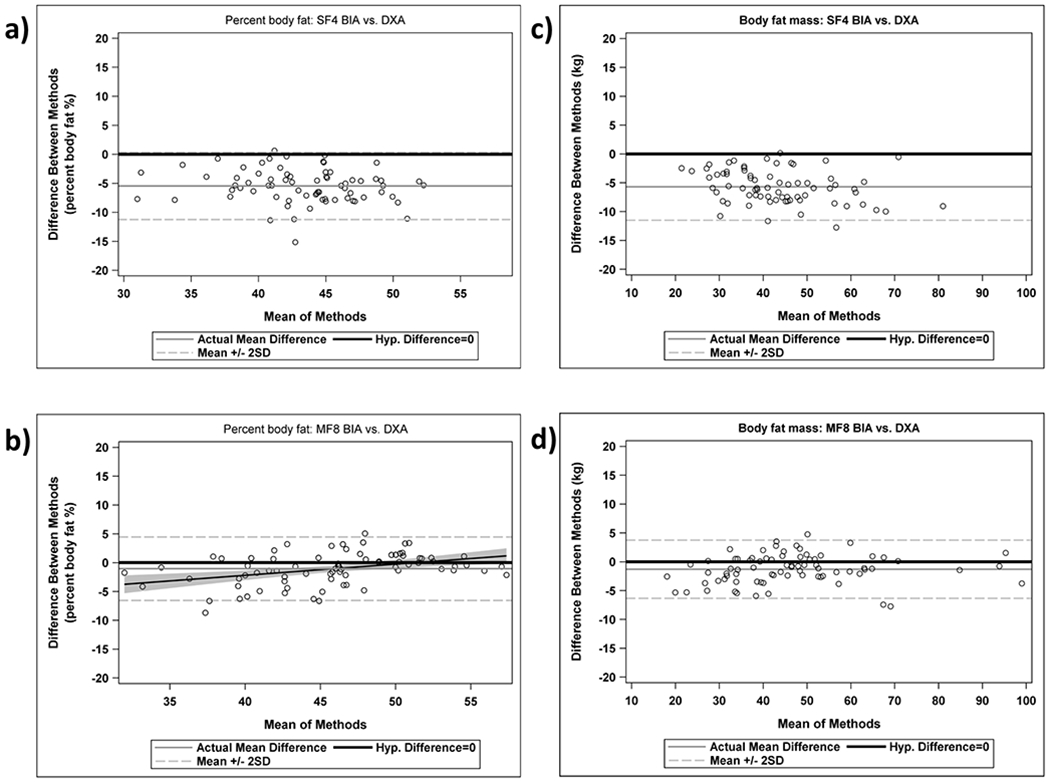
We measured body composition in a cross-sectional study of 78 obese children by a handheld single frequency tetrapolar BIA device (Omron), a stationary multifrequency octopolar BIA device (InBody 370) and DXA. Intermethod agreement was assessed by intraclass correlations, paired t tests, and Bland-Altman analyses.
Participants (37% female, age 14.8 ± 2.7 years) had mean (±standard deviation) body mass index of 36.7 ± 7.5 kg/m, body fat percentage of 46.4% ± 5.2%, and appendicular lean mass of 22.5 ± 6.0 kg by DXA. Intraclass correlations with DXA for body fat percentage were 0.39 and 0.87 for single frequency tetrapolar and multifrequency octopolar BIA devices, respectively. The single frequency tetrapolar BIA underestimated body fat percentage by 5.5% ± 2.9% (P < 0.0001). Differences between the multifrequency octopolar BIA and DXA for body fat percentage (-1.1% ± 2.8%) and appendicular lean mass (-0.3 ± 1.4 kg) were small, and 95% limits of agreement were approximately ±5%.
BIA machines vary in relative accuracy in measuring body composition in children who are obese and severely obese. The multifrequency octopolar BIA device accurately estimated body fat percentage and appendicular lean mass relative to DXA and has the advantage of point of care performance.
不同的生物电阻抗分析(BIA)设备评估肥胖儿童身体成分的准确性尚不清楚。我们比较了两种 BIA 设备与双能 X 线吸收法(DXA)在肥胖和重度肥胖儿童中的相对准确性。
我们通过手持式单频四极 BIA 设备(欧姆龙)、台式多频八极 BIA 设备(InBody 370)和 DXA 对 78 名肥胖儿童进行横断面研究,测量身体成分。通过组内相关系数、配对 t 检验和 Bland-Altman 分析评估方法间的一致性。
参与者(女性占 37%,年龄 14.8±2.7 岁)的平均(±标准差)体重指数为 36.7±7.5kg/m²,体脂百分比为 46.4%±5.2%,四肢骨骼肌质量为 22.5±6.0kg,通过 DXA 测量。与 DXA 相比,单频四极 BIA 和多频八极 BIA 设备的体脂百分比的组内相关系数分别为 0.39 和 0.87。单频四极 BIA 设备低估体脂百分比 5.5%±2.9%(P<0.0001)。多频八极 BIA 与 DXA 相比,体脂百分比(-1.1%±2.8%)和四肢骨骼肌质量(-0.3±1.4kg)的差异较小,95%一致性界限约为±5%。
在测量肥胖和重度肥胖儿童身体成分时,BIA 设备的相对准确性存在差异。多频八极 BIA 设备与 DXA 相比,能够准确估计体脂百分比和四肢骨骼肌质量,具有即时检测的优势。