Hawassa College of Health Sciences, Hawassa, Ethiopia.
School of Public Health, Hawassa University, Hawassa, Ethiopia.
Ital J Pediatr. 2020 May 24;46(1):70. doi: 10.1186/s13052-020-00834-3.
Human Immunodeficiency Virus (HIV) infection and low birth weight (LBW) continue to be significant public health concerns in many low-income countries including Ethiopia. Yet the effect of maternal HIV infection on birth weight has not been thoroughly explored and the existing studies reported opposing findings. We examined the association between maternal HIV infection and LBW in a tertiary hospital in Southern Ethiopia.
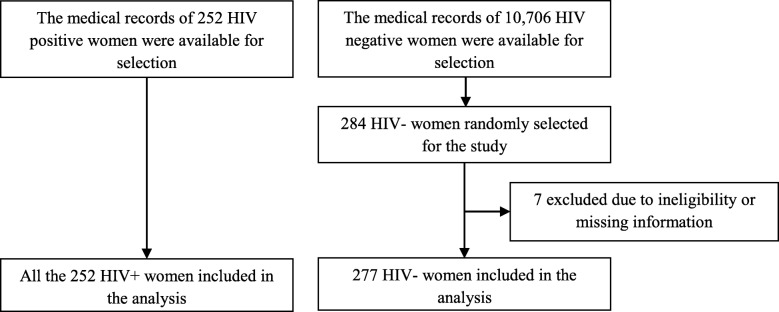
A retrospective cohort study was conducted based on the medical records of 277 HIV-negative and 252 HIV-positive mothers who gave singleton live birth between September 2014 to August 2017 in Hawassa University Comprehensive Specialized Hospital, Southern Ethiopia. The recodes were identified using systematic sampling approach and relevant information were extracted by using pretested extraction form. Multivariable binary logit model was fitted to examine the relationship between the exposure and outcome while adjusting for potential confounders. Adjusted odds ratio (AOR) and 95% confidence intervals (CI) is used for summarizing the findings of the analysis.
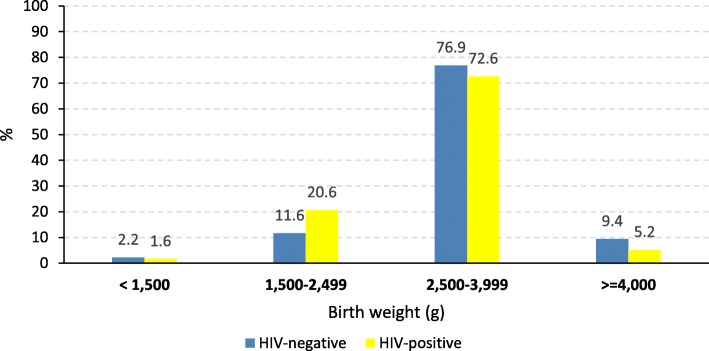
The mean (± standard deviation) birth weight of infants born to HIV-negative women (3.1 ± 0.7 kg) was significantly higher than those born to HIV-positive counterparts (3.0 ± 0.6 kg) (p = 0.020). The prevalence of LBW was also significantly higher in the HIV-exposed group (22.2%) than the non-exposed group (13.7%) (p = 0.011). In the logit model adjusted for multiple covariates, HIV-positive women had four times increased odds than HIV-negative women to give birth to LBW infant(AOR = 4.03, 95% CI: 2.01-8.06). Other significant predictors of LBW were rural place of residence (AOR = 2.04, 95% CI: 1.16-3.60), prenatal anemia (AOR = 3.17, 95% CI: 1.71-5.90), chronic hypertension (AOR = 3.68, 95% CI: 1.10-12.46) and preeclampsia (AOR = 6.80, 95% CI: 3.00-15.38).
Maternal HIV infection is associated with increased odds of LBW. HIV prevention activities are also likely to contribute for the reduction of LBW.
在许多低收入国家,包括埃塞俄比亚,人类免疫缺陷病毒(HIV)感染和低出生体重(LBW)仍然是重大公共卫生问题。然而,HIV 感染对出生体重的影响尚未得到充分探讨,现有研究报告的结果相互矛盾。我们在埃塞俄比亚南部的一家三级医院研究了母婴 HIV 感染与 LBW 之间的关系。
这是一项基于 2014 年 9 月至 2017 年 8 月在 Hawassa 大学综合专科医院分娩的 277 名 HIV 阴性和 252 名 HIV 阳性母亲的医疗记录的回顾性队列研究。采用系统抽样方法识别记录,使用预测试提取表提取相关信息。多变量二项逻辑回归模型用于检查暴露与结局之间的关系,同时调整潜在混杂因素。使用调整后的优势比(AOR)和 95%置信区间(CI)总结分析结果。
HIV 阴性母亲所生婴儿的平均(±标准差)出生体重(3.1±0.7kg)明显高于 HIV 阳性母亲所生婴儿(3.0±0.6kg)(p=0.020)。HIV 暴露组的 LBW 发生率也明显高于非暴露组(22.2%比 13.7%)(p=0.011)。在调整了多个协变量的逻辑回归模型中,HIV 阳性母亲分娩 LBW 婴儿的几率是非 HIV 阴性母亲的四倍(AOR=4.03,95%CI:2.01-8.06)。LBW 的其他显著预测因素包括农村居住地(AOR=2.04,95%CI:1.16-3.60)、产前贫血(AOR=3.17,95%CI:1.71-5.90)、慢性高血压(AOR=3.68,95%CI:1.10-12.46)和子痫前期(AOR=6.80,95%CI:3.00-15.38)。
母婴 HIV 感染与 LBW 发生的几率增加有关。HIV 预防活动也可能有助于降低 LBW。