Worku Workie Zemene, Azale Telake, Ayele Tadesse Awoke, Mekonnen Dawit Kassahun
Department of Community Health Nursing, School of Nursing, College of Medicine and Health Sciences, University of Gondar, Gondar, Ethiopia.
Department of Health Education and Behavioural Sciences, Institute of Public Health, College of Medicine and Health Sciences, University of Gondar, Gondar, Ethiopia.
Int J Womens Health. 2022 Sep 23;14:1405-1423. doi: 10.2147/IJWH.S382685. eCollection 2022.
Human immunodeficiency virus (HIV) has remained to be a significant public health problem worldwide mainly affecting women. Despite a 2 to 3 times higher risk of adverse pregnancy outcomes, around 2 million HIV positive women give birth each year globally. However, there is a dearth of evidences in Ethiopia about the effect of maternal HIV infection on pregnancy outcomes where adverse birth outcomes are still a significant health problem. This study is, therefore, aimed to examine the effect of HIV on the risk of adverse pregnancy outcomes in Amhara Regional State, Ethiopia.
A prospective cohort study was conducted among 704 pregnant women (352 women with HIV and 352 women without HIV infection). Systematic random sampling technique was employed to select the study participants. Data on socio-demographic, obstetric, clinical, as well as behavioral and psychosocial characteristics were collected using a validated tool. Data on the outcome variables were also collected following delivery. Modified Poisson regression was employed to estimate the relative risk (RR) of HIV on low birth weight (LBW), preterm birth, and still birth at 95% confidence level. Attributable fraction (AF) was used to report the impact of HIV infection on pregnancy outcomes.
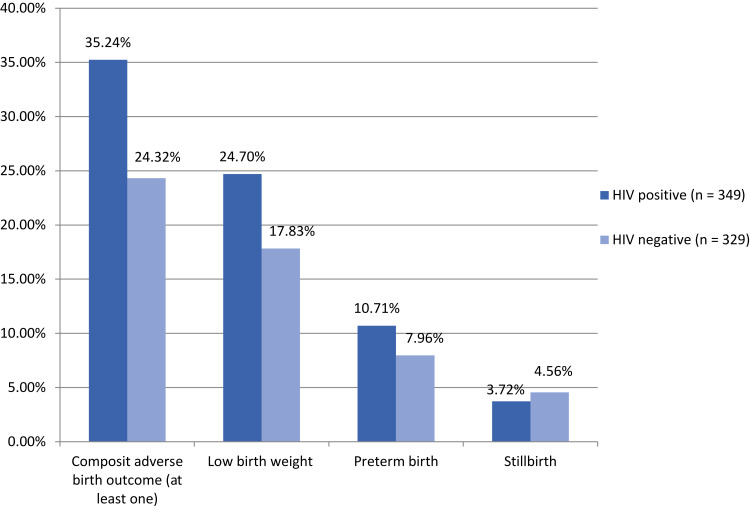
Of the total 704 pregnant women enrolled for the study, 96.3% (678) completed the study. The mean age of the study participants was 30.8 (SD ± 5.4) for HIV positive and 27 (SD ± 5.4) for HIV negative women. The cumulative incidence of low birth weight, preterm birth, and stillbirth were 21.4%, 9.4%, and 4.1%, respectively. The incidence of LBW was 24.7% among HIV positive and 17.8% among HIV negative women. The incidence of preterm birth was 10.7% among HIV positive and 7.9% among HIV negative women. And the incidence of stillbirth was 3.7% and 4.6% among HIV positive and those HIV negative women. New-borns from women with HIV infection had a higher risk of low birth weight and preterm birth than those HIV negative women (Adjusted Relative Risk (ARR) = 1.47; 95% CI: 1.06-2.03) and (ARR = 1.74; 95% CI: 1.08-2.79), respectively. The attributable risk of HIV on low birth weight was 32% (Attributable Fraction (AF) = 32%, 95% CI: 23-46%), and 43% (AF = 43%, 95% CI: 23-46%) for preterm birth.
Maternal HIV infection increased the risk of low birth weight and preterm birth. This implies due attention is required while providing maternal health services primarily antenatal care and delivery services. These services should be aimed at reducing adverse pregnancy outcomes with more attention given to women with HIV infection. Moreover, reinforcement of HIV prevention intervention strategies should be considered at all levels.
人类免疫缺陷病毒(HIV)仍然是全球一个重大的公共卫生问题,主要影响女性。尽管不良妊娠结局的风险高出2至3倍,但全球每年仍有大约200万HIV阳性女性分娩。然而,在埃塞俄比亚,关于孕产妇HIV感染对妊娠结局的影响缺乏证据,而不良分娩结局仍是一个重大的健康问题。因此,本研究旨在探讨HIV对埃塞俄比亚阿姆哈拉州不良妊娠结局风险的影响。
对704名孕妇(352名HIV阳性女性和352名未感染HIV的女性)进行了一项前瞻性队列研究。采用系统随机抽样技术选择研究参与者。使用经过验证的工具收集有关社会人口学、产科、临床以及行为和心理社会特征的数据。分娩后还收集了结局变量的数据。采用修正泊松回归在95%置信水平下估计HIV对低出生体重、早产和死产的相对风险(RR)。归因分数(AF)用于报告HIV感染对妊娠结局的影响。
在纳入研究的704名孕妇中,96.3%(678名)完成了研究。HIV阳性女性研究参与者的平均年龄为30.8岁(标准差±5.4),HIV阴性女性为27岁(标准差±5.4)。低出生体重儿、早产儿和死产儿的累积发病率分别为21.4%、9.4%和4.1%。HIV阳性女性中低出生体重儿的发病率为24.7%,HIV阴性女性中为17.8%。HIV阳性女性中早产率为10.7%,HIV阴性女性中为7.9%。HIV阳性女性和HIV阴性女性中的死产率分别为3.7%和4.6%。感染HIV的女性所生新生儿出现低出生体重和早产的风险高于未感染HIV的女性(调整后相对风险(ARR)=1.47;95%置信区间:1.06 - 2.03)和(ARR = 1.74;95%置信区间:1.08 - 2.79)。HIV对低出生体重的归因风险为32%(归因分数(AF)=32%,95%置信区间:2