Aging Research Center, Department of Neurobiology, Care Sciences and Society (NVS), Karolinska Institutet and Stockholm University, Tomtebodavägen 18 A, Solna, SE-171 65, Sweden.
School of Population Health, University of Queensland, Brisbane, Australia.
Int J Behav Nutr Phys Act. 2020 May 24;17(1):68. doi: 10.1186/s12966-020-00971-2.
The beneficial effects of a physically active lifestyle in aging are well documented. Understanding the factors of importance for physical activity in older adults are therefore essential. Informed by animal and human data linking the dopamine system to motivation and reward processes, we investigated the associations between variations in dopamine genes and objectively measured physical activity and sedentary behaviour. Further, we aimed to verify whether higher age may exacerbate the impact of dopamine genes on physical activity.
We analyzed data from 504 older adults, 66-87 years, from the population-based Swedish National study on Aging and Care in Kungsholmen (SNAC-K). Physical activity was measured with activPAL accelerometers and DNA was extracted from blood samples for genotyping. We assessed the effects of three dopamine relevant genetic variations (DRD1, DRD2, and DRD3) on daily time in sedentary behavior, light-intensity physical activity and moderate-to-vigorous physical activity using analyses of covariance, adjusting for sex, age and physical function.
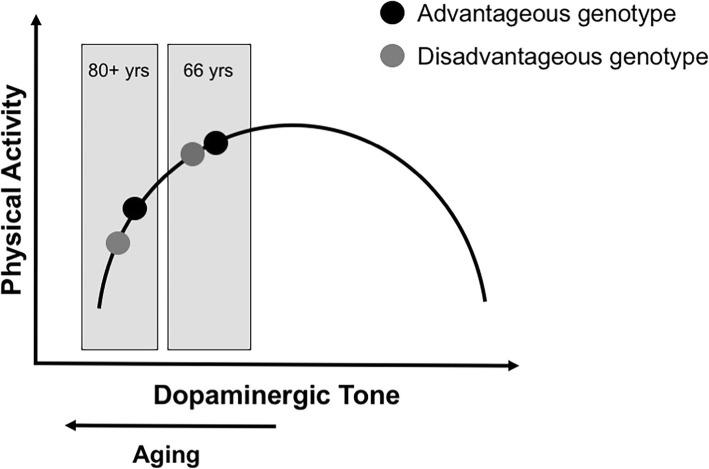
Higher dopamine receptor efficacy was related to moderate-to-vigorous physical activity, but not to light-intensity physical activity or sedentary time. DRD1 explained 2.7% of variance in moderate-to-vigorous physical activity, with more pronounced effect in people aged ≥80 years, about 10% of explained variance.
Stronger genetic effects in older adults are in line with the well-established nonlinear effects of dopamine signaling on performance, expected to be exacerbated with aging. Individuals over 80 years, genetically predisposed to lower dopamine receptor efficacy, engaged on average 100 min/week in moderate-to-high physical activity, below the recommended levels beneficial for healthy aging. Our findings highlight that some individuals might need extra support to maintain a physically active lifestyle.
积极的生活方式对衰老有有益影响,这已得到充分证实。因此,了解老年人进行体育活动的重要因素至关重要。受动物和人类数据的启发,这些数据将多巴胺系统与动机和奖励过程联系起来,我们研究了多巴胺基因的变异与客观测量的体力活动和久坐行为之间的关联。此外,我们旨在验证年龄的增加是否会加剧多巴胺基因对体力活动的影响。
我们分析了来自人口基础的瑞典 Kungsholmen 老龄化和护理全国研究(SNAC-K)的 504 名年龄在 66-87 岁的老年人的数据。使用 activPAL 加速度计测量体力活动,从血液样本中提取 DNA 进行基因分型。我们使用协方差分析评估了三种与多巴胺相关的遗传变异(DRD1、DRD2 和 DRD3)对久坐时间、低强度体力活动和中高强度体力活动的影响,调整了性别、年龄和身体功能。
较高的多巴胺受体效能与中高强度体力活动有关,但与低强度体力活动或久坐时间无关。DRD1 解释了中高强度体力活动的 2.7%的变异性,在年龄≥80 岁的人群中,效果更为明显,约占 10%的变异性。
老年人大脑中多巴胺信号传递的非线性效应已得到充分证实,与更强的遗传效应一致,预计随着年龄的增长会加剧。遗传上易患多巴胺受体效能较低的 80 岁以上个体,平均每周进行 100 分钟/周的中高强度体力活动,低于有益于健康衰老的推荐水平。我们的发现强调了一些个体可能需要额外的支持来保持积极的生活方式。