Institute of Economic Research, Hitotsubashi University.
J Epidemiol. 2021 May 5;31(5):308-314. doi: 10.2188/jea.JE20200071. Epub 2020 May 23.
The "retired husband syndrome" refers to the negative impact of the husband's retirement on the wife's health. This study provided new insights by examining whether and to what extent the wife's social participation, interactions with her husband, and job status prior to her husband's retirement affected the evolution of her mental health after her husband's retirement.
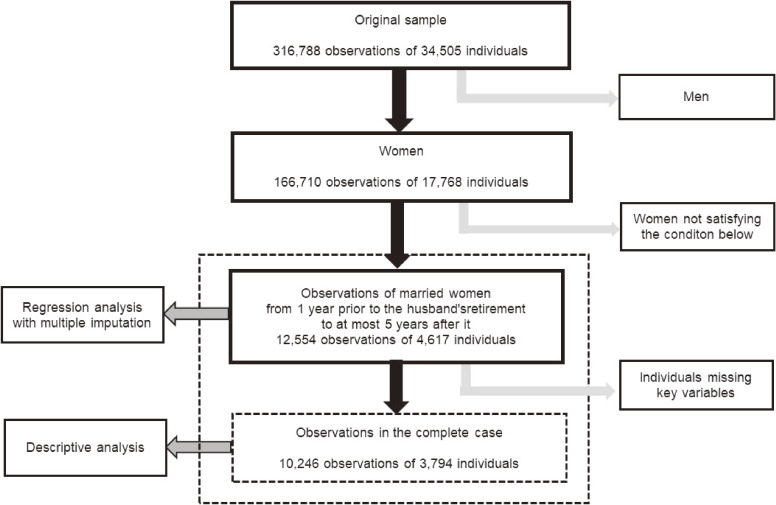
We collected data from a 12-wave nationwide panel survey conducted from 2005 to 2016, starting with individuals aged 50-59 years. Focusing on 3,794 female respondents whose husbands retired during the survey period, we applied random-effects linear regression models to investigate the evolution of their mental health as measured by the Kessler 6 (K6) score (range, 0-24; Mean, 3.41; standard deviation, 4.11) during the 5 years after their husbands' retirement.
On average, the wife's K6 score rose by 0.18 (95% confidence interval [CI], 0.08-0.28), 0.18 (95% CI, 0.03-0.34), and 0.19 (95% CI, -0.02 to 0.43) in the first 3 years, respectively, after the husband's retirement, before declining toward the baseline level. However, the wife's active social participation, intense interactions with her husband, and absence of paid employment before her husband's retirement prevented her mental health from deteriorating.
The results suggest the limited relevance of the "retired husband syndrome" among middle-aged Japanese couples. The effects of a husband's retirement on the wife's mental health depended heavily on her prior behavior.
“退休丈夫综合征”是指丈夫退休对妻子健康的负面影响。本研究通过考察妻子在丈夫退休前的社会参与度、与丈夫的互动以及工作状况是否以及在何种程度上影响了丈夫退休后她的心理健康演变,提供了新的见解。
我们从 2005 年至 2016 年进行的 12 波全国面板调查中收集数据,调查对象年龄在 50-59 岁之间。本研究聚焦于在调查期间丈夫退休的 3794 名女性受访者,通过随机效应线性回归模型来考察她们在丈夫退休后 5 年内心理健康(用 Kessler 6 量表[K6]评分衡量,范围为 0-24 分;平均分 3.41 分;标准差 4.11 分)的演变情况。
平均而言,妻子的 K6 评分在丈夫退休后的前 3 年分别上升了 0.18(95%置信区间[CI],0.08-0.28)、0.18(95% CI,0.03-0.34)和 0.19(95% CI,-0.02 至 0.43),然后逐渐接近基线水平。然而,妻子积极的社会参与、与丈夫的密切互动以及在丈夫退休前没有有偿工作,防止了她的心理健康恶化。
结果表明,“退休丈夫综合征”在日本中年夫妇中相关性有限。丈夫退休对妻子心理健康的影响在很大程度上取决于她之前的行为。