Liver Transplantation Unit, King Faisal Specialist Hospital & Research Center, Riyadh, Saudi Arabia.
Division of Gastroenterology and Hepatology, Johns Hopkins University, Baltimore, USA.
United European Gastroenterol J. 2020 Jun;8(5):509-519. doi: 10.1177/2050640620924157.
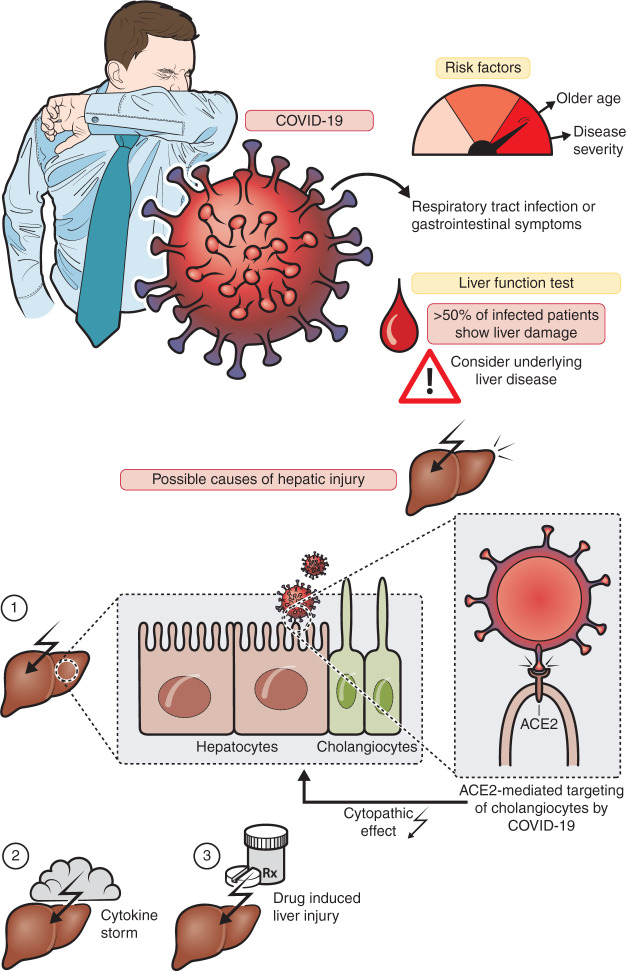
Patients with novel coronavirus disease 2019 (COVID-19) experience various degrees of liver function abnormalities. Liver injury requires extensive work-up and continuous surveillance and can be multifactorial and heterogeneous in nature. In the context of COVID-19, clinicians will have to determine whether liver injury is related to an underlying liver disease, drugs used for the treatment of COVID-19, direct effect of the virus, or a complicated disease course. Recent studies proposed several theories on potential mechanisms of liver injury in these patients. This review summarizes current evidence related to hepatobiliary complications in COVID-19, provides an overview of the available case series and critically elucidates the proposed mechanisms and provides recommendations for clinicians.
新型冠状病毒病 2019(COVID-19)患者会出现不同程度的肝功能异常。肝损伤需要广泛的检查和持续监测,其性质可能是多因素和异质性的。在 COVID-19 背景下,临床医生将不得不确定肝损伤是否与潜在的肝脏疾病、用于治疗 COVID-19 的药物、病毒的直接作用或复杂的疾病过程有关。最近的研究提出了几种关于这些患者肝损伤潜在机制的理论。本综述总结了与 COVID-19 相关肝胆并发症的现有证据,概述了现有的病例系列,并批判性地阐明了提出的机制,并为临床医生提供了建议。