Guanghua School of Management, Peking University, No. 5, Yiheyuan Road, Haidian District, Beijing, 100871, PR China.
School of Public Administration and Policy, The Research Center for Health Protection, Renmin University of China, No. 59, Zhongguancun Street, Haidian District, Beijing, 100872, PR China.
BMC Geriatr. 2020 May 25;20(1):182. doi: 10.1186/s12877-020-01581-0.
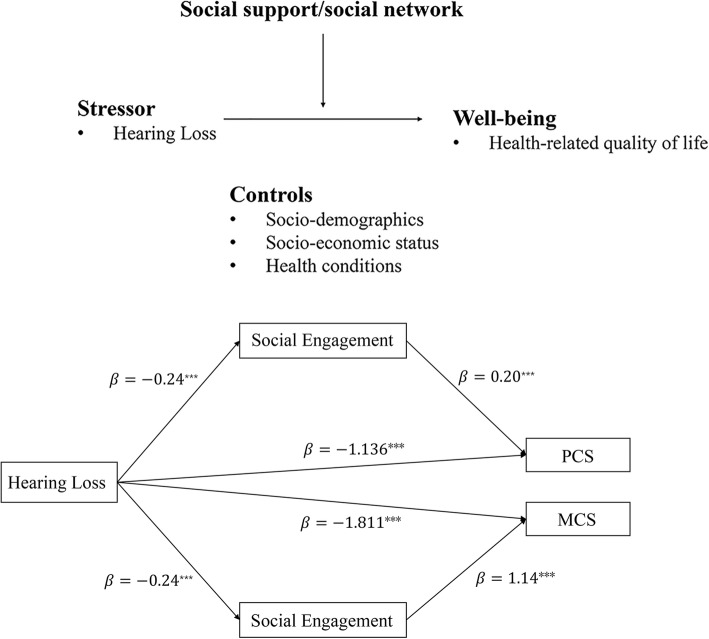
Hearing loss is highly prevalent and associated with reduced well-being in older adults. But little is known about the role of social factors in the association of hearing difficulty and its health consequences. This study aims to examine the association between self-reported hearing loss and health-related quality of life (HRQoL, consisted of physical and mental component summary, PCS and MCS), and to investigate whether social engagement mediates this association.
Data on 4035 older adults aged 60 years or above from a cross-sectional nationally representative database in China were obtained to address this study. HRQoL was measured by the Short Form 12 Health Survey (SF-12). Hearing loss was defined by a dichotomized measure of self-reported hearing difficulty, which has been proved to be sensitive and displayed moderate associations with audiometric assessment in elderly population. Social engagement was measured by the Index of Social Engagement Scale. Bootstrap test was applied to test for the significance of the mediating role of social engagement.
Self-reported hearing loss was found negatively associated with HRQoL in older adults, and hearing loss was much more related to reduced mental well-being. Social engagement played a partial mediating role in the association of hearing loss and HRQoL. Social engagement account for 4.14% of the variance in the change of PCS scores and 13.72% for MCS, respectively.
The study lends support to the hypothesis that hearing loss is associated with aging well beings, and the use of hearing aid or proper social engagement intervention may improve the quality of life among the elderly.
听力损失在老年人中非常普遍,与幸福感降低有关。但人们对社会因素在听力障碍及其健康后果的关联中的作用知之甚少。本研究旨在探讨自我报告的听力损失与健康相关生活质量(由身体和精神成分综合评估,PCS 和 MCS)之间的关系,并调查社会参与是否在这种关联中起中介作用。
本研究使用中国一项全国代表性横断面数据库中 4035 名 60 岁或以上的老年人数据。使用简短健康调查 12 项量表(SF-12)来评估生活质量。听力损失通过自我报告的听力困难的二分测量来定义,这种方法已被证明在老年人群体中对听力评估具有敏感性,并显示出中度相关性。社会参与度通过社会参与指数量表进行评估。采用自举检验来检验社会参与在听力损失和生活质量之间的中介作用的显著性。
研究发现,自我报告的听力损失与老年人的生活质量呈负相关,且听力损失与心理健康的相关性更强。社会参与在听力损失和生活质量之间的关系中起部分中介作用。社会参与分别占 PCS 评分变化的 4.14%和 MCS 变化的 13.72%。
该研究支持听力损失与老年人的健康幸福感相关的假设,使用助听器或适当的社会参与干预措施可能会提高老年人的生活质量。