College of Pharmacy, Korea University, 2511 Sejong-ro, Sejong-si, 30019, South Korea.
Research Institute of Pharmaceutical Sciences and Technology, Korea University College of Pharmacy, 2511 Sejong-ro, Sejong-si, 30019, South Korea.
BMC Musculoskelet Disord. 2020 May 25;21(1):324. doi: 10.1186/s12891-020-03337-8.
With increasing number of patients undergoing spine surgery, the spinal epidural hemorrhage (SEH) has become a growing concern. However, current studies on SEH rely on case reports or observations from a single center. Our study attempted to demonstrate the incidence rate and risk factors of SEH using a national dataset.
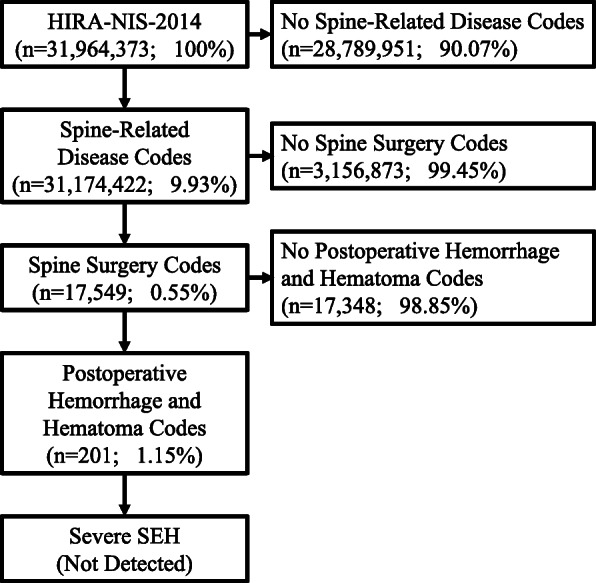
A total of 17,549 spine surgery cases from the Health Insurance Review and Assessment Service National Inpatient Sample of 2014 were analyzed. After evaluating the incidence of SEH based on severe cases requiring reoperation, a univariate comparison was performed. Variables found to be significant were included in a multivariable analysis model to determine the risk factors.
The incidence of SEH was found to be 1.15% in Korean population, and there were no severe SEH cases. Our analysis confirmed the previous findings that lumbar surgery, intraoperative blood loss, prolonged surgical time, high blood pressure, use of nonsteroidal anti-inflammatory drugs, and concurrent bleeding factors are the risk factors of SEH. Anterior approach showed a protective effect. The use of anticoagulant demonstrated no statistical significance.
Although severe SEH cases were not detected, the incidence of SEH was similar to that reported in literature. Given that SEH is a rare complication of spine surgery and constitutes an important research area that needs to be studied further, our study makes a meaningful contribution based on a rigorous national level sample for the first time and provides the academic circle and health professionals with a reliable evidence of improved clinical outcomes in such cases.
随着接受脊柱手术的患者数量不断增加,脊柱硬膜外血肿(SEH)已成为一个日益受到关注的问题。然而,目前关于 SEH 的研究依赖于病例报告或单一中心的观察。我们的研究试图使用全国性数据集来证明 SEH 的发生率和危险因素。
分析了 2014 年健康保险审查和评估服务国家住院患者样本中总计 17549 例脊柱手术病例。根据需要再次手术的严重 SEH 病例评估 SEH 的发生率后,进行单变量比较。将具有统计学意义的变量纳入多变量分析模型,以确定危险因素。
在韩国人群中,SEH 的发生率为 1.15%,且无严重 SEH 病例。我们的分析证实了先前的发现,即腰椎手术、术中失血、手术时间延长、高血压、使用非甾体抗炎药和并发出血因素是 SEH 的危险因素。前路手术显示出保护作用。抗凝剂的使用没有统计学意义。
尽管未发现严重 SEH 病例,但 SEH 的发生率与文献报道的相似。鉴于 SEH 是脊柱手术的罕见并发症,并且是一个需要进一步研究的重要研究领域,我们的研究首次基于严格的全国性样本做出了有意义的贡献,并为学术界和医疗保健专业人员提供了在这种情况下改善临床结局的可靠证据。