Department of Gastrointestinal Surgery, The First Affiliated Hospital of Sun Yat-Sen University, 58 Zhongshan Road 2, Guangzhou, 510080, People's Republic of China.
Department of Medical Ultrasonics, Institute of Diagnostic and Interventional Ultrasound, The First Affiliated Hospital of Sun Yat-Sen University, 58 Zhongshan Road 2, Guangzhou, 510080, People's Republic of China.
BMC Cancer. 2020 May 25;20(1):468. doi: 10.1186/s12885-020-06970-7.
Neoadjuvant chemotherapy is a promising treatment option for potential resectable gastric cancer, but patients' responses vary. We aimed to develop and validate a radiomics score (rad_score) to predict treatment response to neoadjuvant chemotherapy and to investigate its efficacy in survival stratification.
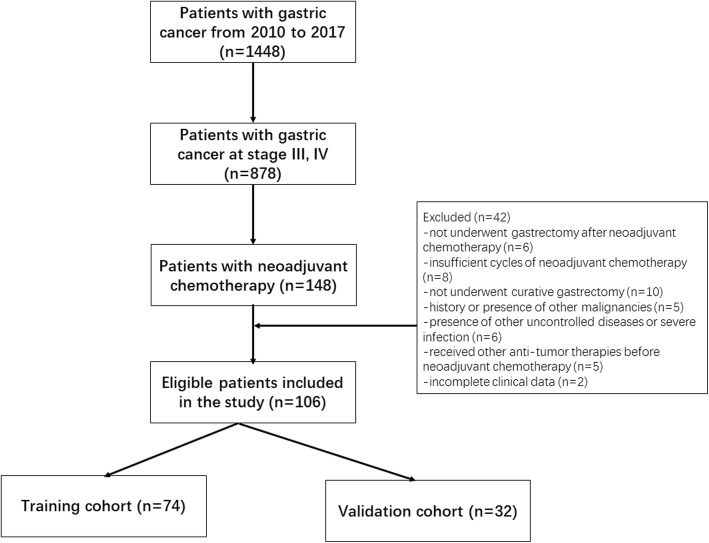
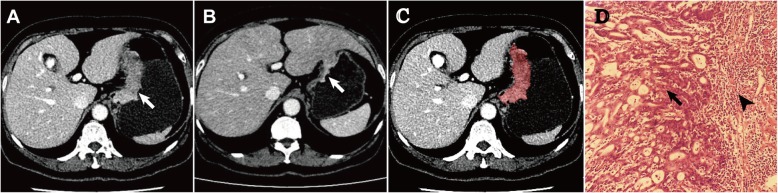
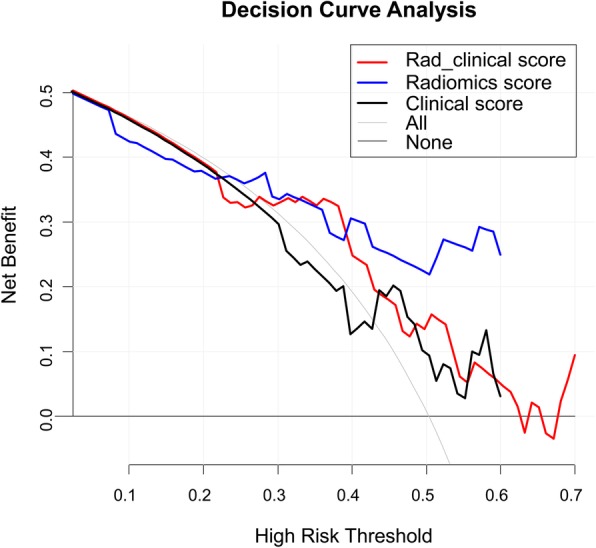
A total of 106 patients with neoadjuvant chemotherapy before gastrectomy were included (training cohort: n = 74; validation cohort: n = 32). Radiomics features were extracted from the pre-treatment portal venous-phase CT. After feature reduction, a rad_score was established by Randomised Tree algorithm. A rad_clinical_score was constructed by integrating the rad_score with clinical variables, so was a clinical score by clinical variables only. The three scores were validated regarding their discrimination and clinical usefulness. The patients were stratified into two groups according to the score thresholds (updated with post-operative clinical variables), and their survivals were compared.
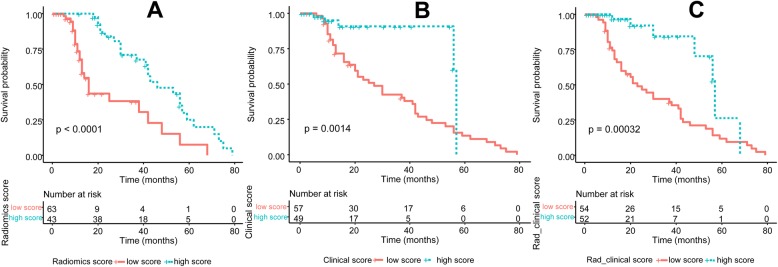
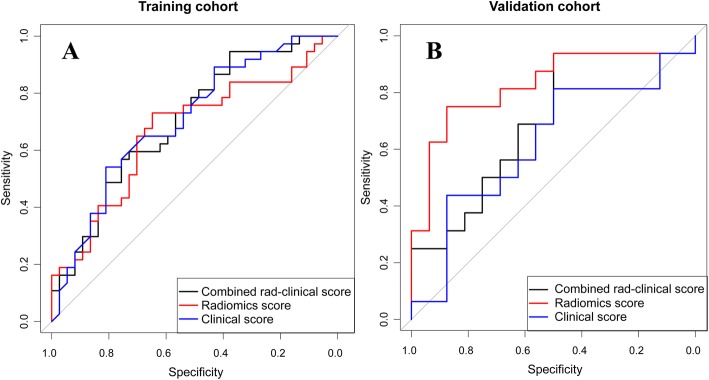
In the validation cohort, the rad_score demonstrated a good predicting performance in treatment response to the neoadjuvant chemotherapy (AUC [95% CI] =0.82 [0.67, 0.98]), which was better than the clinical score (based on pre-operative clinical variables) without significant difference (0.62 [0.42, 0.83], P = 0.09). The rad_clinical_score could not further improve the performance of the rad_score (0.70 [0.51, 0.88], P = 0.16). Based on the thresholds of these scores, the high-score groups all achieved better survivals than the low-score groups in the whole cohort (all P < 0.001).
The rad_score that we developed was effective in predicting treatment response to neoadjuvant chemotherapy and in stratifying patients with gastric cancer into different survival groups. Our proposed strategy is useful for individualised treatment planning.
新辅助化疗是潜在可切除胃癌的一种有前途的治疗选择,但患者的反应各不相同。我们旨在开发和验证一种放射组学评分(rad_score),以预测新辅助化疗的治疗反应,并研究其在生存分层中的疗效。
共纳入 106 例新辅助化疗前行胃切除术的患者(训练队列:n=74;验证队列:n=32)。从术前门静脉期 CT 中提取放射组学特征。经过特征降维后,采用随机树算法建立 rad_score。通过整合 rad_score 与临床变量构建 rad_clinical_score,仅通过临床变量构建临床评分。验证了这三个评分在区分和临床实用性方面的表现。根据评分阈值(用术后临床变量更新)将患者分为两组,并比较其生存情况。
在验证队列中,rad_score 对新辅助化疗的治疗反应具有良好的预测性能(AUC[95%CI] =0.82[0.67, 0.98]),优于不具有显著差异的临床评分(基于术前临床变量)(0.62[0.42, 0.83],P=0.09)。rad_clinical_score 不能进一步提高 rad_score 的性能(0.70[0.51, 0.88],P=0.16)。基于这些评分的阈值,高分组在整个队列中均获得了比低分组更好的生存结果(均 P<0.001)。
我们开发的 rad_score 能够有效预测新辅助化疗的治疗反应,并将胃癌患者分层为不同的生存组。我们提出的策略对于个体化治疗计划是有用的。