Wagner Tobias, Bernhardt Alexander M, Magnussen Christina, Reichenspurner Hermann, Blankenberg Stefan, Grahn Hanno
Department of General and Interventional Cardiology, University Heart Center Hamburg, Martinistr. 52, D-20246, Hamburg, Germany.
Department of Cardiovascular Surgery, University Heart Center Hamburg, Hamburg, Germany.
J Cardiothorac Surg. 2020 May 25;15(1):113. doi: 10.1186/s13019-020-01150-x.
Right heart failure (RHF) after left ventricular assist device (LVAD) implantation is common and associated with worse outcome. Prediction of RHF remains challenging. Our study aims to assess predictors of RHF focusing on clinical manifestations.
We retrospectively analyzed clinical, echocardiographic and hemodynamic parameters of 112 patients undergoing LVAD implantation. Pre-operative, early (ERHF, day 7 and 14) and late postoperative RHF (LRHF, after 1, 3, 6 and 12 months) were assessed.
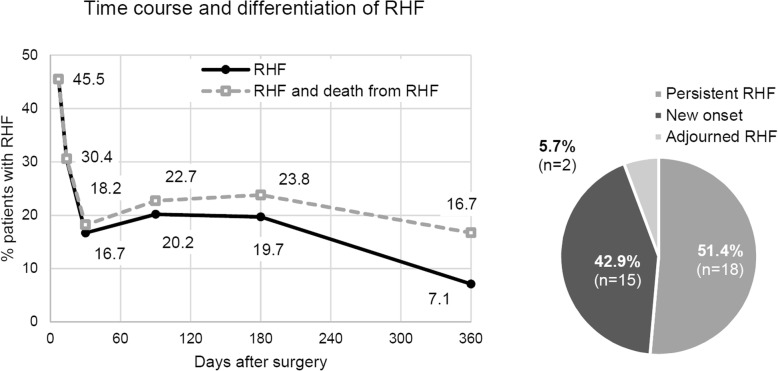
In the total study population (87.5% men, mean age 55 years), early RHF was frequent (47% on day 7 and 30% on day 14). Prevalence of late RHF and death from RHF was high after 3, 6 and 12 months (23, 24 and 17%). Pre-existing RHF was only associated with early RHF and persistent, but not for new onset late RHF. Early RHF was associated with lower INTERMACS level (p < 0.001), higher pulmonary vascular resistance (p = 0.046) and CVP/PAWP quotient (p = 0.011), higher bilirubin (p = 0.038) and creatinine (p = 0.013). LRHF was associated with creatinine (p = 0.006), urea (p = 0.012) and load adaption index (p = 0.007). Binary logistic regression models identified no single risk factors. Comparing the predictive value of regression models with a model of three clinical findings (INTERMACS level, age and pre-operative RHF) did not reveal differences in RHF.
RHF before LVAD implantation enhances the risk of early RHF and persistent late RHF, but not for new onset late RHF, supporting the hypothesis of differences in the etiology. Echocardiographic or hemodynamic parameters did not show a predictive value for new onset late RHF. Similar predictive value of clinical findings and statistic models of risk factors suggest that a clinical evaluation is equally matched to predict RHF.
左心室辅助装置(LVAD)植入术后右心衰竭(RHF)很常见,且与较差的预后相关。RHF的预测仍然具有挑战性。我们的研究旨在评估以临床表现为重点的RHF预测因素。
我们回顾性分析了112例行LVAD植入术患者的临床、超声心动图和血流动力学参数。评估术前、早期(术后第7天和第14天的早期RHF,ERHF)和晚期术后RHF(术后1、3、6和12个月的晚期RHF,LRHF)。
在整个研究人群中(87.5%为男性,平均年龄55岁),早期RHF很常见(第7天为47%,第14天为30%)。3、6和12个月后晚期RHF的患病率和因RHF死亡的发生率很高(分别为23%、24%和17%)。术前存在的RHF仅与早期RHF和持续性晚期RHF相关,而与新发晚期RHF无关。早期RHF与较低的INTERMACS水平(p < 0.001)、较高的肺血管阻力(p = 0.046)和中心静脉压/肺动脉楔压比值(p = 0.011)、较高的胆红素(p = 0.038)和肌酐(p = 0.013)相关。晚期RHF与肌酐(p = 0.006)、尿素(p = 0.012)和负荷适应指数(p = 0.007)相关。二元逻辑回归模型未发现单一危险因素。将回归模型与包含三个临床指标(INTERMACS水平、年龄和术前RHF)的模型的预测价值进行比较,未发现RHF预测方面的差异。
LVAD植入术前的RHF会增加早期RHF和持续性晚期RHF的风险,但不会增加新发晚期RHF的风险,支持病因存在差异的假设。超声心动图或血流动力学参数对新发晚期RHF没有预测价值。临床指标和危险因素统计模型的预测价值相似,表明临床评估在预测RHF方面同样有效。