Gonzalez-Montoro Andrea, Pavón Noriel, Barberá Julio, Cuarella Neus, González Antonio J, Jiménez-Serrano Santiago, Lucero Alejandro, Moliner Laura, Sánchez David, Vidal Koldo, Benlloch José M
Centro Mixto CSIC - UPV, Instituto de Instrumentación Para Imagen Molecular, Camino de Vera S/N, 46022, Valencia, Spain.
Oncovision, C/Jerónimo de Monsoriu, 92 Bajo, Valencia, Spain.
EJNMMI Phys. 2024 Aug 23;11(1):73. doi: 10.1186/s40658-024-00674-8.
Positron Emission Tomography (PET) is a well-known imaging technology for the diagnosis, treatment, and monitoring of several diseases. Most PET scanners use a Ring-Shaped Detector Configuration (RSDC), which helps obtain homogeneous image quality but are restricted to an invariable Field-of-View (FOV), scarce spatial resolution, and low sensitivity. Alternatively, few PET systems use Open Detector Configurations (ODC) to permit an accessible FOV adaptable to different target sizes, thus optimizing sensitivity. Yet, to compensate the lack of angular coverage in ODC-PET, developing a detector with high-timing performance is mandatory to enable Time-of-Flight (TOF) techniques during reconstruction. The main goal of this work is to provide a proof of concept PET scanner appropriate for constructing the new generation of ODC-PET suitable for biopsy guidance and clinical intervention during acquisition. The designed detector has to be compact and robust, and its requirements in terms of performance are spatial and time resolutions < 2 mm and < 200 ps, respectively.
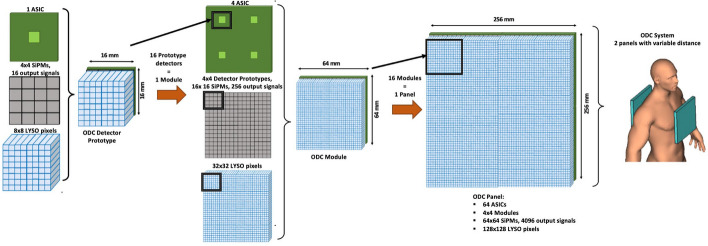
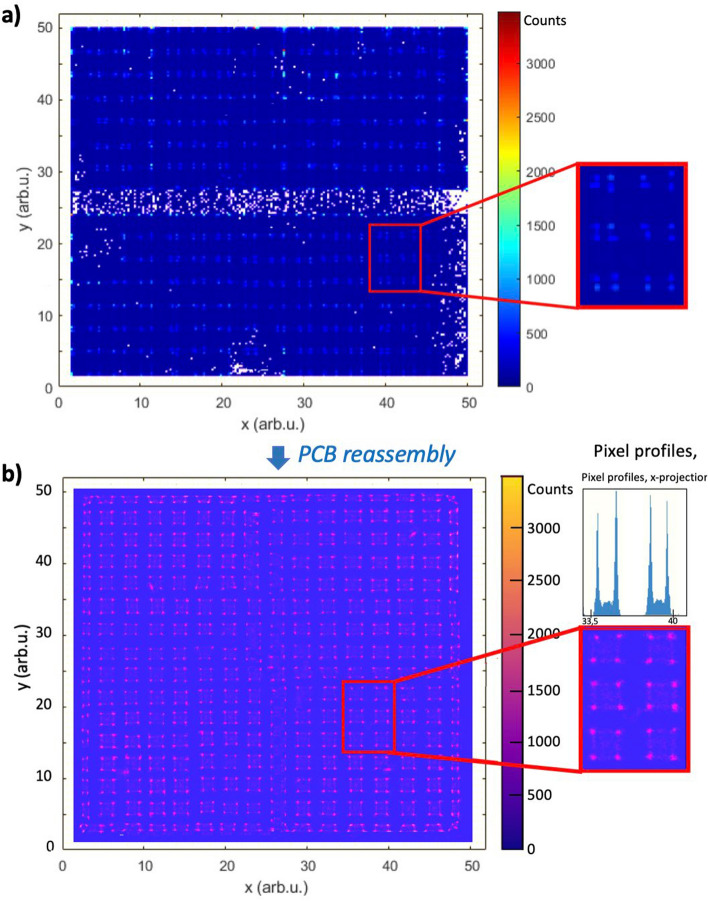
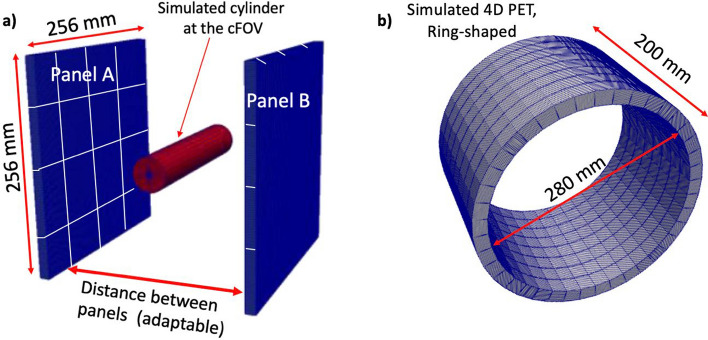
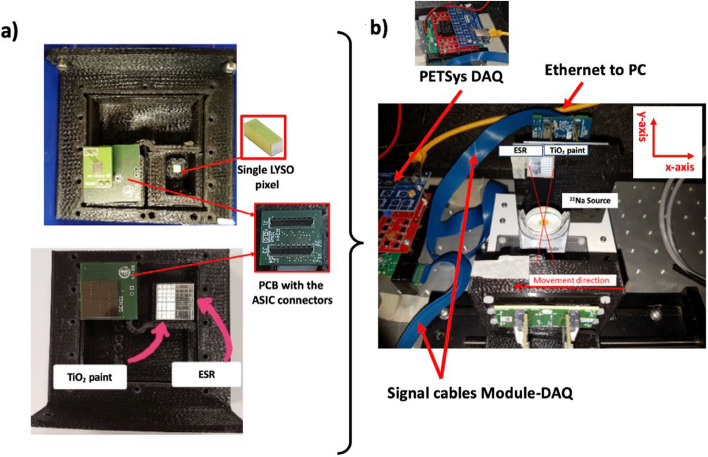
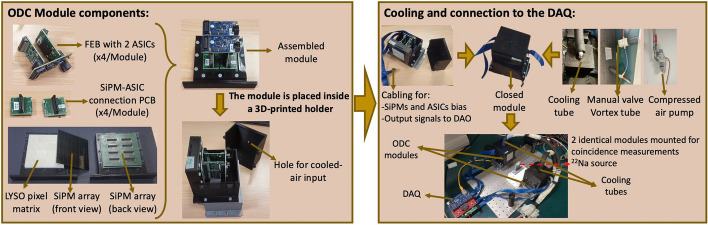
The present work includes a simulation study of an ODC-PET based on 2-panels with variable distance. The image quality (IQ) and Derenzo phantoms have been simulated and evaluated. The phantom simulations have also been performed using a ring-shaped PET for comparison purposes of the ODC approach with conventional systems. Then, an experimental evaluation of a prototype detector that has been designed following the simulation results is presented. This study focused on tuning the ASIC parameters and evaluating the scintillator surface treatment (ESR and TiO), and configuration that yields the best Coincidence Time Resolution (CTR). Moreover, the scalability of the prototype to a module of 64 × 64mm and its preliminary evaluation regarding pixel identification are provided.
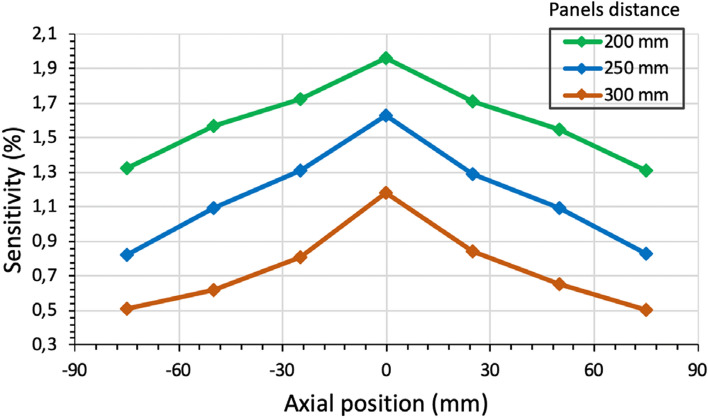
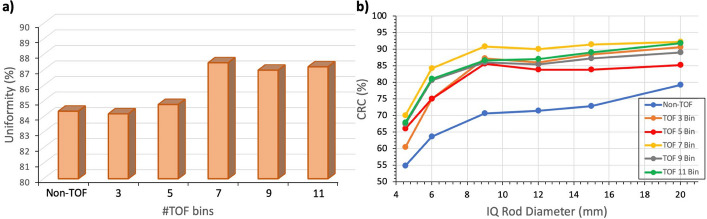
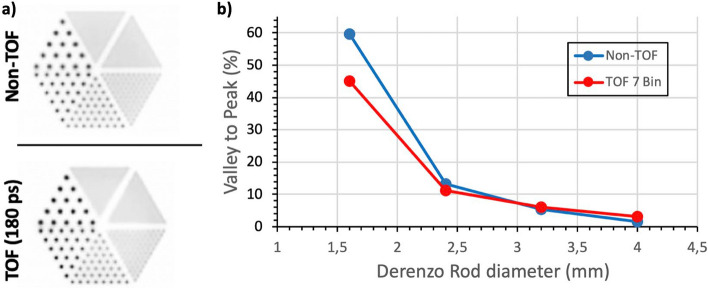
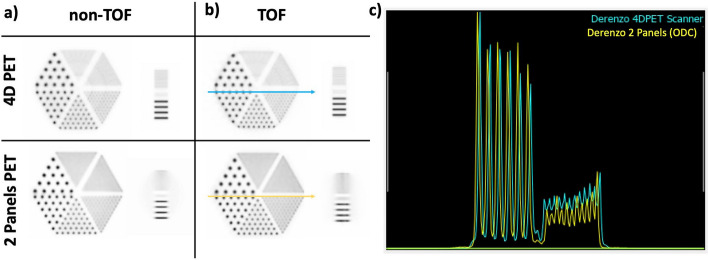
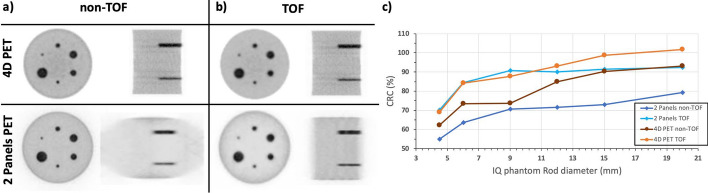
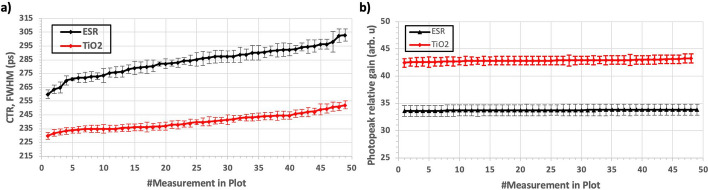
The simulation results reported sensitivity (%) values at the center of the FOV of 1.96, 1.63, and 1.18 for panel distances of 200, 250, and 300 mm, respectively. The IQ reconstructed image reported good uniformity (87%) and optimal CRC values, and the Derenzo phantom reconstruction suggests a system resolution of 1.6-2 mm. The experimental results demonstrate that using TiO coating yielded better detector performance than ESR. Acquired data was filtered by applying an energy window of ± 30% at the photopeak level. After filtering, best CTR of 230 ± 2 ps was achieved for an 8 × 8 LYSO pixel block with 2 × 2 × 12mm each. The detector performance remained constant after scaling-up the prototype to a module of 64 64mm, and the flood map demonstrates the module's capabilities to distinguish the small pixels; thus, a spatial resolution < 2 mm (pixel size) is achieved.
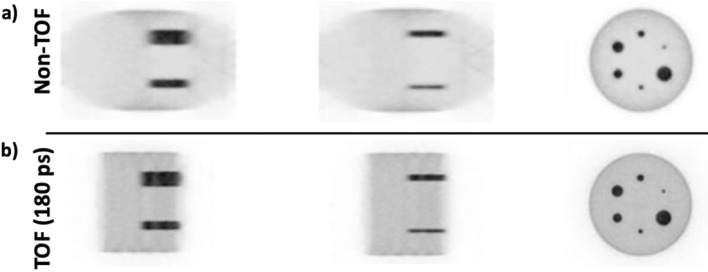
The simulated results of this biplanar scanner show high performance in terms of image quality and sensitivity. These results are comparable to state-of-the-art PET technology and, demonstrate that including TOF information minimizes the image artifacts due to the lack of angular projections. The experimental results concluded that using TiO coating provide the best performance. The results suggest that this scanner may be suitable for organ study, breast, prostate, or cardiac applications, with good uniformity and CRC.
正电子发射断层扫描(PET)是一种用于多种疾病诊断、治疗和监测的知名成像技术。大多数PET扫描仪采用环形探测器配置(RSDC),这有助于获得均匀的图像质量,但受限于固定的视野(FOV)、有限的空间分辨率和低灵敏度。另外,少数PET系统采用开放式探测器配置(ODC)以允许有一个可适应不同目标大小的可及视野,从而优化灵敏度。然而,为了弥补ODC-PET中角度覆盖的不足,开发具有高定时性能的探测器对于在重建过程中启用飞行时间(TOF)技术是必不可少的。这项工作的主要目标是提供一个概念验证PET扫描仪,适合构建新一代适用于活检引导和采集期间临床干预的ODC-PET。设计的探测器必须紧凑且坚固,其在性能方面的要求分别是空间分辨率和时间分辨率小于2毫米和小于200皮秒。
目前的工作包括对基于两块可变距离面板的ODC-PET的模拟研究。对图像质量(IQ)和德伦佐体模进行了模拟和评估。还使用环形PET进行了体模模拟,以便将ODC方法与传统系统进行比较。然后,给出了根据模拟结果设计的原型探测器的实验评估。本研究重点调整了ASIC参数并评估了闪烁体表面处理(ESR和TiO)以及产生最佳符合时间分辨率(CTR)的配置。此外,还提供了原型扩展到64×64毫米模块的可扩展性及其关于像素识别的初步评估。
模拟结果显示,对于面板距离为200毫米、250毫米和300毫米的情况,FOV中心的灵敏度(%)值分别为1.96、1.63和1.18。IQ重建图像显示出良好的均匀性(87%)和最佳的CRC值,德伦佐体模重建表明系统分辨率为1.6 - 2毫米。实验结果表明,使用TiO涂层比ESR产生更好的探测器性能。在光电峰水平应用±30%的能量窗口对采集的数据进行滤波。滤波后,对于每个为2×2×12毫米的8×8 LYSO像素块,实现了230±2皮秒的最佳CTR。将原型扩展到64×64毫米模块后,探测器性能保持不变,泛光图展示了该模块区分小像素的能力;因此,实现了小于2毫米(像素大小)的空间分辨率。
这种双平面扫描仪的模拟结果在图像质量和灵敏度方面显示出高性能。这些结果与最先进的PET技术相当,并且表明包含TOF信息可将由于角度投影不足导致的图像伪影降至最低。实验结果得出结论,使用TiO涂层提供了最佳性能。结果表明,这种扫描仪可能适用于器官研究、乳腺、前列腺或心脏应用,具有良好的均匀性和CRC。