King Fahd Medical Research Center, Special Infectious Agents Unit, King Abdulaziz University, Jeddah, Saudi Arabia.
Division of Microbiology, Department of Biological Science, Faculty of science, King Abdulaziz University, Jeddah, Saudi Arabia.
PLoS One. 2020 May 26;15(5):e0232790. doi: 10.1371/journal.pone.0232790. eCollection 2020.
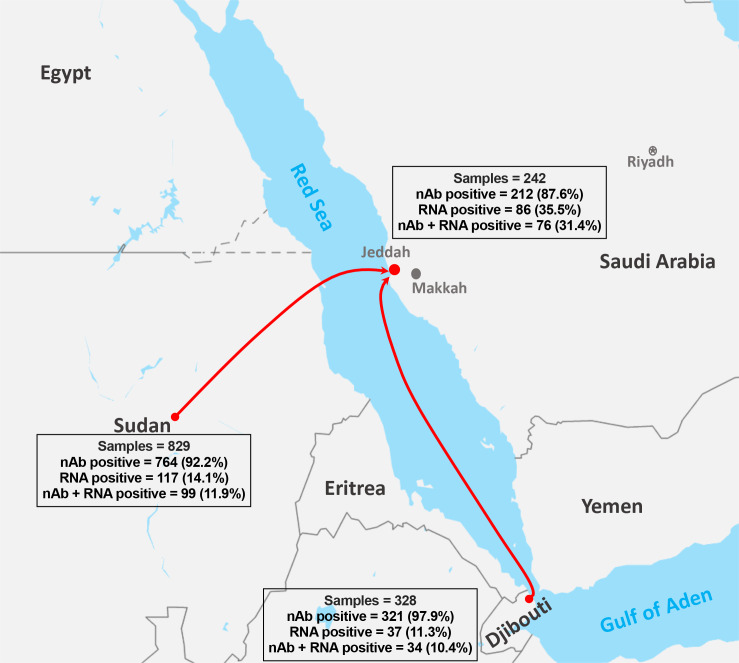
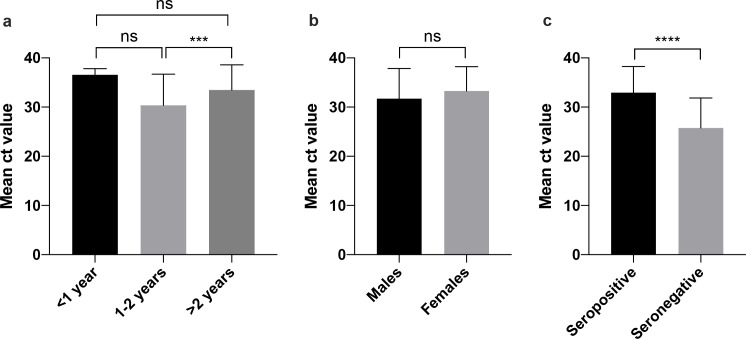
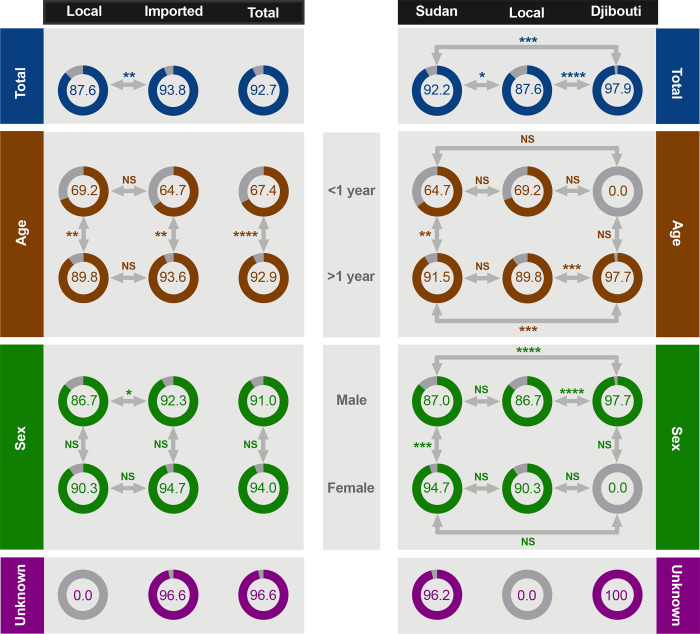
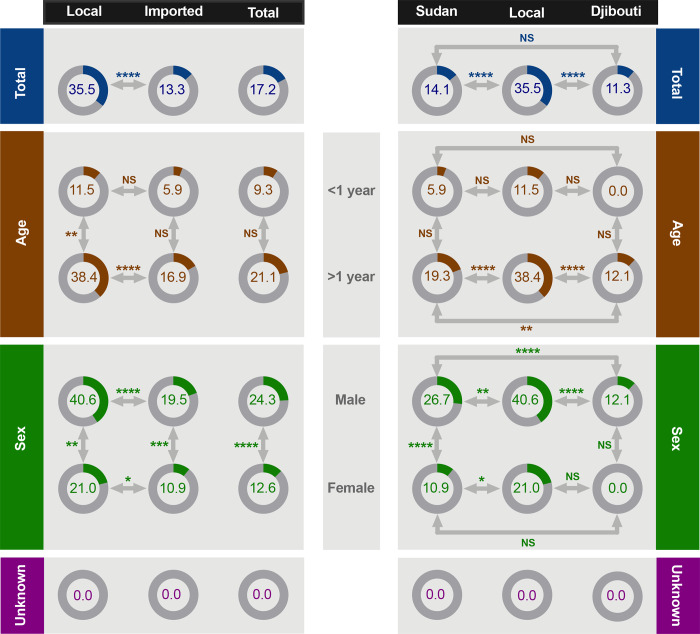
The Middle East Respiratory Syndrome-Coronavirus (MERS-CoV) is an endemic virus in dromedaries. Annually, Saudi Arabia imports thousands of camels from the Horn of Africa, yet the epidemiology of MERS-CoV in these animals is largely unknown. Here, MERS-CoV prevalence was compared in imported African camels and their local counterparts. A total of 1399 paired sera and nasal swabs were collected from camels between 2016 and 2018. Imported animals from Sudan (n = 829) and Djibouti (n = 328) were sampled on incoming ships at Jeddah Islamic seaport before unloading, and local camels were sampled from Jeddah (n = 242). Samples were screened for neutralizing antibodies (nAbs) and MERS-CoV viral RNA. The overall seroprevalence was 92.7% and RNA detection rate was 17.2%. Imported camels had higher seroprevalence compared to resident herds (93.8% vs 87.6%, p <0.01) in contrast to RNA detection (13.3% vs 35.5%, p <0.0001). Seroprevalence significantly increased with age (p<0.0001) and viral RNA detection rate was ~2-folds higher in camels <2-year-old compared to older animals. RNA detection was higher in males verses females (24.3% vs 12.6%, p<0.0001) but seroprevalence was similar. Concurrent positivity for viral RNA and nAbs was found in >87% of the RNA positive animals, increased with age and was sex-dependent. Importantly, reduced viral RNA load was positively correlated with nAb titers. Our data confirm the widespread of MERS-CoV in imported and domestic camels in Saudi Arabia and highlight the need for continuous active surveillance and better prevention measures. Further studies are also warranted to understand camels correlates of protection for proper vaccine development.
中东呼吸综合征冠状病毒(MERS-CoV)是单峰骆驼的地方性病毒。每年,沙特阿拉伯都会从非洲之角进口数千头骆驼,但这些动物中 MERS-CoV 的流行病学情况在很大程度上尚不清楚。在此,比较了进口的非洲骆驼及其当地同类动物中的 MERS-CoV 流行率。2016 年至 2018 年期间,共从骆驼中采集了 1399 对血清和鼻腔拭子。在卸货前,从苏丹(n=829)和吉布提(n=328)进口的动物在吉达伊斯兰港的入境船舶上进行了采样,而从吉达采集了当地骆驼(n=242)。对样本进行了中和抗体(nAb)和 MERS-CoV 病毒 RNA 的筛查。总体血清阳性率为 92.7%,RNA 检测率为 17.2%。与驻留畜群相比(93.8%比 87.6%,p<0.01),进口骆驼的血清阳性率更高,但 RNA 检测(13.3%比 35.5%,p<0.0001)则更低。血清阳性率随年龄显著增加(p<0.0001),且<2 岁的骆驼中 RNA 检测率是较老动物的两倍。RNA 检测在雄性中高于雌性(24.3%比 12.6%,p<0.0001),但血清阳性率相似。在>87%的 RNA 阳性动物中同时检测到病毒 RNA 和 nAb 呈阳性,且随年龄增长而增加,并与性别有关。重要的是,病毒 RNA 载量的减少与 nAb 滴度呈正相关。我们的数据证实了 MERS-CoV 在沙特阿拉伯进口和本地骆驼中的广泛存在,并强调需要持续进行主动监测和更好的预防措施。还需要进一步的研究来了解骆驼对疫苗开发的保护相关性。