• 文献检索
  • 文档翻译
  • 深度研究
  • 学术资讯
  • Suppr Zotero 插件Zotero 插件
  • 邀请有礼
  • 套餐&价格
  • 历史记录
应用&插件
Suppr Zotero 插件Zotero 插件浏览器插件Mac 客户端Windows 客户端微信小程序
定价
高级版会员购买积分包购买API积分包
服务
文献检索文档翻译深度研究API 文档MCP 服务
关于我们
关于 Suppr公司介绍联系我们用户协议隐私条款
关注我们

Suppr 超能文献

核心技术专利:CN118964589B侵权必究
粤ICP备2023148730 号-1Suppr @ 2026

文献检索

告别复杂PubMed语法,用中文像聊天一样搜索,搜遍4000万医学文献。AI智能推荐,让科研检索更轻松。

立即免费搜索

文件翻译

保留排版,准确专业,支持PDF/Word/PPT等文件格式,支持 12+语言互译。

免费翻译文档

深度研究

AI帮你快速写综述,25分钟生成高质量综述,智能提取关键信息,辅助科研写作。

立即免费体验

沙特阿拉伯中东呼吸综合征冠状病毒抗体的存在情况:一项全国性横断面血清学研究。

Presence of Middle East respiratory syndrome coronavirus antibodies in Saudi Arabia: a nationwide, cross-sectional, serological study.

作者信息

Müller Marcel A, Meyer Benjamin, Corman Victor M, Al-Masri Malak, Turkestani Abdulhafeez, Ritz Daniel, Sieberg Andrea, Aldabbagh Souhaib, Bosch Berend-J, Lattwein Erik, Alhakeem Raafat F, Assiri Abdullah M, Albarrak Ali M, Al-Shangiti Ali M, Al-Tawfiq Jaffar A, Wikramaratna Paul, Alrabeeah Abdullah A, Drosten Christian, Memish Ziad A

机构信息

Institute of Virology, University of Bonn Medical Centre, Bonn, Germany.

Institute of Virology, University of Bonn Medical Centre, Bonn, Germany; German Centre for Infection Research, Partner Site Bonn-Cologne, Bonn, Germany.

出版信息

Lancet Infect Dis. 2015 May;15(5):559-64. doi: 10.1016/S1473-3099(15)70090-3. Epub 2015 Apr 8.

DOI:10.1016/S1473-3099(15)70090-3
PMID:25863564
原文链接:https://pmc.ncbi.nlm.nih.gov/articles/PMC7185864/
Abstract

BACKGROUND

Scientific evidence suggests that dromedary camels are the intermediary host for the Middle East respiratory syndrome coronavirus (MERS-CoV). However, the actual number of infections in people who have had contact with camels is unknown and most index patients cannot recall any such contact. We aimed to do a nationwide serosurvey in Saudi Arabia to establish the prevalence of MERS-CoV antibodies, both in the general population and in populations of individuals who have maximum exposure to camels.

METHODS

In the cross-sectional serosurvey, we tested human serum samples obtained from healthy individuals older than 15 years who attended primary health-care centres or participated in a national burden-of-disease study in all 13 provinces of Saudi Arabia. Additionally, we tested serum samples from shepherds and abattoir workers with occupational exposure to camels. Samples were screened by recombinant ELISA and MERS-CoV seropositivity was confirmed by recombinant immunofluorescence and plaque reduction neutralisation tests. We used two-tailed Mann Whitney U exact tests, χ(2), and Fisher's exact tests to analyse the data.

FINDINGS

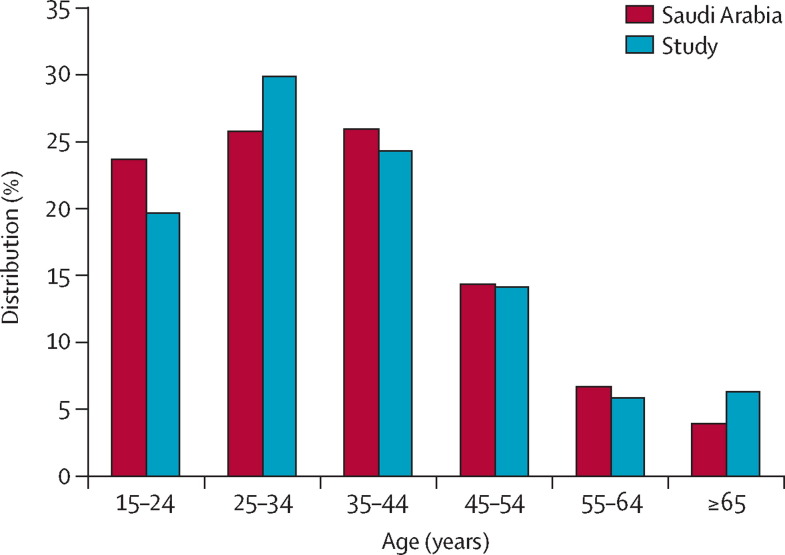
Between Dec 1, 2012, and Dec 1, 2013, we obtained individual serum samples from 10,009 individuals. Anti-MERS-CoV antibodies were confirmed in 15 (0·15%; 95% CI 0·09-0·24) of 10,009 people in six of the 13 provinces. The mean age of seropositive individuals was significantly younger than that of patients with reported, laboratory-confirmed, primary Middle Eastern respiratory syndrome (43·5 years [SD 17·3] vs 53·8 years [17·5]; p=0·008). Men had a higher antibody prevalence than did women (11 [0·25%] of 4341 vs two [0·05%] of 4378; p=0·028) and antibody prevalence was significantly higher in central versus coastal provinces (14 [0·26%] of 5479 vs one [0·02%] of 4529; p=0·003). Compared with the general population, seroprevalence of MERS-CoV antibodies was significantly increased by 15 times in shepherds (two [2·3%] of 87, p=0·0004) and by 23 times in slaughterhouse workers (five [3·6%] of 140; p<0·0001).

INTERPRETATION

Seroprevalence of MERS-CoV antibodies was significantly higher in camel-exposed individuals than in the general population. By simple multiplication, a projected 44,951 (95% CI 26,971-71,922) individuals older than 15 years might be seropositive for MERS-CoV in Saudi Arabia. These individuals might be the source of infection for patients with confirmed MERS who had no previous exposure to camels.

FUNDING

European Union, German Centre for Infection Research, Federal Ministry of Education and Research, German Research Council, and Ministry of Health of Saudi Arabia.

摘要

背景

科学证据表明,单峰骆驼是中东呼吸综合征冠状病毒(MERS-CoV)的中间宿主。然而,与骆驼有过接触的人群中的实际感染人数尚不清楚,且大多数首例患者无法回忆起任何此类接触。我们旨在在沙特阿拉伯开展一项全国性血清学调查,以确定MERS-CoV抗体在普通人群以及与骆驼有最大接触的人群中的流行情况。

方法

在这项横断面血清学调查中,我们检测了从沙特阿拉伯所有13个省份中到初级保健中心就诊或参与全国疾病负担研究的15岁以上健康个体采集的血清样本。此外,我们还检测了职业接触骆驼的牧民和屠宰场工人的血清样本。样本通过重组酶联免疫吸附测定(ELISA)进行筛查,MERS-CoV血清阳性通过重组免疫荧光和蚀斑减少中和试验进行确认。我们使用双侧曼-惠特尼U精确检验、χ²检验和费舍尔精确检验来分析数据。

结果

在2012年12月1日至2013年12月1日期间,我们从10009名个体中采集了血清样本。在13个省份中的6个省份,10009人中有15人(0.15%;95%置信区间0.09 - 0.24)被确认存在抗MERS-CoV抗体。血清阳性个体的平均年龄显著低于报告的、经实验室确诊的原发性中东呼吸综合征患者(43.5岁[标准差17.3]对53.8岁[17.5];p = 0.008)。男性的抗体流行率高于女性(4341人中有11人[0.25%]对4378人中有2人[0.05%];p = 0.028),中部省份的抗体流行率显著高于沿海省份(5479人中有14人[0.26%]对4529人中有1人[0.02%];p = 0.003)。与普通人群相比,牧民中MERS-CoV抗体血清流行率显著升高了15倍(87人中有2人[2.3%],p = 0.0004),屠宰场工人中升高了23倍(140人中有5人[3.6%];p < 0.0001)。

解读

接触骆驼的个体中MERS-CoV抗体血清流行率显著高于普通人群。通过简单乘法计算,预计沙特阿拉伯15岁以上可能有44951人(95%置信区间26971 - 71922)MERS-CoV血清呈阳性。这些个体可能是确诊的未曾接触过骆驼的MERS患者的感染源。

资助

欧盟、德国感染研究中心、联邦教育与研究部、德国研究联合会以及沙特阿拉伯卫生部。
https://cdn.ncbi.nlm.nih.gov/pmc/blobs/9fbf/7185864/653612ae8528/gr2_lrg.jpg
https://cdn.ncbi.nlm.nih.gov/pmc/blobs/9fbf/7185864/188e6b59aaea/gr1_lrg.jpg
https://cdn.ncbi.nlm.nih.gov/pmc/blobs/9fbf/7185864/653612ae8528/gr2_lrg.jpg
https://cdn.ncbi.nlm.nih.gov/pmc/blobs/9fbf/7185864/188e6b59aaea/gr1_lrg.jpg
https://cdn.ncbi.nlm.nih.gov/pmc/blobs/9fbf/7185864/653612ae8528/gr2_lrg.jpg

相似文献

1
Presence of Middle East respiratory syndrome coronavirus antibodies in Saudi Arabia: a nationwide, cross-sectional, serological study.沙特阿拉伯中东呼吸综合征冠状病毒抗体的存在情况:一项全国性横断面血清学研究。
Lancet Infect Dis. 2015 May;15(5):559-64. doi: 10.1016/S1473-3099(15)70090-3. Epub 2015 Apr 8.
2
The prevalence of Middle East respiratory syndrome coronavirus (MERS-CoV) antibodies in dromedary camels in Israel.以色列单峰驼中东呼吸综合征冠状病毒(MERS-CoV)抗体的流行情况。
Zoonoses Public Health. 2018 Sep;65(6):749-754. doi: 10.1111/zph.12482. Epub 2018 May 31.
3
Middle East respiratory syndrome coronavirus (MERS-CoV) neutralising antibodies in a high-risk human population, Morocco, November 2017 to January 2018.2017 年 11 月至 2018 年 1 月期间,摩洛哥高危人群中东呼吸综合征冠状病毒(MERS-CoV)中和抗体。
Euro Surveill. 2019 Nov;24(48). doi: 10.2807/1560-7917.ES.2019.24.48.1900244.
4
MERS-CoV exposure and risk factors for MERS-CoV ELISA seropositivity among members of livestock-owning households in southern Jordan: a population based cross-sectional study.在约旦南部的牲畜养殖户家庭中,MERS-CoV 暴露和 MERS-CoV ELISA 血清阳性的危险因素:一项基于人群的横断面研究。
Lancet Microbe. 2024 Sep;5(9):100866. doi: 10.1016/S2666-5247(24)00082-X. Epub 2024 Jul 22.
5
Cross-sectional study of MERS-CoV-specific RNA and antibodies in animals that have had contact with MERS patients in Saudi Arabia.沙特阿拉伯与 MERS 患者有过接触的动物中 MERS-CoV 特异性 RNA 和抗体的横断面研究。
J Infect Public Health. 2018 May-Jun;11(3):331-338. doi: 10.1016/j.jiph.2017.09.022. Epub 2017 Oct 6.
6
Spatial association between primary Middle East respiratory syndrome coronavirus infection and exposure to dromedary camels in Saudi Arabia.沙特阿拉伯原发性中东呼吸综合征冠状病毒感染与接触单峰骆驼之间的空间关联。
Zoonoses Public Health. 2020 Jun;67(4):382-390. doi: 10.1111/zph.12697. Epub 2020 Feb 29.
7
High Rate of Circulating MERS-CoV in Dromedary Camels at Slaughterhouses in Riyadh, 2019.2019 年利雅得屠宰场的单峰驼中东呼吸综合征冠状病毒的高循环率。
Viruses. 2020 Oct 27;12(11):1215. doi: 10.3390/v12111215.
8
Cross-sectional prevalence study of MERS-CoV in local and imported dromedary camels in Saudi Arabia, 2016-2018.2016-2018 年沙特阿拉伯本地和进口单峰驼中东呼吸综合征冠状病毒的横断面流行研究。
PLoS One. 2020 May 26;15(5):e0232790. doi: 10.1371/journal.pone.0232790. eCollection 2020.
9
High Prevalence of MERS-CoV Infection in Camel Workers in Saudi Arabia.沙特阿拉伯骆驼工作者中中东呼吸综合征冠状病毒感染的高流行率。
mBio. 2018 Oct 30;9(5):e01985-18. doi: 10.1128/mBio.01985-18.
10
Sero-prevalence of Middle East respiratory syndrome coronavirus (MERS-CoV) specific antibodies in dromedary camels in Tabuk, Saudi Arabia.沙特阿拉伯塔布克地区单峰驼中东呼吸综合征冠状病毒(MERS-CoV)特异性抗体的血清流行率。
J Med Virol. 2018 Aug;90(8):1285-1289. doi: 10.1002/jmv.25186. Epub 2018 Apr 26.

引用本文的文献

1
Epidemiological Characteristics of MERS-CoV Human Cases, 2012- 2025.2012年至2025年中东呼吸综合征冠状病毒(MERS-CoV)人间病例的流行病学特征
J Epidemiol Glob Health. 2025 Aug 6;15(1):103. doi: 10.1007/s44197-025-00446-2.
2
The Batalogue: an overview of betacoronaviruses with future pandemic potential.《目录:具有未来大流行潜力的β冠状病毒概述》
FEMS Microbiol Rev. 2025 Jan 14;49. doi: 10.1093/femsre/fuaf023.
3
Dysregulation of lung epithelial cell homeostasis and immunity contributes to Middle East respiratory syndrome coronavirus disease severity.

本文引用的文献

1
An observational, laboratory-based study of outbreaks of middle East respiratory syndrome coronavirus in Jeddah and Riyadh, kingdom of Saudi Arabia, 2014.2014年沙特阿拉伯王国吉达和利雅得中东呼吸综合征冠状病毒疫情的一项基于实验室的观察性研究。
Clin Infect Dis. 2015 Feb 1;60(3):369-77. doi: 10.1093/cid/ciu812. Epub 2014 Oct 16.
2
Hypercholesterolemia and its associated risk factors-Kingdom of Saudi Arabia, 2013.高胆固醇血症及其相关危险因素-沙特阿拉伯王国,2013 年。
Ann Epidemiol. 2014 Nov;24(11):801-8. doi: 10.1016/j.annepidem.2014.08.001. Epub 2014 Aug 20.
3
Transmission of MERS-coronavirus in household contacts.
肺上皮细胞稳态和免疫失调会导致中东呼吸综合征冠状病毒疾病的严重程度增加。
mSphere. 2025 Feb 25;10(2):e0095124. doi: 10.1128/msphere.00951-24. Epub 2025 Jan 30.
4
Ongoing Evolution of Middle East Respiratory Syndrome Coronavirus, Saudi Arabia, 2023-2024.2023 - 2024年沙特阿拉伯中东呼吸综合征冠状病毒的持续演变
Emerg Infect Dis. 2025 Jan;31(1):57-65. doi: 10.3201/eid3101.241030. Epub 2024 Dec 6.
5
Biphasic MERS-CoV Incidence in Nomadic Dromedaries with Putative Transmission to Humans, Kenya, 2022-2023.2022-2023 年肯尼亚游牧单峰驼中存在双峰型 MERS-CoV 感染,疑似发生人间传播。
Emerg Infect Dis. 2024 Mar;30(3):581-585. doi: 10.3201/eid3003.231488.
6
The spatiotemporal analysis of the population migration network in China, 2021.2021年中国人口迁移网络的时空分析
Infect Dis Model. 2023 Oct 11;8(4):1117-1126. doi: 10.1016/j.idm.2023.10.003. eCollection 2023 Dec.
7
Middle East Respiratory Syndrome Coronavirus (MERS-CoV) is Not Circulating Among Hajj Pilgrims.中东呼吸综合征冠状病毒(MERS-CoV)并未在朝觐者中传播。
J Epidemiol Glob Health. 2023 Sep;13(3):387-390. doi: 10.1007/s44197-023-00128-x.
8
MERS-CoV‒Specific T-Cell Responses in Camels after Single MVA-MERS-S Vaccination.单次 MVA-MERS-S 疫苗接种后骆驼体内针对 MERS-CoV 的 T 细胞反应。
Emerg Infect Dis. 2023 Jun;29(6):1236-1239. doi: 10.3201/eid2906.230128.
9
MERS-CoV seroconversion amongst Malaysian Hajj pilgrims returning from the Middle East, 2016-2018: results from the MERCURIAL multiyear prospective cohort study.2016-2018 年从中东返回的马来西亚朝觐者中 MERS-CoV 血清转换:MERCURIAL 多年前瞻性队列研究结果。
Emerg Microbes Infect. 2023 Dec;12(1):2208678. doi: 10.1080/22221751.2023.2208678.
10
SARS-CoV-2-related bat virus behavior in human-relevant models sheds light on the origin of COVID-19.SARS-CoV-2 相关的蝙蝠病毒在人类相关模型中的行为揭示了 COVID-19 的起源。
EMBO Rep. 2023 Apr 5;24(4):e56055. doi: 10.15252/embr.202256055. Epub 2023 Mar 6.
家庭接触者中东呼吸综合征冠状病毒的传播。
N Engl J Med. 2014 Aug 28;371(9):828-35. doi: 10.1056/NEJMoa1405858.
4
Global, regional, and national incidence and mortality for HIV, tuberculosis, and malaria during 1990-2013: a systematic analysis for the Global Burden of Disease Study 2013.全球、区域和国家在 1990-2013 年间艾滋病毒、结核病和疟疾的发病率和死亡率:2013 年全球疾病负担研究的系统分析。
Lancet. 2014 Sep 13;384(9947):1005-70. doi: 10.1016/S0140-6736(14)60844-8. Epub 2014 Jul 22.
5
Middle East respiratory syndrome coronavirus (MERS-CoV) RNA and neutralising antibodies in milk collected according to local customs from dromedary camels, Qatar, April 2014.2014 年 4 月,根据当地习俗收集的来自卡塔尔单峰驼乳中的中东呼吸综合征冠状病毒(MERS-CoV)RNA 和中和抗体。
Euro Surveill. 2014 Jun 12;19(23):20829. doi: 10.2807/1560-7917.es2014.19.23.20829.
6
Human infection with MERS coronavirus after exposure to infected camels, Saudi Arabia, 2013.2013年,沙特阿拉伯,人类在接触感染的骆驼后感染中东呼吸综合征冠状病毒。
Emerg Infect Dis. 2014 Jun;20(6):1012-5. doi: 10.3201/eid2006.140402.
7
Serological assays for emerging coronaviruses: challenges and pitfalls.新型冠状病毒的血清学检测:挑战与陷阱
Virus Res. 2014 Dec 19;194:175-83. doi: 10.1016/j.virusres.2014.03.018. Epub 2014 Mar 23.
8
Middle East respiratory syndrome coronavirus infection in dromedary camels in Saudi Arabia.沙特阿拉伯单峰驼中中东呼吸综合征冠状病毒感染。
mBio. 2014 Feb 25;5(2):e00884-14. doi: 10.1128/mBio.00884-14.
9
Middle East respiratory syndrome coronavirus in dromedary camels: an outbreak investigation.中东呼吸综合征冠状病毒在单峰驼中的流行情况:暴发调查。
Lancet Infect Dis. 2014 Feb;14(2):140-5. doi: 10.1016/S1473-3099(13)70690-X. Epub 2013 Dec 17.
10
Lack of MERS coronavirus neutralizing antibodies in humans, eastern province, Saudi Arabia.沙特阿拉伯东部省份未检测到中东呼吸综合征冠状病毒中和抗体。
Emerg Infect Dis. 2013 Dec;19(12):2034-6. doi: 10.3201/eid1912.130701.