Key Laboratory of Endocrinology, Ministry of Health, Department of Endocrinology, Peking Union Medical College Hospital, Peking Union Medical College, Chinese Academy of Medical Sciences, Beijing 100730, China.
Department of Clinical Nutrition, Peking Union Medical College Hospital, Peking Union Medical College, Chinese Academy of Medical Sciences, Beijing 100730, China.
Oxid Med Cell Longev. 2020 May 4;2020:8235873. doi: 10.1155/2020/8235873. eCollection 2020.
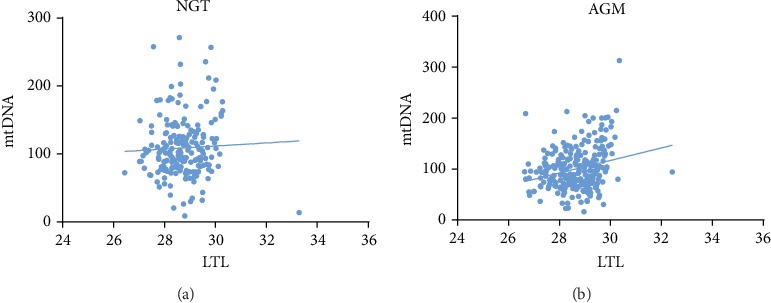
This study is aimed at evaluating the relationship between leukocyte telomere length (LTL) and mitochondrial DNA copy number (mtDNAcn) in a noninterventional rural community of China with different glucose tolerance statuses. In addition, we investigate whether the indicators of oxidative stress and inflammation were involved and identify mediators among them. A total of 450 subjects in rural China were included and divided into two groups according to a 75 g oral glucose tolerance test (OGTT): the abnormal glucose metabolism (AGM, = 257, 57.1%) group and the normal glucose tolerance (NGT, = 193, 42.9%) group. Indicators of oxidative stress (superoxide dismutase (SOD) and glutathione reductase (GR)) and inflammatory indices (tumor necrosis factor (TNF) and interleukin-6 (IL-6)) were all determined by ELISA. LTL and mtDNAcn were measured using a real-time PCR assay. Linear regressions were used to adjust for covariates that might affect the relationship between LTL and mtDNAcn. Mediation analyses were utilized to evaluate the mediators. In the AGM, LTL was correlated with mtDNAcn ( = 0.214, = 0.001), but no correlation was found in the NGT. The association between LTL and mtDNAcn was weakened after adjusting for inflammatory factors in the AGM ( = 0.087). LTL and mtDNAcn were both inversely related to HbA1c, IL-6, TNF, and SOD activity. Mediation analysis demonstrated that TNF was a significant mediator in the telomere-mitochondrial interactome in the AGM. This result suggests that inflammation and oxidative stress may play a vital role in telomere shortening as well as mitochondrial dysfunction. In the subjects with hyperglycemia, a significant positive correlation is observed between LTL and mtDNAcn, which is probably mediated by TNF. TNF may be considered a potential therapeutic target against aging-related disease in hyperglycemia.
这项研究旨在评估白细胞端粒长度(LTL)与线粒体 DNA 拷贝数(mtDNAcn)在中国不同葡萄糖耐量状态的非干预性农村社区之间的关系。此外,我们还研究了氧化应激和炎症指标是否参与其中,并确定其中的介导因素。共有 450 名中国农村居民被纳入研究,并根据 75g 口服葡萄糖耐量试验(OGTT)分为两组:异常葡萄糖代谢(AGM,n=257,57.1%)组和正常葡萄糖耐量(NGT,n=193,42.9%)组。氧化应激指标(超氧化物歧化酶(SOD)和谷胱甘肽还原酶(GR))和炎症指标(肿瘤坏死因子-α(TNF-α)和白细胞介素-6(IL-6))均通过 ELISA 法测定。LTL 和 mtDNAcn 采用实时 PCR 法测定。线性回归用于调整可能影响 LTL 和 mtDNAcn 之间关系的协变量。采用中介分析评估介导因素。在 AGM 中,LTL 与 mtDNAcn 呈正相关(r=0.214,P=0.001),但在 NGT 中无相关性。在 AGM 中,经炎症因子调整后,LTL 与 mtDNAcn 的相关性减弱(r=0.087)。LTL 和 mtDNAcn 均与 HbA1c、IL-6、TNF-α和 SOD 活性呈负相关。中介分析表明,在 AGM 中,TNF-α是端粒-线粒体相互作用的重要介导因素。这一结果表明,炎症和氧化应激可能在端粒缩短和线粒体功能障碍中发挥重要作用。在高血糖患者中,LTL 和 mtDNAcn 之间存在显著正相关,可能由 TNF-α介导。TNF-α可能被认为是治疗与高血糖相关疾病的潜在靶点。