Zhou Meicen, Zhu Lixin, Cui Xiangli, Feng Linbo, Zhao Xuefeng, He Shuli, Ping Fan, Li Wei, Li Yuxiu
Department of Endocrinology, Key Laboratory of Endocrinoly, Peking Union Medical College Hospital, Peking Union Medical College, Chinese Academy of Medical Sciences, Beijing, 100730, China.
Nankou Community Health Service Centers, Changping District, Beijing, 102200, China.
Nutr J. 2016 Apr 12;15:39. doi: 10.1186/s12937-016-0157-x.
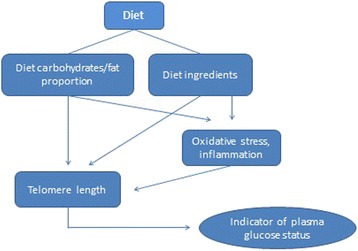
To explore influence of carbohydrates/fat proportions, dietary ingredients on telomere length shortening, oxidative stress and inflammation in a Chinese population with different glucose tolerance status.
Five hundred and fifty-six Chinese subjects without diabetes history underwent a 75 g, 2 h Oral Glucose Tolerance Test (OGTT). Subjects with diabetes (n = 159), pre-diabetes (n = 197), and normal glucose tolerance (n = 200) were screened. Dietary intakes were evaluated using a semi-quantitative food frequency questionnaire (FFQ). Peripheral blood leukocyte telomere length (LTL) was assessed using a real-time PCR assay. Blood lipid profile, levels of the oxidative stress indicators superoxide dismutase (SOD), glutathione reductase (GR), 8-oxo-2'-deoxyguanosine (8-oxo-dG) and inflammation indicators tumor necrosis factor (TNF-ɑ), interleukine-6 (IL-6) were measured. Levels of HbA1c, plasma glucose, insulin, and C peptide were also determined. Measurements were taken at 0 min, 30 min, 60 min, and 120 min after 75 g OGTT. Insulin sensitivity was evaluated by HOMA-IR. Basal insulin secretion index (HOMA-β), early phase disposition index (DI30) and total phase disposition index (DI120) indicate insulin levels at different phases of insulin secretion.
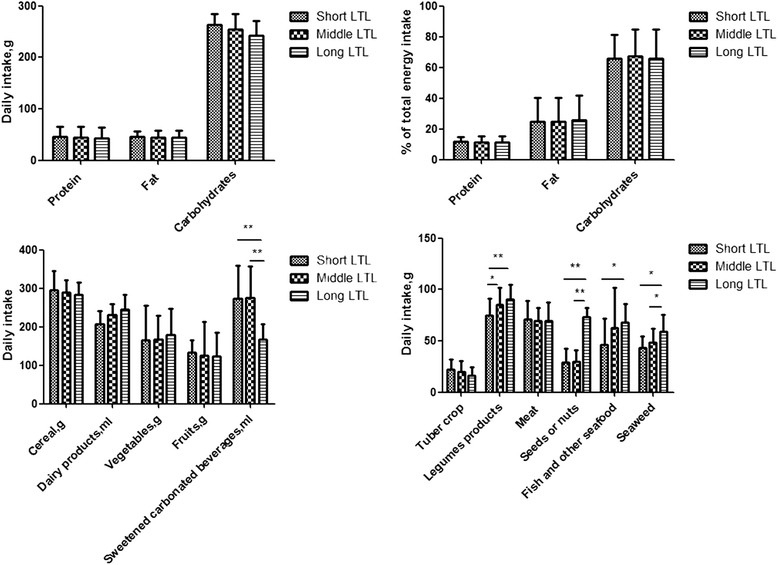
In patients with newly diagnosed diabetes, LTL adjusted by age was longer in HbA1c < 7 % group (log (LTL):1.93 ± 0.25) than in HbA1c ≥ 7 % group (log (LTL):1.82 ± 0.29). LTL was not associated with daily energy intake, diet fat, carbohydrates and protein proportions. Multiple linear regression analysis indicated that legumes, nuts, fish and seaweeds were protective factors for LTL shortening, and sweetened carbonated beverage was a risk factor for LTL shortening ( legumes: β = 0.105, p = 0.018; nuts: β = 0.110, p = 0.011; fish: β = 0.118, p = 0.007; seaweeds: β = 0.116, p = 0.009; sweetened carbonated beverage: β = -0.120, p = 0.004 ). Daily energy intake was positively associated with TNF-ɑ, IL-6 (TNF-ɑ: r = 0.125, p = 0.006;IL-6: r = 0.092, p =0.04). Fat, carbohydrate proportions were positively associated with TNF-ɑ (fat: r = 0.119, p = 0.008 ; carbohydrate: r = 0.094, p = 0.043). Seaweeds and dairy intake were negatively associated with 8-oxo-dG (seaweed: r = -0.496, p = 0.001;dairy: r = -0.246, p = 0.046 ), vegetables and fruits were positively associated with GR ( vegetables: r = 0.101, p = 0.034;fruits: r = 0.125, p = 0.045). Cereal, meat were positively associated with TNF-ɑ ( cereal: r = 0.091, p = 0.048 ; meat: r = 0.405, p = 0.009).
Diabetes patients with better plasma glucose (HbA1c < 7 %) had longer LTL, LTL could reflect plasma glucose status in diabetes patients. LTL were probably not influenced by diet carbohydrates/fat proportions but was associated with diet ingredients. Diet ingredients significantly impacted on markers of inflammation and oxidative stress, which probably had an effect on LTL.
探讨碳水化合物/脂肪比例、膳食成分对不同糖耐量状态的中国人群端粒长度缩短、氧化应激及炎症的影响。
556例无糖尿病病史的中国受试者接受75g、2小时口服葡萄糖耐量试验(OGTT)。筛选出糖尿病患者(n = 159)、糖尿病前期患者(n = 197)和糖耐量正常者(n = 200)。使用半定量食物频率问卷(FFQ)评估膳食摄入量。采用实时荧光定量PCR法检测外周血白细胞端粒长度(LTL)。检测血脂谱、氧化应激指标超氧化物歧化酶(SOD)、谷胱甘肽还原酶(GR)、8-氧代-2'-脱氧鸟苷(8-氧代-dG)水平以及炎症指标肿瘤坏死因子(TNF-α)、白细胞介素-6(IL-6)水平。同时测定糖化血红蛋白(HbA1c)、血糖、胰岛素及C肽水平。于75g OGTT后0分钟、30分钟、60分钟和120分钟进行测量。通过稳态模型评估胰岛素抵抗(HOMA-IR)评估胰岛素敏感性。基础胰岛素分泌指数(HOMA-β)、早期处置指数(DI30)和总处置指数(DI120)反映胰岛素分泌不同阶段的胰岛素水平。
新诊断的糖尿病患者中,糖化血红蛋白<7%组经年龄校正后的LTL(log(LTL):1.93±0.25)长于糖化血红蛋白≥7%组(log(LTL):1.82±0.29)。LTL与每日能量摄入、膳食脂肪、碳水化合物及蛋白质比例无关。多元线性回归分析表明,豆类、坚果、鱼类和海藻是LTL缩短的保护因素,而含糖碳酸饮料是LTL缩短的危险因素(豆类:β = 0.105,p = 0.018;坚果:β = 0.110,p = 0.011;鱼类:β = 0.118,p = 0.007;海藻:β = 0.116,p = 0.009;含糖碳酸饮料:β = -0.120,p = 0.004)。每日能量摄入与TNF-α、IL-6呈正相关(TNF-α:r = 0.125,p = 0.006;IL-6:r = 0.092,p = 0.04)。脂肪、碳水化合物比例与TNF-α呈正相关(脂肪:r = 0.119,p = 0.008;碳水化合物:r = 0.094,p = 0.043)。海藻和乳制品摄入与8-氧代-dG呈负相关(海藻:r = -0.496,p = 0.001;乳制品:r = -0.246,p = 0.046),蔬菜和水果与GR呈正相关(蔬菜:r = 0.101,p = 0.034;水果:r = 0.125,p = 0.045)。谷类、肉类与TNF-α呈正相关(谷类:r = 0.091,p = 0.048;肉类:r = 0.405,p = 0.009)。
血糖控制较好(糖化血红蛋白<7%)的糖尿病患者LTL较长,LTL可反映糖尿病患者的血糖状态。LTL可能不受膳食碳水化合物/脂肪比例影响,但与膳食成分有关。膳食成分显著影响炎症和氧化应激标志物,这可能对LTL产生影响。