Xiong Fen, Tu Jun, Mao Tian, Yu Li, Lin Nana, Liao Hongfei
Affiliated Eye Hospital, Nanchang University, Nanchang 330006, China.
Department of Orthopaedics, The First Affiliated Hospital of Nanchang University, Nanchang 330006, China.
J Ophthalmol. 2020 May 4;2020:5896016. doi: 10.1155/2020/5896016. eCollection 2020.
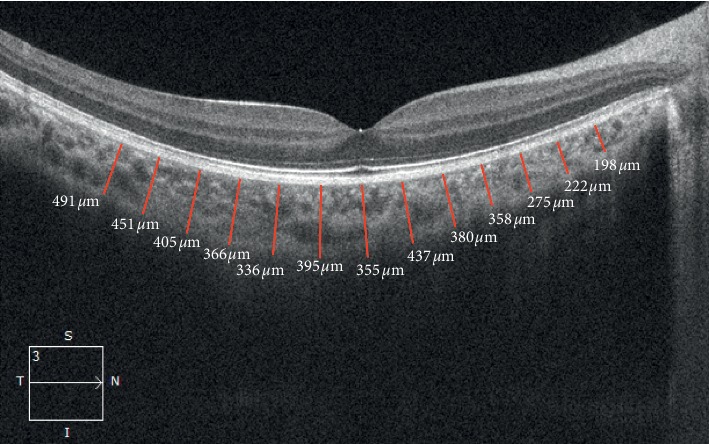
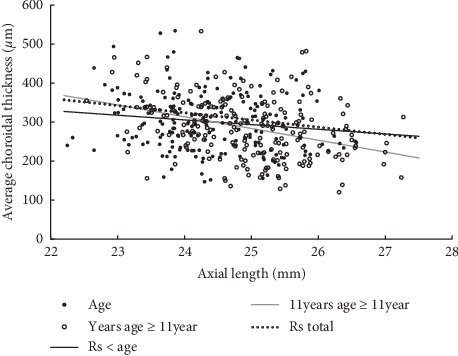
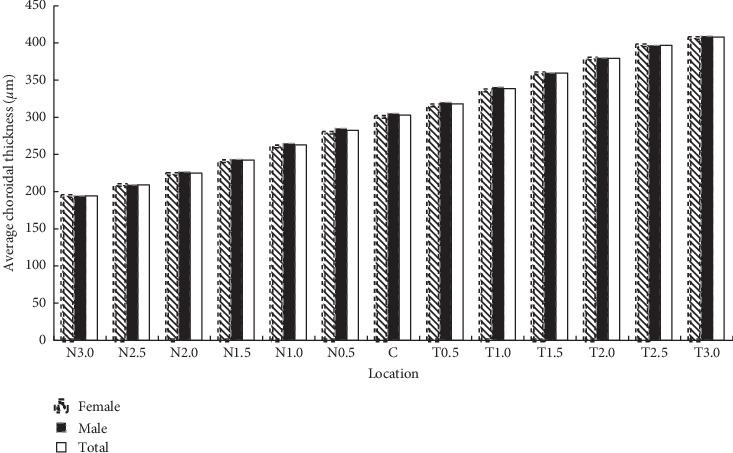
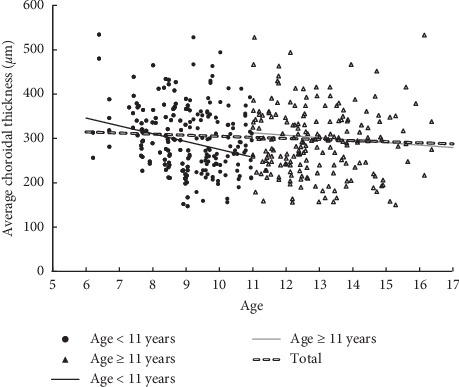
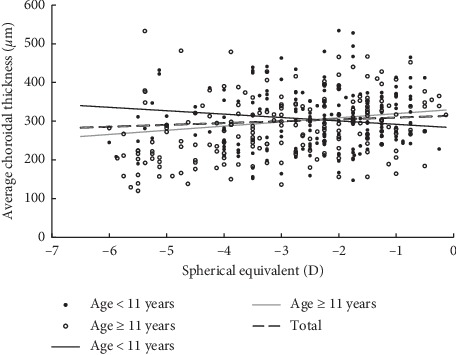
Myopia is a common cause of visual impairment worldwide. Choroidal thickness (ChT) reflects the characteristic changes in myopic children and may be used as an important index of myopia. The purpose of this study was to investigate ChT and its distribution across the posterior pole in young myopic Chinese patients using enhanced depth imaging optical coherence tomography (EDI-OCT) and to explore the factors associated with it. A total of 402 myopic Chinese patients aged 6-16 years who underwent complete ophthalmic examinations, including those for axial length, cycloplegic refraction, and intraocular pressure, were examined with EDI-OCT. The mean subfoveal ChT was 303.08 ± 76.87 m and displayed large variations at different positions ( < 0.05). The thickest sector was located 3 mm temporally from the fovea. Multivariate regression analysis showed a significant negative correlation of the subfoveal ChT values with axial length (AL), whereas the ChT was moderately influenced by the patient's sex. AL accounted for 7.9% of the ChT variance, whereas sex explained 9.6% of the ChT variance. In the population aged 11 years and older, AL accounted for 13.1% of the ChT variance. However, in those younger than 11 years, age was the only significant explanatory factor accounting for 5.2% of the ChT variance. In conclusion, we found a significant decrease in ChT with age in myopic children younger than 11 years. The negative association between age and ChT in children aged 11 years and older may be offset by the choroidal thickening mediated by pubertal growth spurts. The positive correlation between ChT and spherical equivalent in myopic adolescents aged 11 years and older suggests that the protective effect of lens thinning against rapid axial elongation disappears with age. Axial elongation becomes the dominant determinant of ChT in this age group.
近视是全球视力损害的常见原因。脉络膜厚度(ChT)反映了近视儿童的特征性变化,可作为近视的重要指标。本研究的目的是使用增强深度成像光学相干断层扫描(EDI-OCT)研究中国年轻近视患者的ChT及其在后极部的分布,并探讨与之相关的因素。对402例年龄在6至16岁的中国近视患者进行了全面的眼科检查,包括眼轴长度、散瞳验光和眼压测量,并使用EDI-OCT进行检查。平均黄斑中心凹下ChT为303.08±76.87μm,在不同位置显示出较大差异(<0.05)。最厚的区域位于黄斑中心凹颞侧3mm处。多因素回归分析显示,黄斑中心凹下ChT值与眼轴长度(AL)呈显著负相关,而ChT受患者性别的影响中等。AL占ChT变异的7.9%,而性别解释了ChT变异的9.6%。在11岁及以上的人群中,AL占ChT变异的13.1%。然而,在11岁以下的人群中,年龄是唯一显著的解释因素,占ChT变异的5.2%。总之,我们发现11岁以下近视儿童的ChT随年龄显著降低。11岁及以上儿童年龄与ChT之间的负相关可能被青春期生长突增介导的脉络膜增厚所抵消。11岁及以上近视青少年中ChT与等效球镜度之间的正相关表明,晶状体变薄对眼轴快速伸长的保护作用随年龄消失。在这个年龄组中,眼轴伸长成为ChT的主要决定因素。