Department of Biochemistry and Molecular Biology, College of Medicine, University of South Alabama, Mobile, AL 36688, USA.
Int J Mol Sci. 2020 May 21;21(10):3630. doi: 10.3390/ijms21103630.
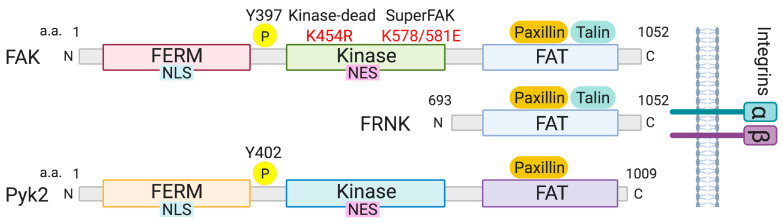
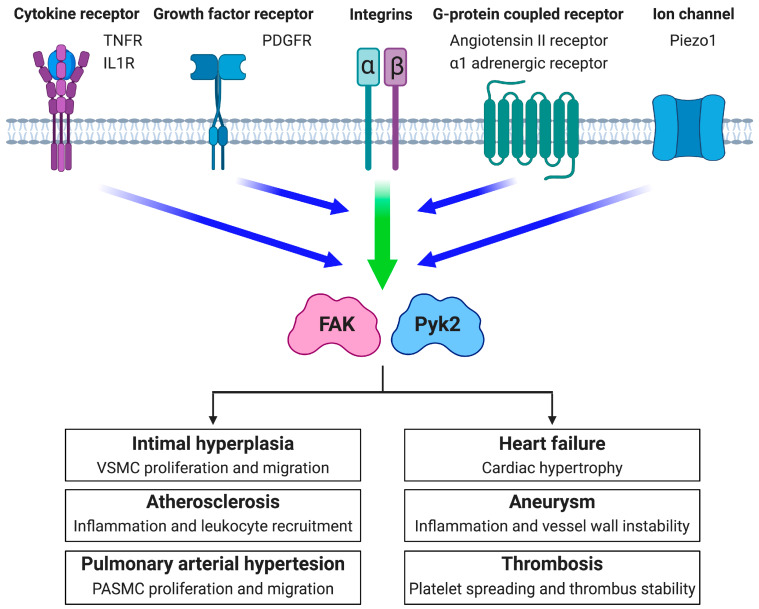
In various vascular diseases, extracellular matrix (ECM) and integrin expression are frequently altered, leading to focal adhesion kinase (FAK) or proline-rich tyrosine kinase 2 (Pyk2) activation. In addition to the major roles of FAK and Pyk2 in regulating adhesion dynamics via integrins, recent studies have shown a new role for nuclear FAK in gene regulation in various vascular cells. In particular, FAK primarily localizes within the nuclei of vascular smooth muscle cells (VSMCs) of healthy arteries. However, vessel injury increased FAK localization back to adhesions and elevated FAK activity, leading to VSMC hyperplasia. The study suggested that abnormal FAK or Pyk2 activation in vascular cells may cause pathology in vascular diseases. Here we will review several studies of FAK and Pyk2 associated with integrin signaling in vascular diseases including restenosis, atherosclerosis, heart failure, pulmonary arterial hypertension, aneurysm, and thrombosis. Despite the importance of FAK family kinases in vascular diseases, comprehensive reviews are scarce. Therefore, we summarized animal models involving FAK family kinases in vascular diseases.
在各种血管疾病中,细胞外基质(ECM)和整合素的表达经常发生改变,导致粘着斑激酶(FAK)或富含脯氨酸的酪氨酸激酶 2(Pyk2)的激活。除了 FAK 和 Pyk2 通过整合素调节黏附动力学的主要作用外,最近的研究表明,核 FAK 在各种血管细胞的基因调控中具有新的作用。特别是,FAK 主要定位于健康动脉的血管平滑肌细胞(VSMC)的核内。然而,血管损伤导致 FAK 重新定位回到黏附处,并使 FAK 活性升高,导致 VSMC 过度增生。研究表明,血管细胞中异常的 FAK 或 Pyk2 激活可能导致血管疾病的病理学改变。在这里,我们将回顾几项与血管疾病中的整合素信号相关的 FAK 和 Pyk2 的研究,包括再狭窄、动脉粥样硬化、心力衰竭、肺动脉高压、动脉瘤和血栓形成。尽管 FAK 家族激酶在血管疾病中非常重要,但全面的综述却很少。因此,我们总结了涉及血管疾病中 FAK 家族激酶的动物模型。