Ma Yingying, Liu Kai, Yin Yong, Qin Jianru, Zhou Yan-Heng, Yang Juan, Li Shenwei, Poon Leo L M, Zhang Chiyu
Chinese Academy of Sciences (CAS) Key Laboratory of Molecular Virology & Immunology, Institut Pasteur of Shanghai, Chinese Academy of Sciences: University of Chinese Academy of Sciences, Shanghai, China.
Department of Pulmonary, Shanghai Children's Medical Center Affiliated to Shanghai Jiao Tong University School of Medicine, Shanghai, China.
Front Microbiol. 2020 Apr 28;11:735. doi: 10.3389/fmicb.2020.00735. eCollection 2020.
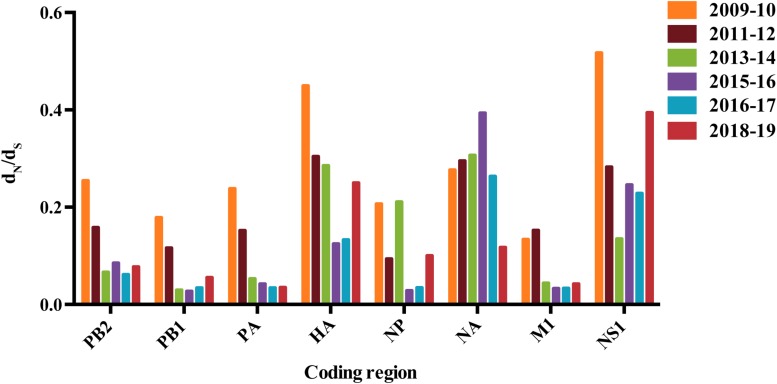
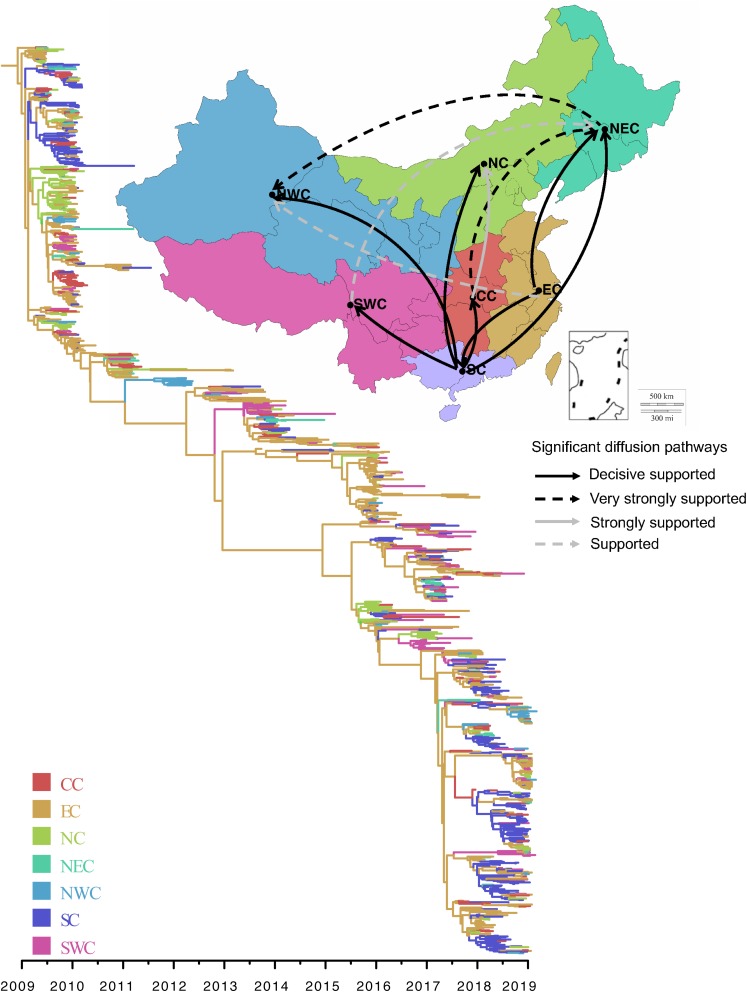
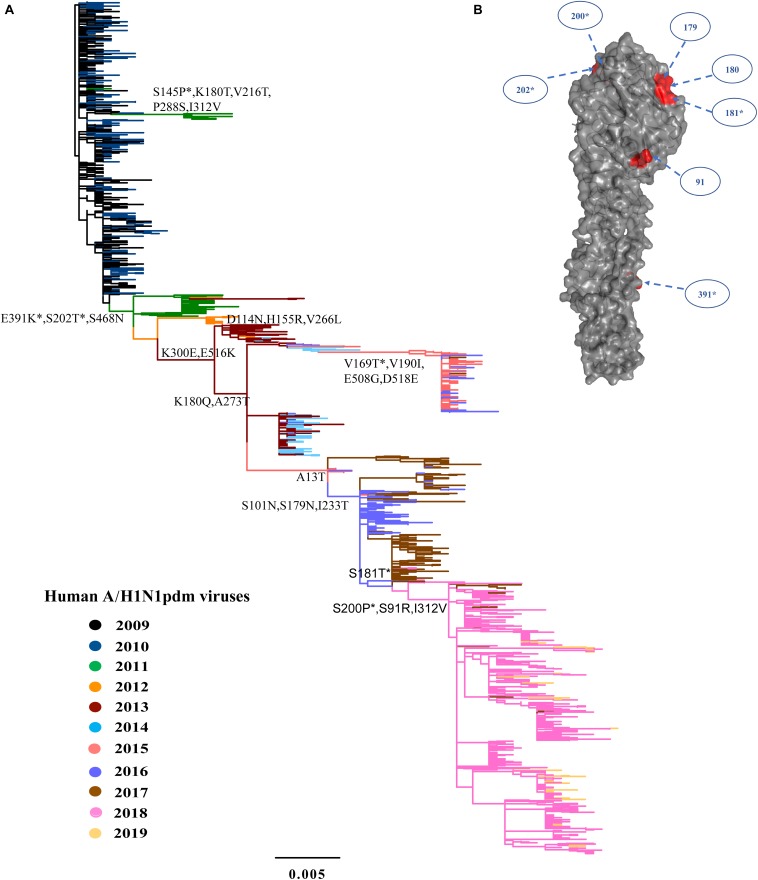
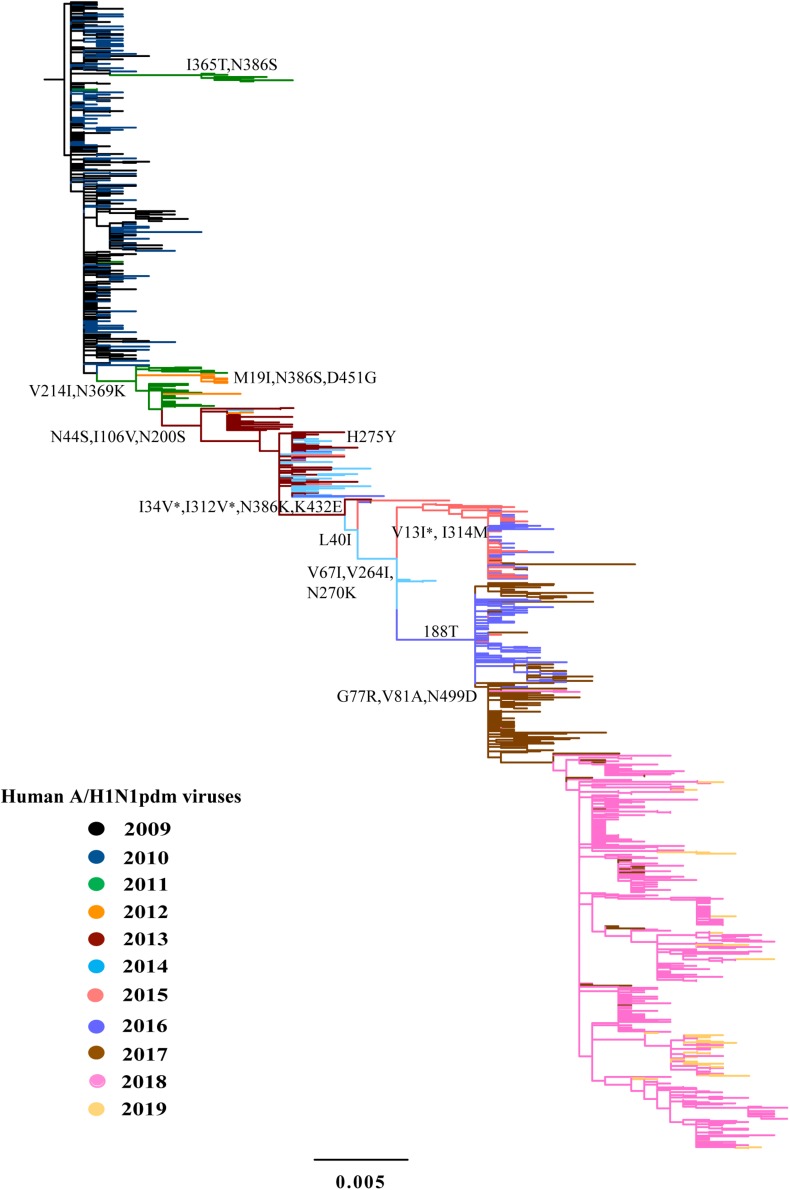
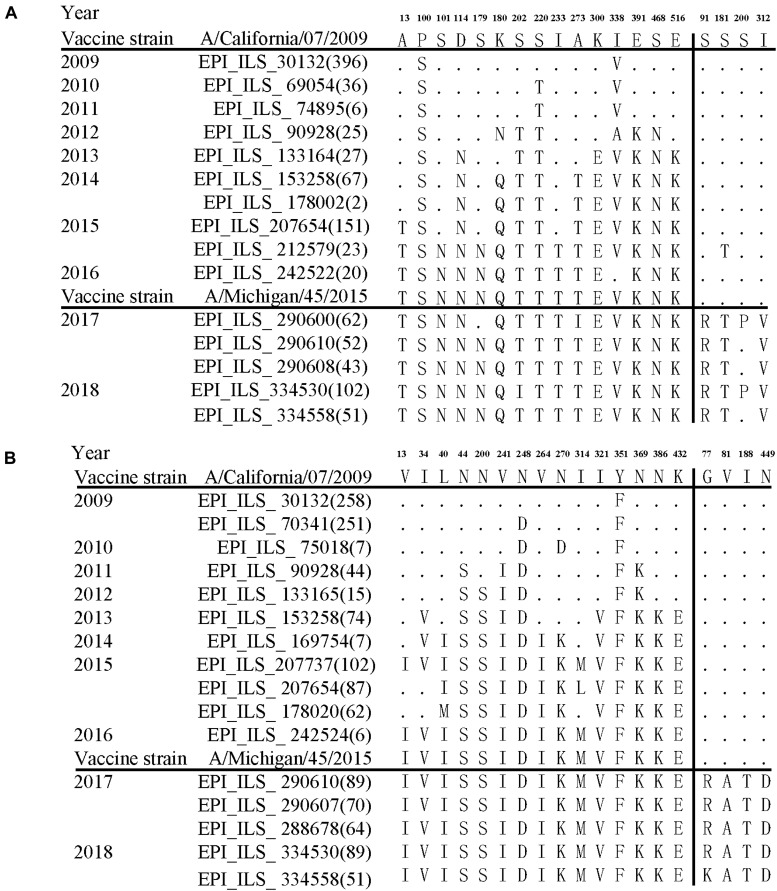
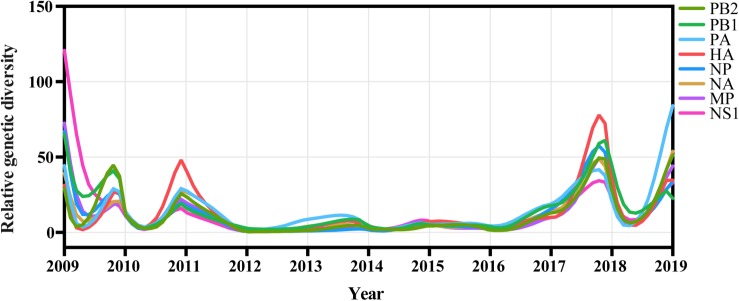
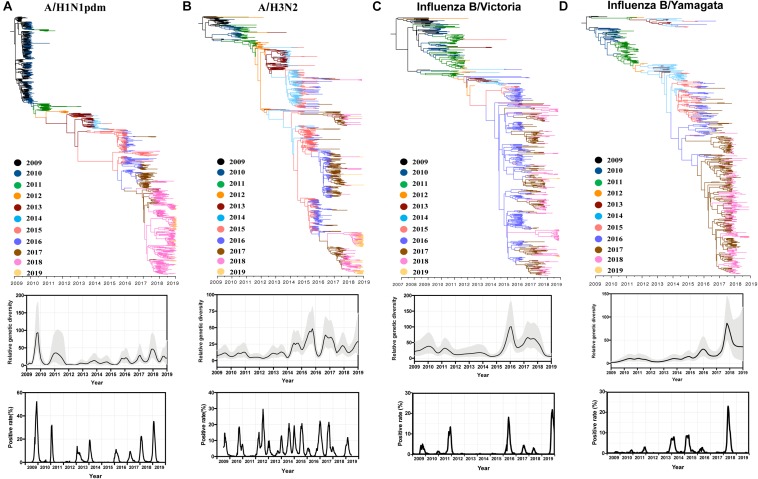
Since its first introduction into China in 2009, influenza A/H1N1pdm virus has undergone a rapid expansion and replaced the classical seasonal A(H1N1) virus. To characterize the ongoing evolution and national transmission dynamics of this virus, we analyzed 335 complete genome, 1259 HA, and 1043 NA sequences of the A/H1N1pdm strains detected in China. We found that the dN/dS value and relative genetic diversity of the A/H1N1pdm virus experienced a decrease from 2009 to 2017, and then a rapid increase during 2018-2019. Importantly, elevated relative genetic diversity was observed in the A/H1N1pdm and the A/H3N2 viruses, as well as two lineages (Victoria and Yamagata) of influenza B virus during 2018-2019, suggesting the simultaneous changes of these viruses in terms of genetic diversity might be associated with the recent large outbreak of seasonal influenza epidemic in China during 2018-2019. Fifteen amino acid mutations were found to be fixed along the main trunks of both HA and NA phylogenetic trees, and some of them are located in the antigen binding site or the receptor binding site. A sequential accumulation of mutations relative to the 2009-vaccine strain was observed in the circulating A/H1N1pdm strains during 2009-2016, while a rapid accumulation of mutations relative to the 2015-vaccine strain appeared in the emerging variants in 2017 shortly after the release of the vaccine. Multiple introductions of the A/H1N1pdm lineages into China were observed during 2009-2019, and East China and South China were found to serve as two major epicenters responsible for the national migration of the virus. In summary, these data provide important insights into the understanding of the evolution, epidemiology and transmission of the A/H1N1pdm virus, and highlight the importance of strengthening influenza surveillance in East China and South China.
自2009年甲型H1N1pdm流感病毒首次传入中国以来,它迅速传播并取代了经典季节性甲型(H1N1)病毒。为了描述该病毒持续的进化及全国传播动态,我们分析了在中国检测到的335个甲型H1N1pdm毒株的完整基因组、1259个血凝素(HA)和1043个神经氨酸酶(NA)序列。我们发现,2009年至2017年期间,甲型H1N1pdm流感病毒的非同义替换率与同义替换率之比(dN/dS值)和相对遗传多样性有所下降,而在2018 - 2019年期间迅速上升。重要的是,在2018 - 2019年期间,甲型H1N1pdm流感病毒、甲型H3N2流感病毒以及乙型流感病毒的两个谱系(维多利亚系和山形系)均出现了相对遗传多样性升高的情况,这表明这些病毒在遗传多样性方面的同步变化可能与2018 - 2019年期间中国近期季节性流感疫情的大规模爆发有关。在HA和NA系统发育树的主要分支上发现了15个固定的氨基酸突变,其中一些位于抗原结合位点或受体结合位点。在2009 - 2016年期间,流行的甲型H1N1pdm毒株相对于2009年疫苗株出现了突变的逐步积累,而在2017年疫苗发布后不久,新出现的变异株相对于2015年疫苗株出现了突变的快速积累。在2009 - 2019年期间观察到甲型H1N1pdm谱系多次传入中国,并且发现中国东部和南部是该病毒在全国传播的两个主要中心。总之,这些数据为理解甲型H1N1pdm流感病毒的进化、流行病学和传播提供了重要见解,并突出了加强中国东部和南部流感监测的重要性。