Clinic for Orthopedics and Trauma Surgery, Center for Orthopedics, Trauma Surgery and Spinal Cord Injury, Heidelberg University Hospital, Schlierbacher Landstrasse 200a, 69118, Heidelberg, Germany.
Arcus Sportklinik Pforzheim, Rastatterstr. 17-19, 75179, Pforzheim, Germany.
BMC Musculoskelet Disord. 2020 May 27;21(1):329. doi: 10.1186/s12891-020-03355-6.
The treatment of fracture-related infections (FRI) is still a challenge for orthopedic surgeons. The prevalence of FRI is particularly high in open fractures with extensive soft-tissue damage. This study aimed to develop a new two-step animal model for non-unions with segmental bone defects, which could be used to evaluate new innovative bone substitutes to improve the therapeutic options in humans with FRI and bone defects.
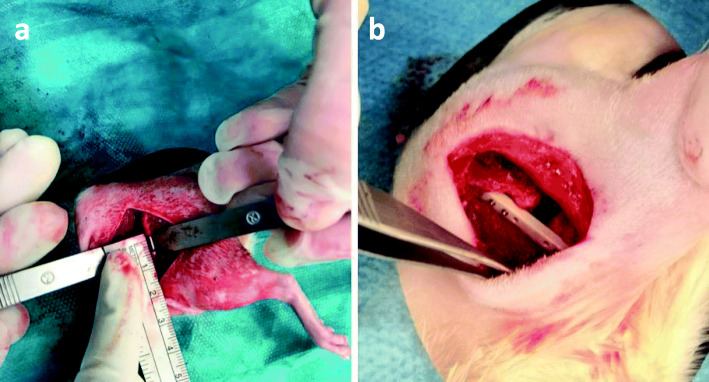
After randomization to infected or non-infected groups, 30 Sprague-Dawley rats underwent a transverse osteotomy of the mid-shaft femur with a 5 mm defect. Additionally, the periosteum at the fracture zone was cauterized at both sides. After intramedullary inoculation with 10 CFU Staphylococcus aureus (infected group) or PBS (non-infected group), a fracture stabilization was done by intramedullary K-wires. After 5 weeks, the bone healing process was evaluated, and revision surgery was performed in order to obtain increased bone healing. The initial K-wires were removed, and debridement of the osteotomy-gap was done followed by a more stable re-osteosynthesis with an angle-stable plate. After further 8 weeks all rats were euthanized and the bone consolidation was tested biomechanically and the callus formation quantitatively by micro-CT analysis.
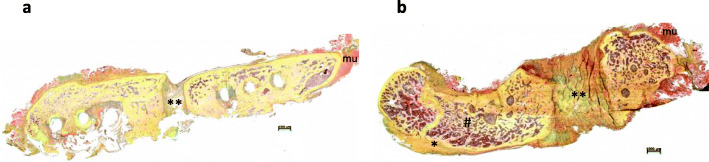
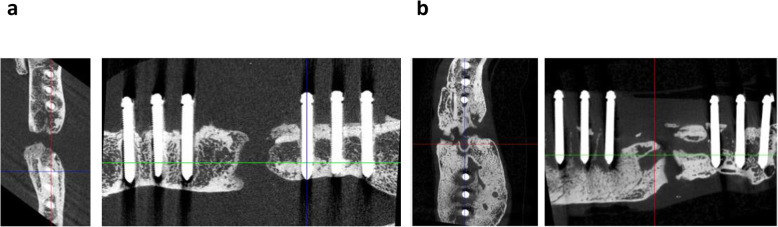
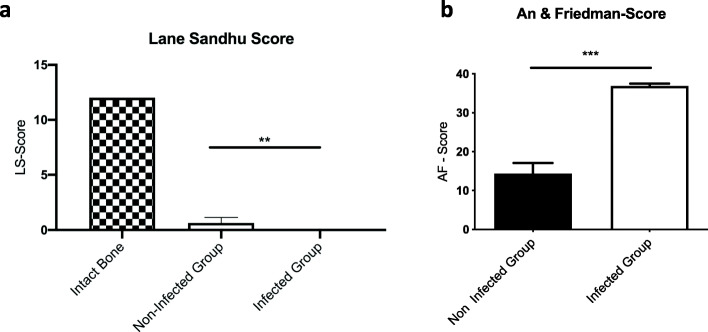
We developed and presented a new two-stage non-union animal model through a targeted S. aureus infection. After 5 weeks, all animals showed a non-union irrespective of assignment to the infected and non-infected group. Lane and Sandhu score showed a higher callus formation in the infected group. In all infected animals, the inoculated S. aureus strain was detected in the revision surgery. The second surgery did not improve bone healing, as shown by the Lane Sandhu score and in the μ-CT analysis. Similarly, biomechanical testing showed in both groups a significantly lower maximum torque as compared to the contralateral side (p < 0.0001).
We were able to successfully develop a new two-stage non-union animal model, which reflects a genuine clinical situation of an infection-related non-union model with segmental bone defects. This model could be used to evaluate various therapeutic anti-infectious and osteoinductive strategies in FRIs.
骨折相关感染(FRI)的治疗仍然是骨科医生面临的挑战。在伴有广泛软组织损伤的开放性骨折中,FRI 的发生率尤其高。本研究旨在建立一种新的伴有节段性骨缺损的非愈合性骨折的两步骤动物模型,可用于评估新的创新骨替代物,以改善 FRI 和骨缺损患者的治疗选择。
30 只 Sprague-Dawley 大鼠随机分为感染组或非感染组,行股骨干中段横断截骨术,缺损 5mm。同时在骨折区两侧骨膜电灼。经骨髓腔内接种 10 CFU 金黄色葡萄球菌(感染组)或 PBS(非感染组)后,用髓内 K 线进行骨折固定。5 周后,评估骨愈合过程,进行翻修手术以获得增加的骨愈合。取出初始 K 线,清除断端间隙的坏死组织,然后用更稳定的角度稳定钢板进行再骨合成。再进一步 8 周后,所有大鼠均安乐死,进行生物力学测试和微 CT 分析定量检测骨痂形成。
我们通过靶向金黄色葡萄球菌感染建立了一种新的两阶段非愈合动物模型。5 周后,所有动物均出现非愈合,无论感染组和非感染组。Lane 和 Sandhu 评分显示感染组骨痂形成较高。在所有感染动物中,在翻修手术中均检测到接种的金黄色葡萄球菌菌株。第二次手术并未改善骨愈合,Lane Sandhu 评分和 μ-CT 分析均显示如此。同样,生物力学测试显示,与对侧相比,两组的最大扭矩均显著降低(p<0.0001)。
我们成功地建立了一种新的两阶段非愈合动物模型,反映了一种具有节段性骨缺损的感染相关非愈合模型的真实临床情况。该模型可用于评估 FRI 中各种治疗性抗感染和成骨诱导策略。