Henry D. Janowitz Division of Gastroenterology, Icahn School of Medicine at Mount Sinai, New York, USA.
BMC Gastroenterol. 2020 May 27;20(1):161. doi: 10.1186/s12876-020-01308-w.
Emerging evidence demonstrates that surveillance of individuals at high-risk (HRIs) of developing pancreatic adenocarcinoma allows for identification and treatment of resectable tumors with improved survival. Population-based data suggest that hyperglycemia may be present up to three years before the development of pancreatic cancer. We investigated whether elevated hemoglobin A1c (HbA1c) is associated with the development of pancreatic cysts in a pancreatic surveillance program.
We performed a retrospective study of HRIs who underwent pancreatic surveillance at a single institution between May 2013 and March 2019, according to published criteria. We collected demographic information, clinical data including HbA1c, and imaging results. We compared data using univariable and multivariable analyses. Our primary outcome was the presence of pancreatic cysts on initial surveillance in patients with elevated HbA1c.
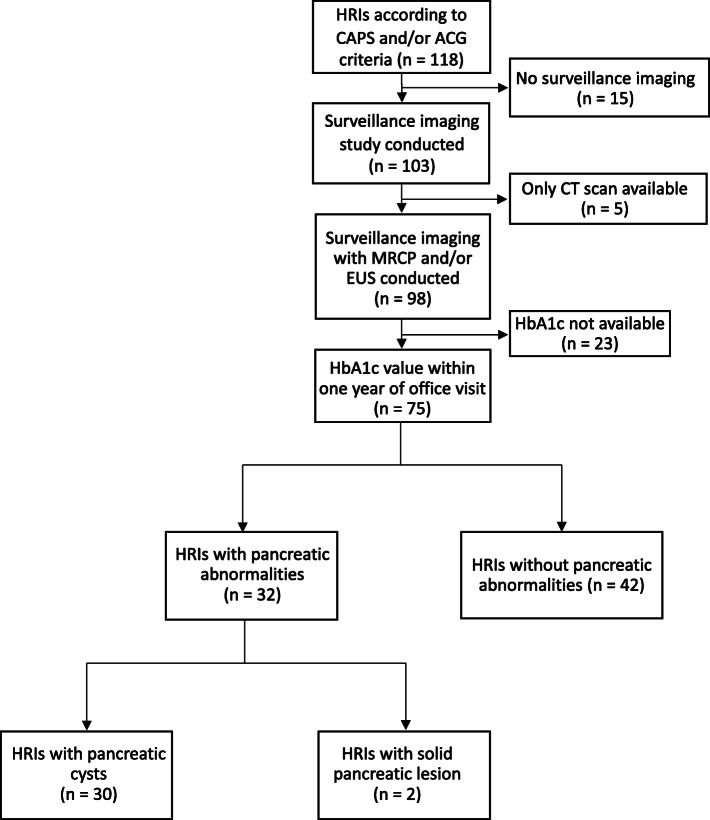
Ninety-eight patients underwent surveillance imaging via EUS or MRCP and seventy-four patients met inclusion criteria. Thirty patients were found to have cysts on initial imaging. Older age (p < 0.01) and HbA1c in the prediabetic range or higher (p = 0.01) were associated with the presence of cysts or solid lesions on univariable analysis. After controlling for confounders, age (aOR 9.08, 95% CI 2.29-36.10), and HbA1c > 5.7% (aOR 5.82, 95% CI 1.50-22.54) remained associated with presence of cysts and solid lesions in HRIs. In patients with cysts or solid lesions there was a strong association between increased age and elevated HbA1c (p < 0.01).
HRIs with elevated HbA1c were more likely to have pancreatic cysts compared to individuals with lower HbA1c on initial imaging in a pancreatic surveillance program. These findings may help tailor the surveillance protocols for those at increased risk of developing pancreatic adenocarcinoma.
新出现的证据表明,对发展为胰腺腺癌高危(HRIs)的个体进行监测,可以识别和治疗可切除的肿瘤,从而提高生存率。基于人群的数据表明,高血糖可能在胰腺癌发生前长达三年就存在。我们研究了在一个胰腺监测计划中,升高的血红蛋白 A1c(HbA1c)是否与胰腺囊肿的发展有关。
我们对 2013 年 5 月至 2019 年 3 月期间在一家机构接受胰腺监测的 HRIs 进行了回顾性研究,依据已发表的标准进行筛选。我们收集了人口统计学信息、包括 HbA1c 在内的临床数据和影像学结果。我们使用单变量和多变量分析比较了数据。我们的主要结局是在 HbA1c 升高的患者的初始监测中是否存在胰腺囊肿。
98 名患者通过 EUS 或 MRCP 进行了监测成像,其中 74 名患者符合纳入标准。30 名患者在初次成像时发现有囊肿。单变量分析显示,年龄较大(p<0.01)和处于糖尿病前期或更高范围的 HbA1c(p=0.01)与存在囊肿或实体病变有关。在控制了混杂因素后,年龄(优势比 9.08,95%置信区间 2.29-36.10)和 HbA1c>5.7%(优势比 5.82,95%置信区间 1.50-22.54)与 HRIs 中存在囊肿和实体病变仍然相关。在有囊肿或实体病变的患者中,年龄增加与 HbA1c 升高之间存在很强的相关性(p<0.01)。
在胰腺监测计划中,与 HbA1c 较低的个体相比,HbA1c 升高的 HRIs 在初次成像时更有可能出现胰腺囊肿。这些发现可能有助于为那些患有胰腺腺癌风险增加的患者制定更具针对性的监测方案。