Istituto di Ricerche Farmacologiche Mario Negri IRCCS, Clinical Research Center for Rare Diseases Aldo e Cele Daccò and Centro Anna Maria Astori, Science and Technology Park Kilometro Rosso, Bergamo, Italy.
Istituto di Ricerche Farmacologiche Mario Negri IRCCS, Clinical Research Center for Rare Diseases Aldo e Cele Daccò and Centro Anna Maria Astori, Science and Technology Park Kilometro Rosso, Bergamo, Italy.
Kidney Int. 2020 Aug;98(2):314-322. doi: 10.1016/j.kint.2020.05.013. Epub 2020 May 24.
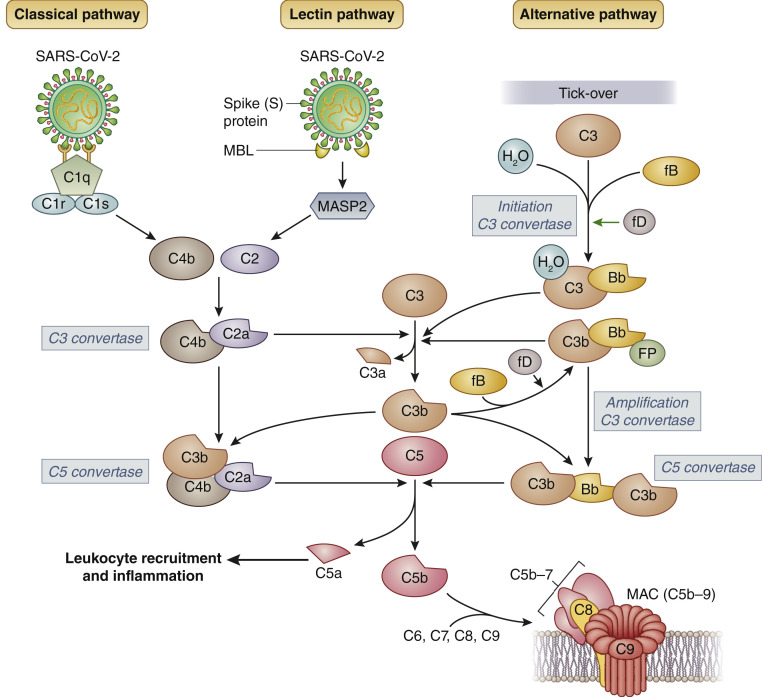
The novel coronavirus disease COVID-19 originates in the lungs, but it may extend to other organs, causing, in severe cases, multiorgan damage, including cardiac injury and acute kidney injury. In severe cases, the presence of kidney injury is associated with increased risk of death, highlighting the relevance of this organ as a target of SARS-CoV-2 infection. COVID-19-associated tissue injury is not primarily mediated by viral infection, but rather is a result of the inflammatory host immune response, which drives hypercytokinemia and aggressive inflammation that affect lung parenchymal cells, diminishing oxygen uptake, but also endothelial cells, resulting in endotheliitis and thrombotic events and intravascular coagulation. The complement system represents the first response of the host immune system to SARS-CoV-2 infection, but there is growing evidence that unrestrained activation of complement induced by the virus in the lungs and other organs plays a major role in acute and chronic inflammation, endothelial cell dysfunction, thrombus formation, and intravascular coagulation, and ultimately contributes to multiple organ failure and death. In this review, we discuss the relative role of the different complement activation products in the pathogenesis of COVID-19-associated tissue inflammation and thrombosis and propose the hypothesis that blockade of the terminal complement pathway may represent a potential therapeutic option for the prevention and treatment of lung and multiorgan damage.
新型冠状病毒病(COVID-19)源于肺部,但可能会扩展到其他器官,在严重情况下会导致多器官损伤,包括心脏损伤和急性肾损伤。在严重情况下,存在肾损伤与死亡风险增加相关,这突出了该器官作为 SARS-CoV-2 感染靶器官的重要性。COVID-19 相关的组织损伤不是主要由病毒感染介导的,而是宿主炎症反应的结果,该反应导致细胞因子过度产生和剧烈炎症,影响肺实质细胞,降低氧气摄取,还会影响内皮细胞,导致血管内皮炎和血栓形成以及血管内凝血。补体系统代表宿主免疫系统对 SARS-CoV-2 感染的初始反应,但越来越多的证据表明,病毒在肺部和其他器官中引发的补体不受控制的激活在急性和慢性炎症、内皮细胞功能障碍、血栓形成和血管内凝血中发挥主要作用,并最终导致多器官衰竭和死亡。在这篇综述中,我们讨论了不同补体激活产物在 COVID-19 相关组织炎症和血栓形成发病机制中的相对作用,并提出了阻断末端补体途径可能是预防和治疗肺和多器官损伤的潜在治疗选择的假说。