Department of Molecular & Human Genetics, Centre for Genomics, Jiwaji University, Gwalior, Madhya Pradesh, India.
Department of Pathology & Laboratory Medicine, Pennsylvania State University College of Medicine, Milton S. Hershey Medical Center, Hershey, PA, USA.
Indian J Med Res. 2020 Apr;151(4):311-318. doi: 10.4103/ijmr.IJMR_501_18.
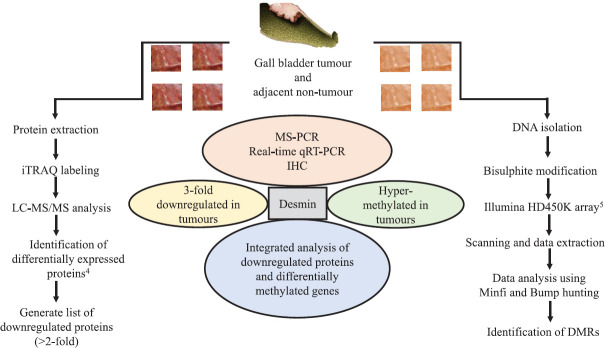
BACKGROUND & OBJECTIVES: Gall bladder cancer (GBC) is a fatal neoplasm, with a globally variable incidence rates. To improve the survival rate of patients, a newer set of biomarkers needs to be discovered for its early detection and better prognosis. Our earlier studies on GBC proteomics and whole-genome methylome data revealed expression of desmin to be significantly downregulated with correlated promoter hypermethylation during gall bladder carcinogenesis. Thus, to evaluate desmin as a potential biomarker for GBC, we carried out a detailed follow up study.
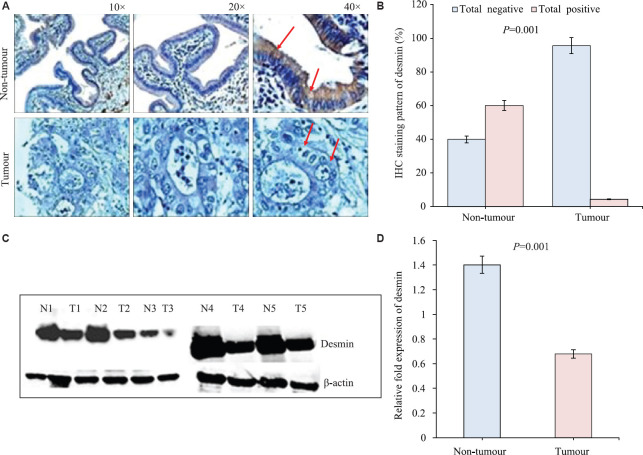
Methylation-specific polymerase chain reaction (MS-PCR) (n=17, GBC and n=23, non-tumour control), real-time quantitative reverse transcription-polymerase chain reaction (qRT-PCR) [n=14, GBC and n=14, adjacent non-tumour (ANT)], immunohistochemistry (n=27, GBC and n=14, non-tumour) and immunoblotting (n=13, GBC and n=13, ANT) were performed in surgically removed gall bladder tissue samples.
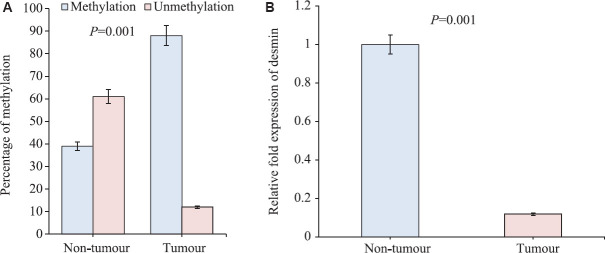
MS-PCR analysis showed methylation of desmin in 88.23 per cent (15/17) gall bladder tumour samples as compared to non-tumour tissues (39.13%, 9/23). Real-time qRT-PCR analysis revealed a significant downregulation of desmin expression in GBC as compared to ANT tissue. This was further confirmed by western blot, showing reduced expression of desmin protein in GBC, as compared to non-tumour tissue. Immunohistochemical analysis also showed a decreased level of desmin i.e., more than 95 per cent (26/27) in tumour cells compared to non-tumours (35.71%, 5/14).
INTERPRETATION & CONCLUSIONS: The increased frequency of desmin promoter methylation which could be responsible for its significant downregulation, indicates its potential as a candidate biomarker for GBC. This requires further validation in a large group of patients to evaluate its clinical utility.
胆囊癌(GBC)是一种致命的肿瘤,其发病率在全球范围内存在差异。为了提高患者的生存率,需要发现一组新的生物标志物,以便早期检测和改善预后。我们之前对 GBC 蛋白质组学和全基因组甲基化组数据的研究表明,在胆囊癌发生过程中,结蛋白的表达显著下调,且其启动子发生超甲基化。因此,为了评估结蛋白是否可作为 GBC 的潜在生物标志物,我们进行了一项详细的后续研究。
采用甲基化特异性聚合酶链反应(MS-PCR)(n=17,GBC;n=23,非肿瘤对照)、实时定量逆转录聚合酶链反应(qRT-PCR)[n=14,GBC;n=14,邻近非肿瘤(ANT)]、免疫组织化学(n=27,GBC;n=14,非肿瘤)和免疫印迹(n=13,GBC;n=13,ANT)检测手术切除的胆囊组织样本中的结蛋白甲基化情况。
MS-PCR 分析显示,与非肿瘤组织(39.13%,9/23)相比,结蛋白在 88.23%(15/17)的胆囊肿瘤样本中发生甲基化。与 ANT 组织相比,qRT-PCR 分析显示 GBC 中结蛋白表达显著下调。Western blot 进一步证实了这一点,结果显示 GBC 中结蛋白蛋白表达减少,而非肿瘤组织中则没有。免疫组织化学分析也显示,与非肿瘤组织(35.71%,5/14)相比,肿瘤细胞中的结蛋白水平降低,超过 95%(26/27)。
结蛋白启动子甲基化频率增加可能导致其表达显著下调,表明其有潜力成为 GBC 的候选生物标志物。这需要在更大的患者群体中进一步验证,以评估其临床应用价值。