Institute of Microbiology College of Life Sciences, Zhejiang University, Hangzhou, 310058, Zhejiang, China.
College of Biotechnology and Bioengineering, Zhejiang University of Technology, 18 Chaowang Road, Hangzhou, 310014, Zhejiang, China.
Commun Biol. 2020 May 27;3(1):269. doi: 10.1038/s42003-020-0991-4.
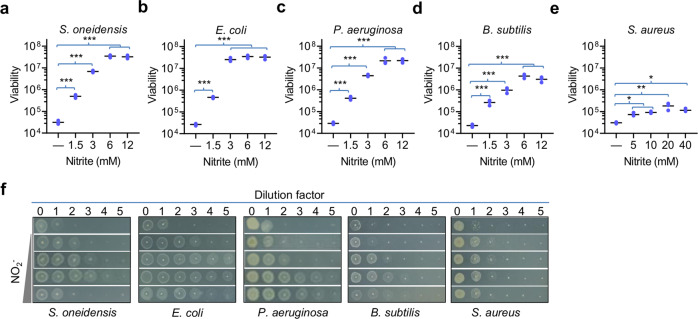
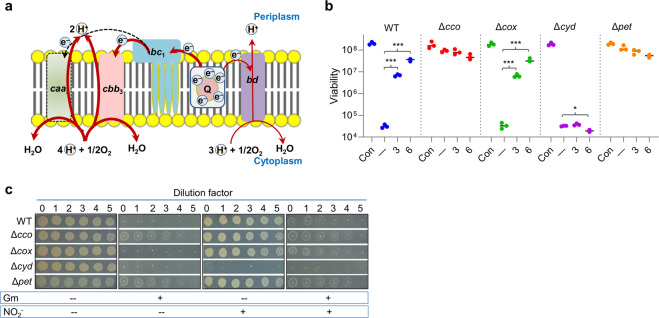
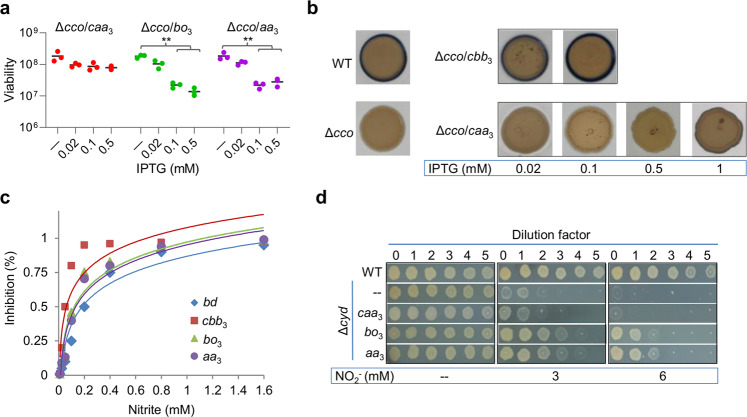
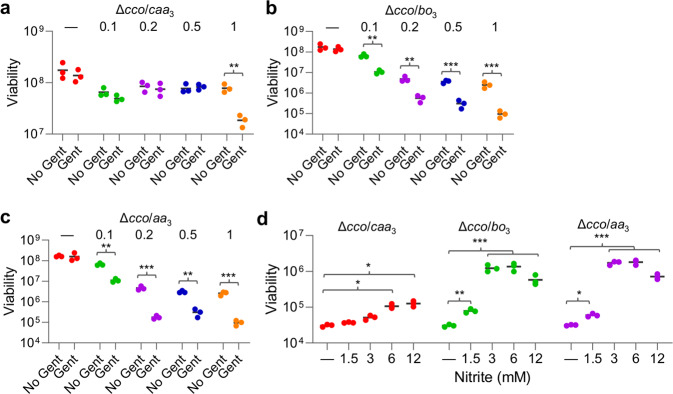
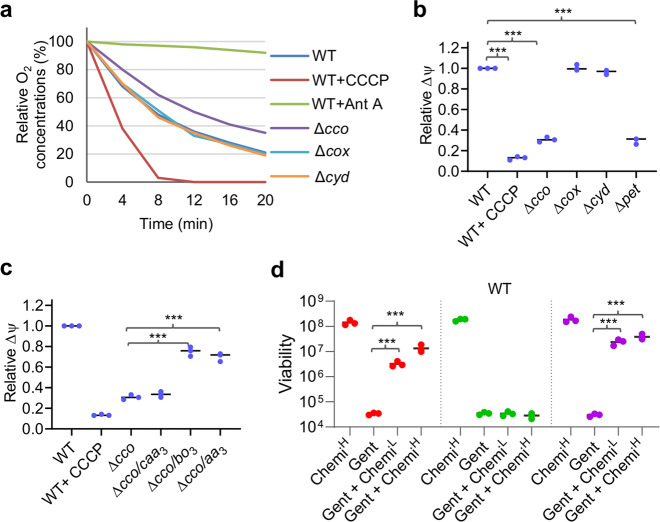
As a bacteriostatic agent, nitrite has been used in food preservation for centuries. When used in combination with antibiotics, nitrite is reported to work either cooperatively or antagonistically. However, the mechanism underlying these effects remains largely unknown. Here we show that nitrite mediates tolerance to aminoglycosides in both Gram-negative and Gram-positive bacteria, but has little interaction with other types of antibiotics. Nitrite directly and mainly inhibits cytochrome heme-copper oxidases (HCOs), and by doing so, the membrane potential is compromised, blocking uptake of aminoglycosides. In contrast, reduced respiration (oxygen consumption rate) resulting from nitrite inhibition is not critical for aminoglycoside tolerance. While our data indicate that nitrite is a promising antimicrobial agent targeting HCOs, cautions should be taken when used with other antibiotics, aminoglycosides in particular.
作为一种抑菌剂,亚硝酸盐在食品保存中已经使用了数个世纪。当与抗生素联合使用时,据报道亚硝酸盐的作用是协同或拮抗的。然而,这些作用的机制在很大程度上仍然未知。在这里,我们表明亚硝酸盐介导了革兰氏阴性菌和革兰氏阳性菌对氨基糖苷类药物的耐受性,但与其他类型的抗生素几乎没有相互作用。亚硝酸盐直接主要抑制细胞色素血红素铜氧化酶(HCOs),从而使膜电位受损,阻止氨基糖苷类药物的摄取。相比之下,亚硝酸盐抑制作用导致的还原呼吸(耗氧率)对于氨基糖苷类药物的耐受性并不是关键的。虽然我们的数据表明亚硝酸盐是一种有前途的靶向 HCOs 的抗菌剂,但在与其他抗生素,特别是氨基糖苷类药物一起使用时应谨慎。